
Camino De Santiago Attracts 500,000 Visitors A Year, But Climate Change Threatens It
“It's very challenging and a little scary because I'm really sensitive to the heat as a redhead,” said Vandy Louise, an American tourist, while walking the Camino de Santiago during a heatwave in Spain last June.
“There is no air conditioning in most auberges, municipal hostels or dormitories. Which can also be tough.”
Her experience is becoming increasingly common among pilgrims walking the Camino De Santiago (The Way of Saint James) during the summer months, as Spain faces more frequent and intense heatwaves each summer.

Real People. Real Reporting. Donate to Religion Unplugged now through August 17, and your gift will be doubled.
The vast network of trails extends throughout Europe but is most closely associated with Spain, Portugal and France, which offer regional pilgrimage routes that can take anywhere from 44 days to six days to complete on foot — and a fraction of that time for cyclists. The routes converge in northwest Spain, where the remains of Saint James are said to be buried at the Cathedral of Santiago de Compostela.
Tourist groups said fewer pilgrims are choosing to walk the route for religious reasons, saying instead they attempt to tackle the trails to connect to nature, enjoy a challenge or hang out with friends. Still, almost half a million people completed the trails last year, making it a major tourist attraction throughout the region.
Last summer was the hottest ever recorded, with an average temperature of 75 degrees and temperatures that regularly topped 100 degrees — sometimes hitting as high as 109. Almost 4,000 deaths were attributed to the heat, according to authorities.
Even northern Spain — humid, green and temperate — has long been considered a climate refuge from the country's scorching summers. It is now increasingly experiencing extreme events like heatwaves, driven by climate change.
“We observe almost a disappearance of spring and autumn in these regions, and instead we see summer becoming significantly longer,” explained Dominic Royé, researcher at the Biological Mission of Galicia, a research institute. “We are seeing an increase in all extremes. This includes stronger winds, heavy rainfall, as well as increasingly extreme temperatures across almost the entire region.”
Last year, more than 250,000 hectares also burned in just a few weeks in northern and northwestern Spain during a period of extreme heat. The fires have not spared the trail system, and parts of the route were even closed to the public.
“It was historic, as these routes had never been closed for such a long period before. A French pilgrim described entering Galicia as having an “end-of-the-world atmosphere.”
By eight in the evening, it already seemed like night; the sun was orange, and the air was very thick,” Royé added. “With climate change, this type of incident is becoming increasingly frequent, and the risks are becoming more pronounced.”
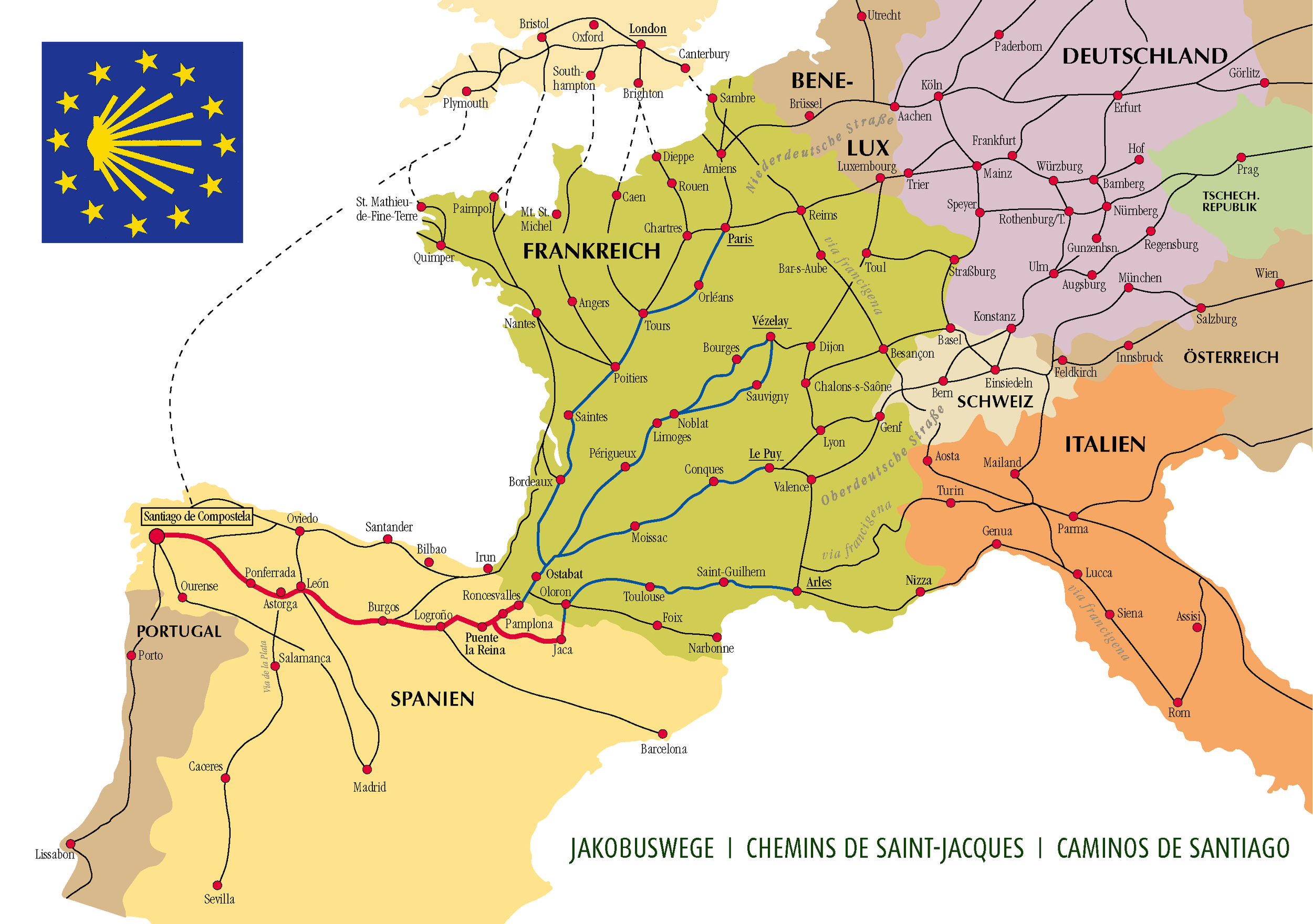
Some pilgrims start from very far away on their journey to north eastern Spain, others travel to Spain or nearby France before formally starting the hike. (WikiMedia graphic)
Waking up at 4 a.m.
Nevertheless, a record 530,987 pilgrims received the Compostela certificate after walking the Camino de Santiago last year, according to the Pilgrim’s Office in Santiago de Compostela. But for pilgrims walking the Camino, these climate changes are beginning to reshape both the experience and the risks of the journey.
“This rise in temperatures has direct consequences for health, including dehydration, fatigue, and dizziness, which is particularly true for older people, as many of them undertake this kind of hike,” said Francisco Tomatis, a researcher who has studied the impact of climate change on the Camino de Santiago. “It is becoming increasingly difficult to keep moving at around 2 or 3 p.m., especially during the summer. It is also changing the way people travel.”
Walkers now leave before dawn, cool off in rivers, and adapt their routes to avoid the worst heat.
“I have changed my itinerary multiple times to shorten my days,” Louise said. “I also have to get up at about 4 to leave at 4:30 so that I can get as much walking in before the sun comes up and it gets too hot. Which sometimes sucks because I'm doing it alone most of the time. Not many people want to walk that early.”
To help pilgrims cope with increasingly extreme summer conditions, local authorities have launched a project to plant trees in the sections of the Camino most exposed to the sun, as there are still parts of the route with little or no shade.
“If possible, we leave as early as we can to avoid the heat after noon,” said Marta Sagatowska, a guide who accompanies groups on the Camino. “But we cannot leave before breakfast because it is included in the itinerary. So we often have to wait for the hotels or cafés to open before setting off.”
Sagatowska said she is receiving more and more questions about weather conditions before pilgrimages, from people of all ages and physical conditions. To address these concerns, she has even created an online guide to help future visitors prepare as best as possible.
“The key message is to carry as much water as possible. I think it's crucial. Fortunately, on most Camino routes there are water sources available, although not everywhere”, explained Sagatowska. “I also watch them very carefully to see if they are tired, if they are dehydrated or if they are simply not able to go further. It's also important.”
A big economic impact
This situation also raises economic questions, especially in Spain, where tourism represents more than 12% of GDP. The country received nearly 100 million foreign tourists in 2025.
“Some pilgrims are choosing alternative routes simply because they are easier to manage in the heat,” Tomatis said. “This is particularly common in regions such as Castile and León, a flat area with very little shade. It is a route that an increasing number of pilgrims are abandoning in favor of a shorter path starting in Galicia, allowing them to concentrate their stages and walk much shorter distances rather than undertaking long 30-kilometer days. The potential economic impact is significant.”
The long-term environmental consequences also raise serious questions about the future.
“In the area of El Bierzo, which borders Galicia and recorded a record number of wildfires last year, the landscape and natural heritage of the Camino de Santiago have been heavily affected — not only during the fires themselves, but also afterward,” Tomatis added. “Many villages lost their vegetation cover as a result of last summer's historic wildfires and are now facing drinking water shortages. Water resources, already limited in some rural areas, have been further strained by the aftermath of the fires.”
The Camino has several routes: The most traditional is the French Way, but there is also the Portuguese Way, the Primitive Way, the English Way and the Northern Way. This means that pilgrims can choose from a variety of itineraries, each with its own characteristics and advantages.
“The Meseta, an expansive plateau on the Camino Francés, is the area of greatest health risk with the current climate,” Royé said. “In summer, the heat becomes stifling, and combined with the long kilometers where there is no shade or services for pilgrims, the experience can be frustrating.”
Royé added that the Northern Way could be a good option as it passes through the mountains of northern Spain, where temperatures are generally cooler.
Given that Europe is the world's fastest-warming continent, the question arises as to the future of this Camino. Could some sections become too dangerous to walk during periods of extreme heat?
“It’s possible,” said Tomatis. “The Camino de Santiago is unlikely to disappear, but the way it is walked may continue to change as summers grow hotter and longer across Europe.”
Romain Chauvet is a French-Canadian journalist based in Madrid.