
Cesar Chavez’s Faith Reexamined Amid Abuse Allegations
(ANALYSIS) The legacy of Cesar Chavez has long been enshrined in American history as one of moral courage and social justice. As co-founder of the United Farm Workers, Chavez became a symbol of the struggle for dignity for agricultural laborers, advocating nonviolence and collective action.
His image — one that included praying and marching — was deeply intertwined with the teachings of the Catholic Church, which shaped both his activism and his public persona. Chavez’s faith was central to his identity and leadership. He framed the struggle of workers in spiritual terms, presenting sacrifice and suffering as pathways to justice. His public fasts, inspired by Catholic traditions of penance, were meant to purify both himself and the movement, reinforcing a commitment to nonviolence.
To supporters, Chavez, who regularly attended Mass, was a near-saintly figure, infusing his faith and political activism into a massive movement. He became revered among Mexican Americans and a notable figure for organized labor and leftist groups in the U.S. His birthday is a state holiday in several states like California and Arizona every March 31, several places are named for him and posthumously awarded the Presidential Medal of Freedom in 1994 by Bill Clinton.
READ: Antisemitism Has Brought Together Islamic Terrorists And Left‑Wing Extremists
On its website, the U.S. Conference of Catholic Bishops referred to Chavez as a “champion” of “life and dignity” alongside others such as Dorothy Day and St. Oscar Romero.
In recent days, Chavez’s life and legacy have come under intense scrutiny. A series of bombshell allegations reported by The New York Times have forced a difficult reassessment of the man behind the movement. Chavez has been accused by multiple women of sexual abuse, including allegations involving minors. These accounts describe years of manipulation, coercion and exploitation. Some women recalled that the abuse began when they were teenagers.
The Times reported Chavez, who died in 1993 at the age of 66, sexually abused two minors during the height of his fame in the 1970s. Both women — now in their 60s — told their stories for the first time. They were 13 and 12 at the time the abuse started, which lasted for nearly four years. The investigation, certainly worthy of a Pulitzer Prize, found evidence Chavez also fathered four children with women who were not his wife. Chavez had eight children with his wife Helen.
Among the women who have come forward is Dolores Huerta, Chavez’s closest collaborator and the UFW’s co-founder. She has alleged that Chavez sexually assaulted her during the early years of the movement, highlighting the profound power imbalance between Chavez and the women around him.
As both a political leader and a figure imbued with spiritual authority, Chavez occupied a position that made any type of resistance or public disclosure extraordinarily difficult.
“I carried this secret for as long as I did because building the movement and securing farmworker rights was life’s work,” Huerta, now 96, said in a statement. “The formation of a union was the only vehicle to accomplish and secure those rights and I wasn’t going to let Cesar or anyone else get in the way.”
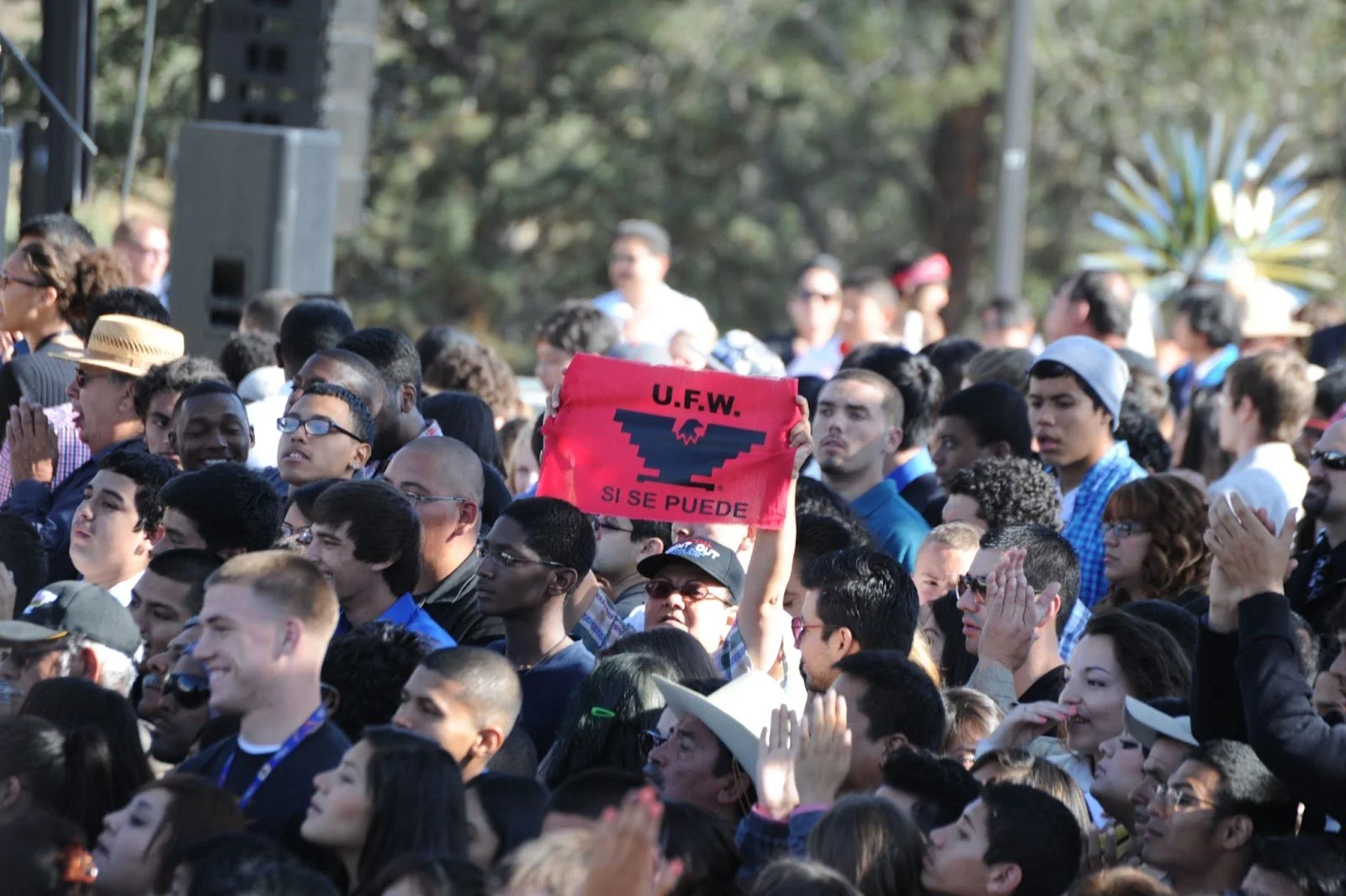
The flag of the United Farm Workers of America — featuring the Aztec eagle — is decorated with Dolores Huerta’s iconic phrase: “Sí se puede.” (Photo courtesy of The National Archives)
What happens next?
These allegations fundamentally change Chavez’s image. The man who publicly championed human dignity is now accused of violating those very principles in private. The tension is especially stark given his deep identification with Catholic values, which emphasize the protection of the vulnerable.
In this light, Chavez’s faith — once seen as the source of his moral strength — also becomes part of the story of how his authority was constructed and abused. Like the Catholic clergy sex abuse scandal of the past two decades and the recent #MeToo movement, another icon has fallen amid an overall crisis of credibility in institutions.
Writing in the National Catholic Reporter, Jeromiah Taylor, the newspaper’s Associate Opinion Editor, noted:
“Chavez is not the first Catholic hero to fall in the light of truth. Jean Vanier, founder of the L'Arche community, was credibly discovered to have sexually abused women. The legendary Abbé Pierre, who founded the Emmaus movement, has been accused of abusing dozens of girls and women in his life.
In the wake of these sorts of revelations, it's understandable to feel disillusionment, grief, betrayal. Does any of the work matter? How can a person committed to the common good commit such heinous harm? What are we to do about it?
The horrifying statement from Huerta — outlining her abuse and the two resulting pregnancies — demonstrates the cost of hero worship, particularly to those who feel pressure not to reveal the truth about individuals revered by large swaths of people. While many have long criticized Chavez's well-documented high-control tactics, and the potency of his personality cult, Huerta's story raises the pitch of those conversations about power and personality.”
Taylor’s conclusion: “But we don't need heroes. We need each other.” He added:
The devastating revelations about Chavez arrive during Lent, and the Gospels have much to teach us about our temptation toward hero worship. Jesus offers an alternative. When James and John seek greatness through him, Jesus tells them that to be first, they must be last, and that if they want true glory they must drink from his bitter cup. When the devil tempts Jesus with worldly domination, he tells the deceiver, "You shall worship the Lord your God, and him only you shall serve." Jesus refused to allow himself to be cast as a worldly hero, and he would not name one among his followers.
A Mass held each year at the Cathedral of Our Lady of the Angels in Los Angeles, the nation’s largest Catholic diocese, was canceled following the revelations.
In response, the United Farm Workers said they had “not received any direct reports, and we do not have any firsthand knowledge of these allegations.”
“However, the allegations are serious enough that we feel compelled to take urgent steps to learn more and provide space for people who may have been victimized to find support and to share their stories if that is what they choose,” the union added.
But the Times probe found that internal emails revealed that that union leaders had been aware “for years” of misconduct allegations regarding Chavez, while women he allegedly abused were reportedly discouraged from publicly revealing what had happened to them.
The fallout from these revelations has prompted broader debates about how society should remember Chavez. While his contributions to labor rights remains significant, there is increasing resistance to treating him as an unblemished hero. Such uncomfortable truths has forever changed how Chavez is viewed.
Chavez’s faith helped inspire a movement grounded in justice and sacrifice. It also, unfortunately, helped elevate him to a position of near-unquestioned authority.
Clemente Lisi is executive editor at Religion Unplugged.