
Can The UK’s Ambitious Push To Build ‘New Towns’ Make Room For Faith?
Among the stately marble interiors of Westminster along the River Thames and amid swathes of once-empty fields on the edge of England’s towns and cities, a quiet but heated debate is unfolding. It isn’t just about how to build the 1.5 million homes the Labour government wants delivered by 2029, but about what kind of communities such homes will create.
This five-year housing target — one of the boldest commitments by a British government in a generation — was enshrined in Labour’s promises and later embedded in policy through planning reforms and new legislative frameworks looking at speeding up development and cutting through years of bureaucratic inertia. The goal — often encapsulated in the slogan “getting Britain building again” — relies on ambitious planning reforms and the creation of “new towns” to absorb population and ease the housing crisis.
“Even with the level of our infrastructure, every day, communities, businesses, and people up and down the country are slowed down by congestion or lack of access to the physical and digital connections they need. This is holding us back,” the government said in a 2023 policy paper. “The U.K. will not be able to meet its long-term objectives – whether that be building more housing, spreading opportunity and prosperity across the country … without building the right economic infrastructure.”
READ: Vatican Museums Begin Restoration Of Michelangelo’s Monumental ‘Last Judgment’
Communities, some argue, are more than homes and success. A growing chorus of experts, faith leaders and community planners argue for a broader, human-centered approach to the building of communities — one that places spiritual and social infrastructure alongside physical buildings. At the heart of this debate is a question: Where do places of worship and religious community life fit into a modern housing plan?
As urban planners work on infrastructure, part of the government’s plan includes a generation of new towns — settlements of 10,000 houses or more designed to be integrated communities. Historians pointed out that Britain’s post-war new towns — Harlow, Welwyn Garden City and Stevenage — were built on a holistic vision of community life, drawing on Christian and religiously-inspired ideas for neighborhoods and civic engagement.
A report last October by Faith & Belief Policy Collective, a group established in 2023 by the Faith & Belief Forum and Goldsmiths, University of London’s Faiths and Civil Society Unit, highlighted this past as a possibility for the future, noting that those towns integrated housing with where people could worship, celebrate and support one another and generate community life.
These are all factors that have become more difficult in a digital age dominated by secularism. The same 64-page report urged planners to view faith communities not as peripheral interest groups, but as essential partners. At last year’s World Architecture Festival, for example, the Holy Redeemer Church on the Spanish island of Tenerife — along with its community center and public square — was named building of the year for helping to ignite urban renewal.
“As we embark on this next chapter of New Town building in England, it is vital to understand the contribution that faith and belief bring to the sustaining of new communities, through their vision, experience, resources and local leadership,” said Christopher Baker, the study’s lead author and professor at Goldsmiths University.
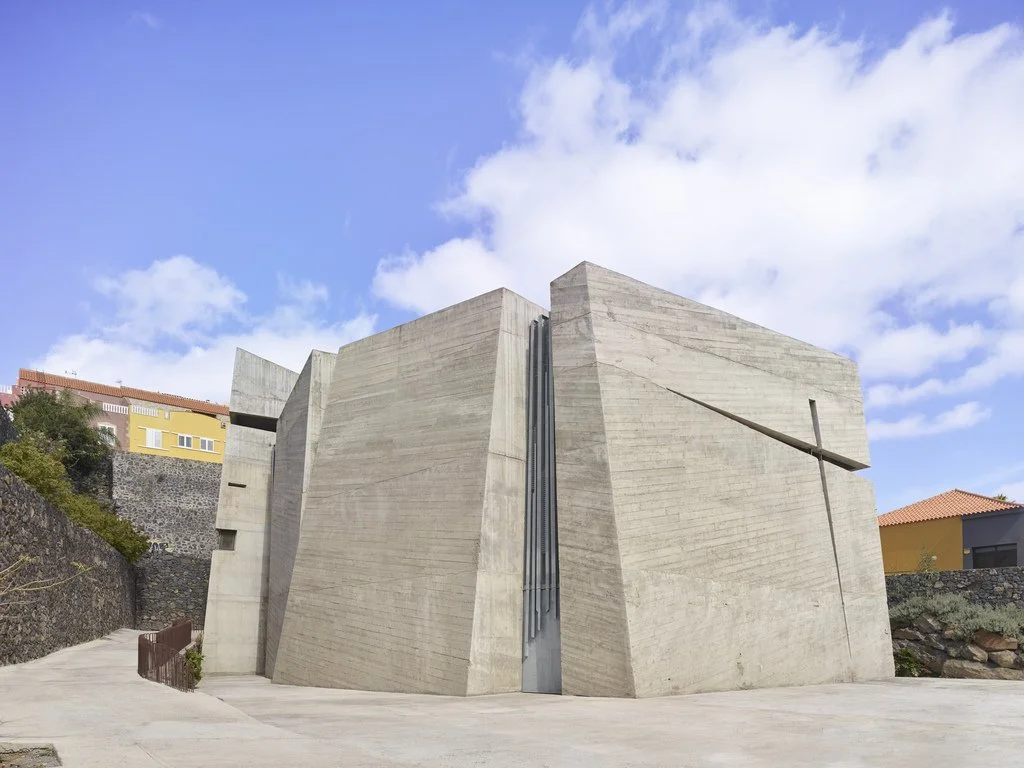
The Holy Redeemer Church and Community Centre of Las Chumberas in Tenerife, Spain (Photo courtesy of the World Architecture Festival)
For now, the report recommended establishing a taskforce — a body that would bridge the gap between planners, developers and faith communities – that would ensure new settlements incorporate spaces for worship and community service.
The plan wouldn’t be limited to Christianity and churches. The 2021 U.K. Census revealed a major shift in England and Wales, with Christians dropping below 50% for the first time (to 46.2%). Non-Christian, non-religious groups grew significantly, with “nones” rising to 37.2%. Other major groups included Muslims (6.5%), Hindus (1.7%), Sikhs (0.9%), Buddhists (0.5%) and Jews (0.5%).
“The challenge now is to understand the immense contribution in terms of physical and social resources that all faith communities living in England can bring to the table,” Baker said. “It is vital that we create channels through which this important contribution can be leveraged into the planning system as a whole.”
Various religious organizations have begun to answer the call. In conferences and planning forums, leaders from diverse traditions — Christian, Muslim, Hindu and Sikh — are pushing for inclusion, arguing that places of worship help anchor social networks, reduce loneliness and provide support like youth programs and elder care.
“Not only has the demography of the U.K. changed significantly over past decades but so has the diversity of our faiths and beliefs,” said University of Birmingham Professor Jagbir Jhutti-Johal, who specializes in Sikh theology and interfaith dialogue. “This poses new challenges for planners and developers who need support in ensuring important voices from the faith and belief sector are not missed in efforts to make New Towns work for all.”
This urban planning vision is not without controversy. Secular critics warn that privileging faith groups in planning could risk exclusion of non-religious residents. The diversity of faiths in modern U.K. also means plans need to take on a pluralistic approach, accommodating a wide spectrum of faith traditions.
Over the next few years, as new towns are planned and eventually built, will be a test of whether Britain’s housing revolution can also be a community one that includes faith.
Clemente Lisi is executive editor at Religion Unplugged.