
How The ‘Hand Of Providence’ Helped Decide The American Revolution
YORKTOWN, Virginia — The road into Yorktown takes you back into history. It is not just the site of the decisive Battle of Yorktown, but over two centuries later, a landscape layered with meaning. It’s where cannon fire once settled an empire’s fate and the birth of a new nation. It’s also the place where the “Hand of Providence” prevailed.
By October 1781, this quiet field became the stage for a convergence so unlikely that even today historians struggle to explain it in purely human terms. American forces under George Washington, joined by French troops led by Comte de Rochambeau, closed in on British General Charles Cornwallis. At sea, the French fleet sealed the trap. Within weeks, the British army would surrender.
Yorktown is a place where military history and spiritual interpretation meet, where a young nation’s defining victory can be read both as the product of strategy and as a moment touched by Providence. To fully understand Yorktown as more than a military victory, you have to step into the mindset of the 18th century.
READ: What Jefferson And Madison Would Have Thought About ‘Rededicate 250’
For many Americans at the time, this outcome — so dependent on precise timing and cooperation — did not feel accidental. Sermons delivered in the days and weeks after the victory spoke not just of triumph, but of divine intervention. Ministers pointed to the alignment of events: The sudden availability of French naval power and the coordination between armies speaking different languages. These were, in their view, signs of Providence at work. At the visitor center and along the interpretive trails, the story is told primarily through strategy. The French presence added another layer to the battle.
At the time of the 13 colonies, religion was highly diverse, featuring Puritan Congregationalists in New England, Anglicans in the South and a combination of Quakers and Catholics in the mid-Atlantic colonies. During the American Revolution, religious networks and sermons helped unify colonists, transforming their resistance into a righteous, divinely sanctioned cause.
The Revolutionary era shifted dynamics by forcing colonies to work together. In 1781, the alliance between the American colonies and Catholic France was anything but inevitable. Colonists came from Protestant traditions that had long viewed Catholic powers with suspicion. And yet, at Yorktown, those divisions gave way to shared purpose. French soldiers marched and fought alongside American troops whose religious identities varied widely, but were often shaped by Protestant beliefs.
“For a lot of colonists — clergy included — the help the French provided was providential, meaning it came from God,” said Katherine Carté, author of “Religion and the American Revolution: An Imperial History.” “For that reason, they welcomed it, even if they were nervous about having so many new Catholics around. Some religious leaders went so far as to say that the Alliance provided an opportunity for U.S. protestants to help bring Protestantism to France. On the other hand, for those in Britain and loyalists in the colonies, it was easy to make the argument that the French Alliance was a sign of how badly the Patriots had gone astray.”
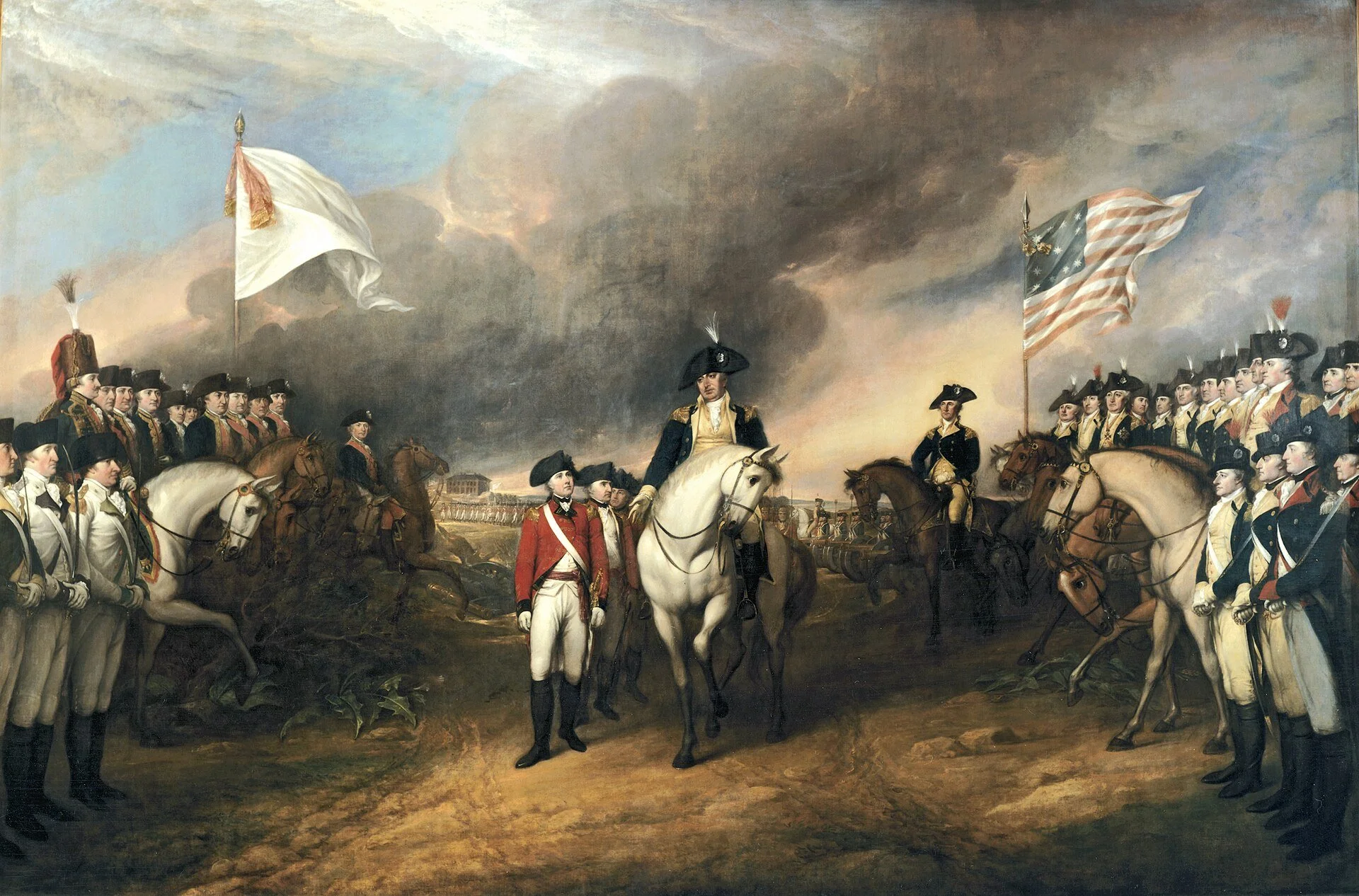
This John Trumbull painting from 1820 depicts the forces of British Major General Charles Cornwallis surrendering to French and American forces after the Siege of Yorktown. The central figures depicted are Generals Charles O'Hara and Benjamin Lincoln. (Wikipedia Commons photo)
Historian Rod Gragg, author of “By the Hand of Providence: How Faith Shaped the American Revolution,” said the French wanted the British to lose the colonies.
“Our revolution was unique because it was a revolution of law,” he said, adding that the French Revolution that began in 1789 was against the king as well as the church.
This convergence today may be an historical footnote, but it was central to the story of Yorktown. Visit the areas where French troops were encamped, and you can imagine the cultural exchange that took place. Different languages and liturgies were set aside for a shared commitment to a cause that transcended those differences.
For some observers at the time, this cooperation itself seemed providential. That a Protestant rebellion could be secured with the help of a Catholic monarchy suggested, to them, a divine plan that worked through unlikely instruments.
The French contribution near the war’s end was not symbolic. Without their navy, the outcome at Yorktown might have been different. The naval victory that prevented British reinforcement effectively sealed Cornwallis’s fate.
Even this strategic advantage took on spiritual meaning in the eyes of contemporaries. Newspapers and sermons alike framed the French arrival as timely in a way that felt almost scripted — as though history had been nudged in a particular direction.
When you explore Yorktown today, you may find yourself moving between these two ways of seeing. On one hand, there is the historian’s view: A careful reconstruction of troop movements, supply lines and tactical decisions.
On the other hand, there is the interpretive lens of those who lived through it — a belief that the outcome reflected something larger than human agency.
Clemente Lisi serves as executive editor at Religion Unplugged.