
25 Years Later, The World That Made 9/11 Still Casts A Shadow
NEW YORK — The 9/11 attacks are often remembered as a single event. That morning, 19 terrorists turned commercial airliners into weapons and the modern era of terrorism began.
A total of 2,977 people died in the terror attacks at the World Trade Center, the Pentagon and in Shanksville, Pennsylvania — the deadliest to ever take place on U.S. soil.
That recollection, however true, obscures more than it reveals. The attacks were not something that occurred out of the blue. They were the product of decades of decisions, alliances, betrayals and unintended consequences stretching from the mountains of Afghanistan to the oil fields of Saudi Arabia to the corridors of Washington, D.C.
READ: Americans No Longer Come Together Over Tragic Events
Twenty-five years later, memories of 9/11 are forever embedded in the minds of a majority of Americans old enough to recall the attacks. Their historic importance of that day far surpasses other events in people’s lifetimes.
In a survey conducted by Pew Research Center in association with A+E Networks’ HISTORY in 2016 — 15 years after 9/11 — 76% of adults named the Sept. 11 attacks as one of the 10 historical events of their lifetime that had the greatest impact on the country.
To fully understand 9/11 — and the world that made it possible — one needs to take a look at the slow, decades-long Islamic radicalization, led by Osama bin Laden’s transnational movement, that few in the West took seriously until it was too late.
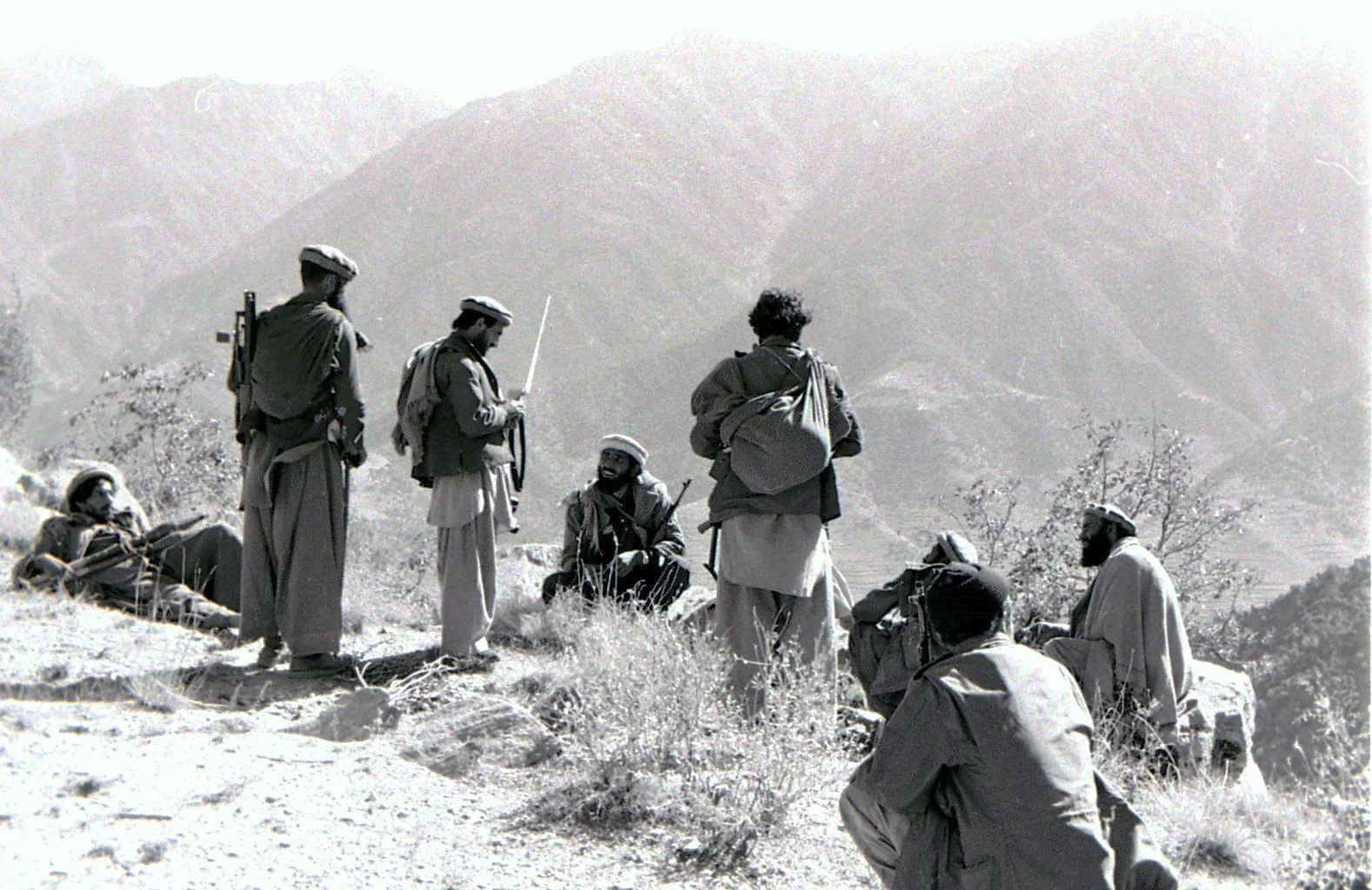
Afghan resistance fighters, known as the mujahideen, in 1979. (Wikipedia Commons photo)
Soviet invasion of Afghanistan
The story of 9/11 begins in December 1979, when Soviet tanks rolled into Afghanistan to prop up a faltering communist government. For Washington, still reeling from Vietnam, Afghanistan offered an irresistible opportunity: A chance to bleed the Soviet Union in its own quagmire, at minimal cost and without a single American soldier on the ground.
The CIA, working with Pakistan, began funneling money and weapons to Afghan resistance fighters, known as the mujahideen. The term, mujahid, meaning “one who engages in holy war” or a “striver for God and community.” Saudi Arabia matched American funding dollar for dollar. The two countries’ intelligence services worked in tandem to route billions of dollars into the insurgency.
This arrangement drew fighters from across the Muslim world who saw the war not merely as a national liberation struggle but as a religious obligation — a jihad against an atheist occupying power. Among the volunteers who traveled to the region was a young and wealthy Saudi named Osama bin Laden, who used his family’s construction fortune to help build training camps, tunnels and roads for the fighters streaming in from the Arab world.
It was under these conditions that bin Laden met Abdullah Azzam, a Palestinian scholar whose writings would help define the ideology of global jihad. It was here that this loose network, later known as al-Qaida (which means “the base”), began to take shape, initially as little more than a logistics operation for Arab volunteers.
When the Soviets finally withdrew in 1989 with the end of the Cold War, the United States and its allies declared victory and largely walked away. Pakistan was left to manage a fractured, heavily armed Afghanistan on its border. The mujahideen, flush with weapons and battlefield experience but without an enemy, splintered into rival factions that would spend the next several years fighting each other for control of Kabul.
Out of that chaos emerged the Taliban, a movement of religious students promising order through a rigid interpretation of Islamic law. By 1996, they controlled most of the country, and that same year, bin Laden — expelled from Sudan under American and Saudi pressure — returned to Afghanistan and found in the Taliban a hospitable host.
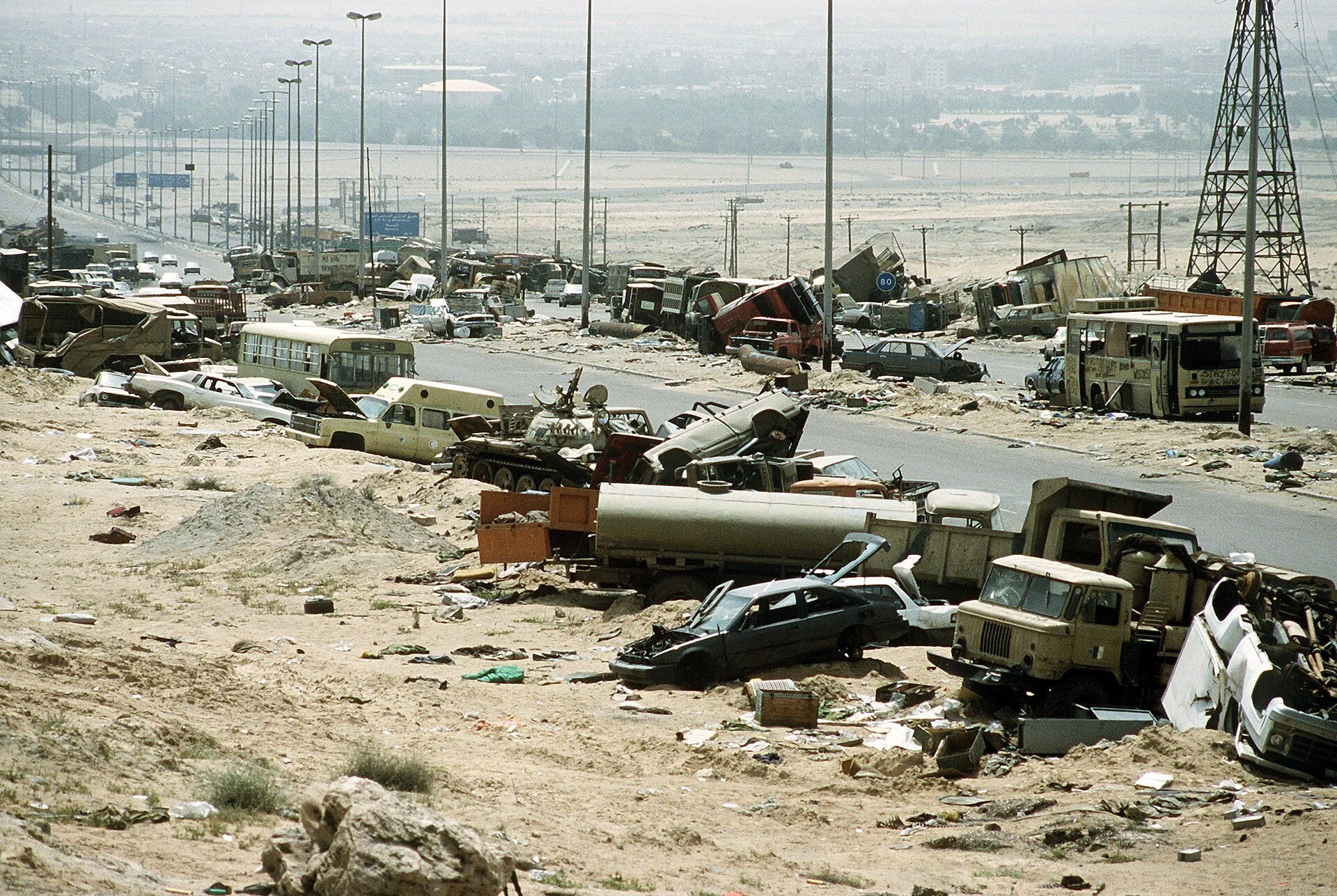
Demolished vehicles along Highway 80, also known as the “Highway of Death,” the route fleeing Iraqi forces took as they retreated from Kuwait during Operation Desert Storm. (Wikipedia Commons photo)
1991 Gulf War
If Afghanistan supplied the organizational start for al-Qaida, the 1991 Gulf War supplied its ideological grievance. When Iraq invaded Kuwait, Saudi Arabia — home to Islam’s two holiest sites — allowed U.S. troops onto its soil to repel Saddam Hussein and defend the kingdom.
For bin Laden, who had offered his own mujahideen veterans to defend the kingdom instead, the decision to host a non-Muslim army near Mecca and Medina was an unforgivable betrayal. He began openly criticizing the Saudi royal family. In 1991, he had been effectively exiled and his citizenship eventually revoked.
This grievance became the organizing principle of bin Laden’s worldview. The edict is for this growing global terror network to direct attacks on the United States.
Hussein had defied U.N. Security Council demands to withdraw from Kuwait by January 1991, and Operation Desert Storm began with a massive U.S.-led air offensive. After 42 days of attacks, President George H.W. Bush declared a ceasefire on Feb. 28.
By that time, most Iraqi forces in Kuwait had either surrendered or fled. Hussein, who remained in power, eventually withdrew from Kuwait and the U.S. declared victory.
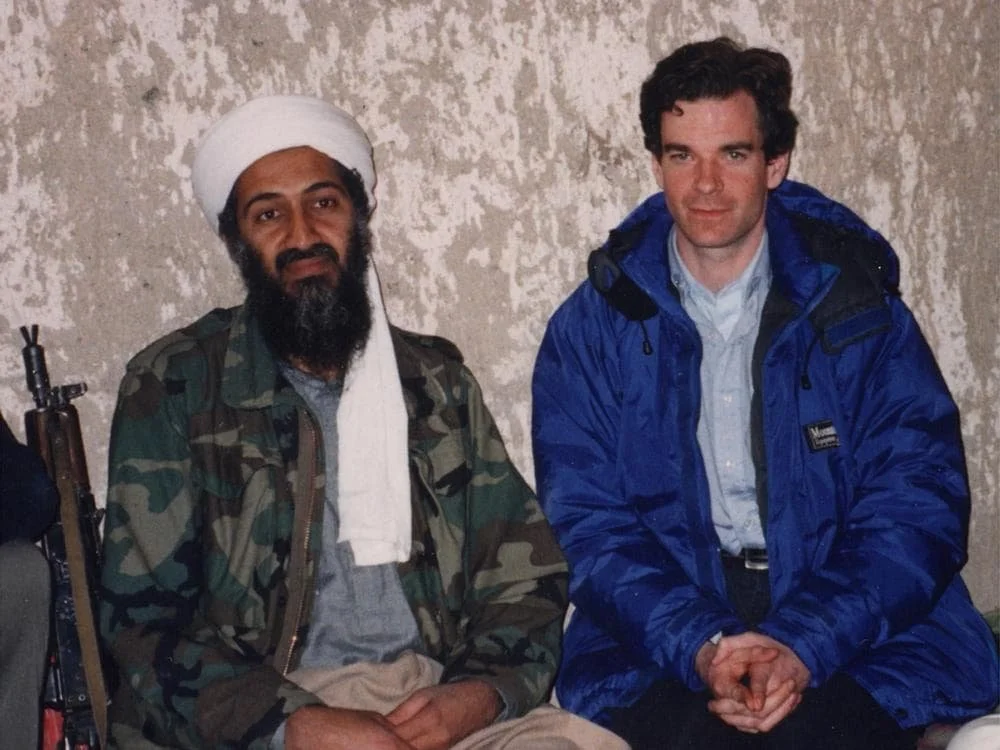
Terror mastermind Osama bin Laden (left) and journalist Peter Bergen in 1997. (Photo courtesy of Peter Bergen)
Decade of warnings
Throughout the ‘90s, the warning signs accumulated, even as they were treated by policymakers and the public as scattered, disconnected incidents rather than a coherent campaign.
The 1993 World Trade Center bombing, carried out by a loosely affiliated cell linked to Omar Abdel-Rahman, killed six people and was intended to topple one tower into the other — a plot that failed only as a result of poor execution. American counterterrorism officials at the time treated it primarily as a law-enforcement matter, prosecuting the plotters through the criminal justice system rather than treating it as an act of war.
In January 1995, authorities thwarted the Bojinka plot, a failed large-scale, three-phase terror attack. The terrorists intended to assassinate Pope John Paul II while in The Philippines, blow up 11 airliners in flight from Asia to the United States, with the goal of killing 4,000 passengers and shutting down air travel around the world. Part of the plot, financed by bin Laden, was to crash a plane into CIA headquarters in Langley, Virginia.
Bin Laden formalized his declaration of hostilities a year later, issuing fatwas calling on Muslims to kill Americans and their allies wherever possible. That same year, al-Qaida terrorists bombed the U.S. embassies in Nairobi and Dar es Salaam, killing over 2,000 people, most of them African civilians.
The Clinton administration responded with missile strikes on a suspected chemical weapons facility in Sudan and on terrorist training camps in Afghanistan. In 2000, al-Qaida operatives in Yemen nearly sank the U.S.S. Cole with a boat laden with explosives, killing 17 American sailors.
Each of these attacks generated headlines and congressional hearings, but none generated a fundamental reassessment of the threat. Al-Qaida became a dangerous, but secondary concern for the U.S.
Bureaucratic barriers between the CIA and FBI, along with legal walls meant to separate intelligence-gathering from criminal investigation, meant that fragments of information about the 9/11 plot itself — including the presence of two future hijackers on U.S. soil more than a year before the attacks — were never assembled into a single attack.
Several of the 9/11 hijackers, including plot leader Mohamed Atta, were radicalized not in impoverished camps but in a terror cell in Hamburg, Germany — a reminder that the terror network’s appeal cut across both class and geography.
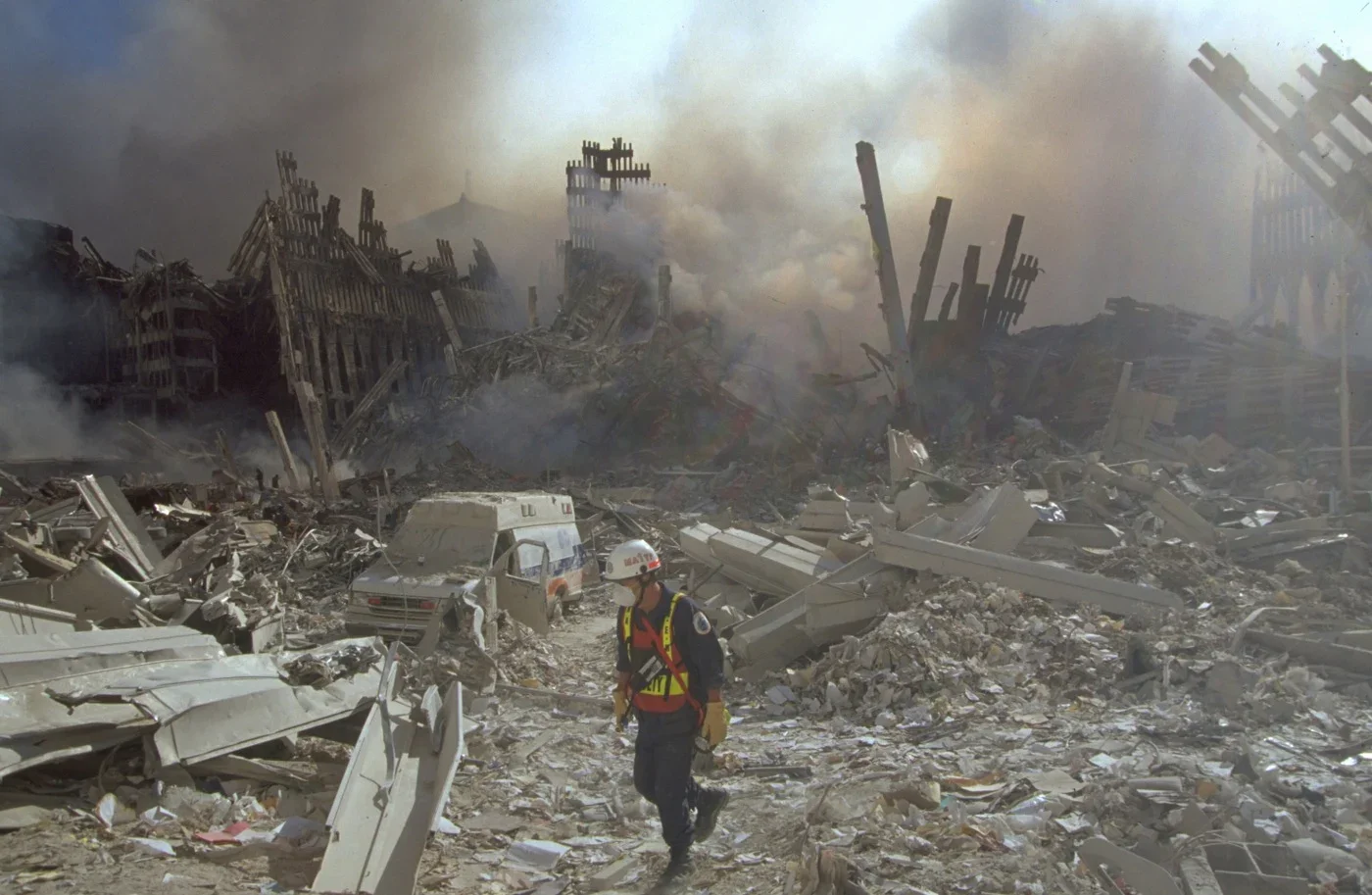
The wreckage following the Sept. 11 attacks on the World Trade Center in New York. (FBI photo)
9/11 not inevitable
None of this means 9/11 was inevitable or that any single inaction bears sole responsibility for a catastrophe born decades earlier.
The series of bureaucratic failures within the American intelligence community in the late 1990s didn’t help matters. The raw material for connecting the plot was, in fragments, available, but no institution was positioned or empowered to assemble it in time, according to a final 9/11 Review Commission Report.
Nineteen hijackers (15 of them from Saudi Arabia), armed with knives and box cutters, carried out the attacks on the World Trade Center and the Pentagon, but the world that made those attacks possible had been under construction for more than 20 years.
The attacks killed 2,977 victims at the three sites, including 343 firefighters and 71 law enforcement officers in New York City, alongside 441 total emergency responders. Exposure to toxic debris at Ground Zero has led to over 9,000 deaths from 9/11-related illnesses, surpassing the initial death toll of the attacks.
“Terrorist attacks can shake the foundations of our biggest buildings, but they cannot touch the foundation of America,” President George W. Bush said on the night of the attacks. “These acts shattered steel, but they cannot dent the steel of American resolve.”
American resolve would be tested in the years that followed. Two wars, in Afghanistan and later Iraq, would shape the geopolitical landscape, cost thousands of lives and trillions of dollars and profoundly transform domestic security and the nation’s foreign policy for decades to come.
“We respect Islam. But we will protect our people from those who pervert Islam to sow death and destruction,” President George W. Bush said during a 2006 U.N. speech. “Our goal is to help you build a more tolerant and hopeful society that honors people of all faiths and promotes the peace.”
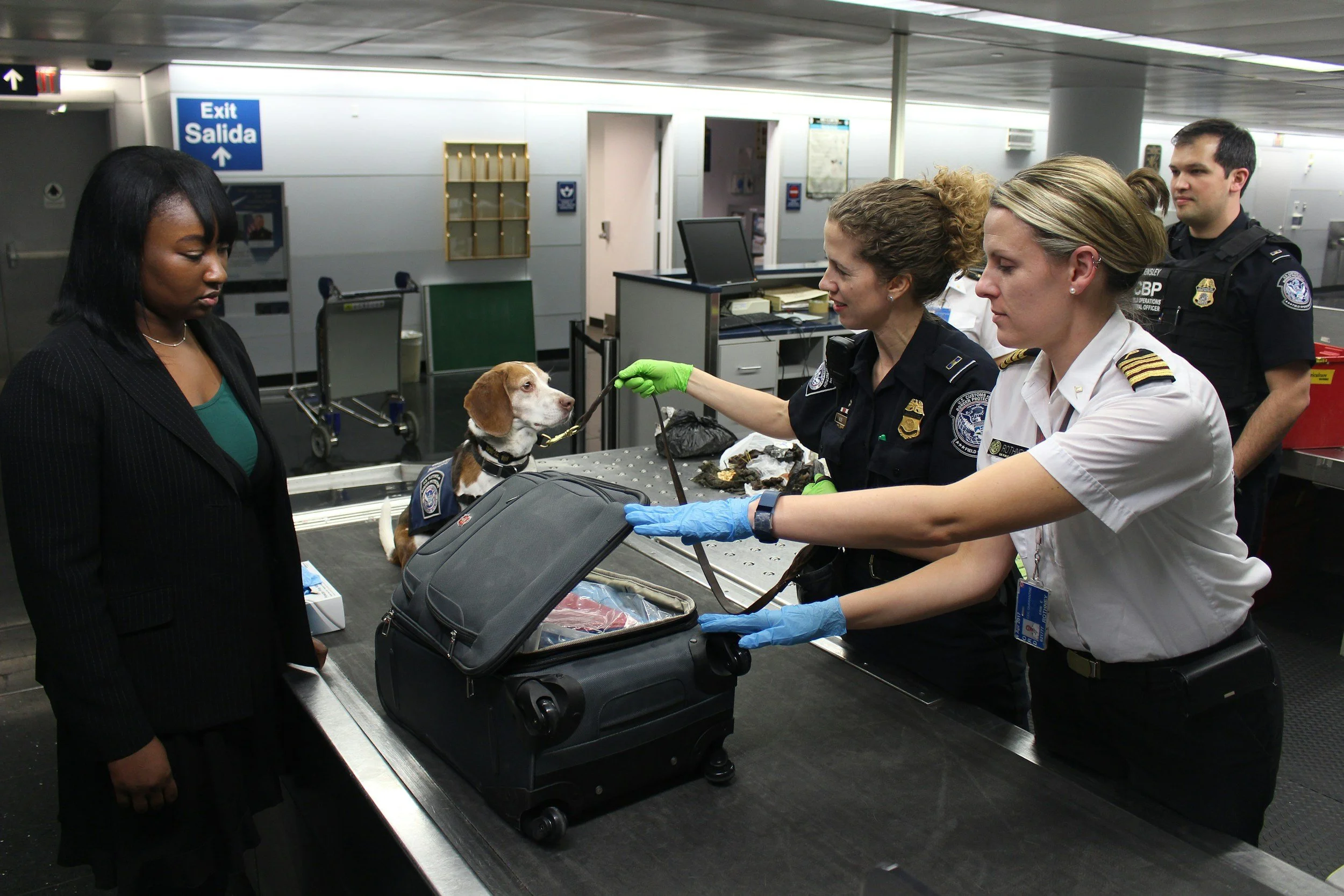
Increased airport security has become the norm since 9/11. (Unsplash photo)
The last 25 years
The attacks forever reshaped American power and its exercise abroad overnight, while that “more tolerant and hopeful society” never really took shape in the Middle East.
Within weeks, the U.S. invaded Afghanistan to topple the Taliban and hunt al-Qaida’s leadership, opening a war that would become the longest in American history. In 2021, following the U.S. pullout, the Taliban returned to power — a strikingly circular outcome that left many asking what, strategically, had been accomplished.
Eighteen months after 9/11, the Bush administration launched an the invasion of Iraq, a war built in part on the false premise the country had weapons of mass destruction. That war destabilized the Middle East, contributing to sectarian civil war, the rise of ISIS out of the wreckage of occupied Iraq and a refugee crisis that would later reshape European politics.
At home, 9/11 produced the most significant expansion of the American security state since the Cold War. The PATRIOT Act, passed weeks after the attacks, broadened surveillance powers dramatically.
The Department of Homeland Security was created and consolidated dozens of agencies under one agency. Airport security was permanently transformed in the U.S. and around the world. By a double-digit margin, Americans told a Pew Research Center poll in 2004 that the anti-terrorism policies imposed so far had “not gone far enough to protect the country.” By 2013, Americans largely believed the opposite.
“When you ponder on it more, it becomes clear that this was truly evil attacking innocent people,” New York firefighter Tim Brown told Religion Unplugged in 2023. “The kind of the clash of civilization. People come to America because of our freedom. People come to America because of our diversity, and we're better for it. We’re a better society for that. People come here because they want to live in freedom.”
The attacks also changed how the United States saw the world, and how the world saw the United States. The wave of global sympathy that followed 9/11 ended within a few years.
Muslim communities in the U.S. and Europe faced a surge in surveillance, suspicion and hate crimes that reshaped civic life for millions of people who had nothing to do with the attacks.
“When I was 6 years old, I had to learn the geopolitics of the Middle East and teach people about my religion and the differences among Islam, al-Qaida, Taliban and ISIS,” Anan Hafez told The Harvard Gazette. “My dad always told me to portray my religion and my culture with honesty and courage. I had to educate my peers because, for many of them, I was the first Muslim they encountered.”
Twenty-five years later, the movement that produced 9/11 has been militarily broken — bin Laden is dead and al-Qaida have largely been decimated — but the underlying conditions that gave rise to it have proven far harder to eliminate than the organization itself.
We live in a post-9/11 world where the assumptions of a previous era — that oceans and military might could insulate a superpower from the actions of a handful of committed extremists — no longer hold. The choices made in the attacks’ immediate aftermath continue to shape wars, borders, laws and our lives 25 years later.
Clemente Lisi serves as executive editor at Religion Unplugged.