
What Americans Think Of Israel And Gaza Since The Oct. 7 Attacks
It’s the conflict that seems to never end — and Americans have shifted their opinions on it.
Following Hamas’ Oct. 7, 2023, attack on Israel, a messy war ensued in Gaza. Half a world away, Americans fiercely debated which side, if any, the U.S. should align with.
Were Palestinians or Israeli Jews the rightful occupants of the Gaza Strip? What role should Hamas play in the region’s future?
American college students vocally protested on college campuses, sometimes barricading themselves in long-standing encampments on their college grounds, and triggering a rash of high-profile antisemitism allegations and complaints.
Politicians created a national spectacle as they called university leaders into televised hearings about their anti-discrimination and free-speech policies. Many employees and U.S. residents participated in boycotts and pressured corporations, public pension funds and charity organizations to disinvest from companies that were contributing to Israel’s military.

Real People. Real Reporting. Donate to Religion Unplugged now through August 17, and your gift will be doubled.
The highly publicized anti-Israel sentiment was a stark contrast to the long-running U.S. official policies that support Israel and that largely view the country as a key ally in the Middle East.
Now, after almost three years of war, researchers have been able to gauge how American sentiments about Israel, Palestine and the terrorist group Hamas have changed over time. A new Pew study surveyed more than 12,500 Americans on their views. It’s worth noting that the survey was performed in early May, about two months after the U.S. and Israel launched their joint war on Iran, which backs Hamas, but before Hamas announced it would dissolve Gaza’s government.
“U.S. public opinion toward Israelis has grown increasingly negative, while views of Palestinians have not changed much,” the report, which was issued last week, said. “As a result, Americans now view the Palestinian people nearly as favorably as they view the Israeli people.”
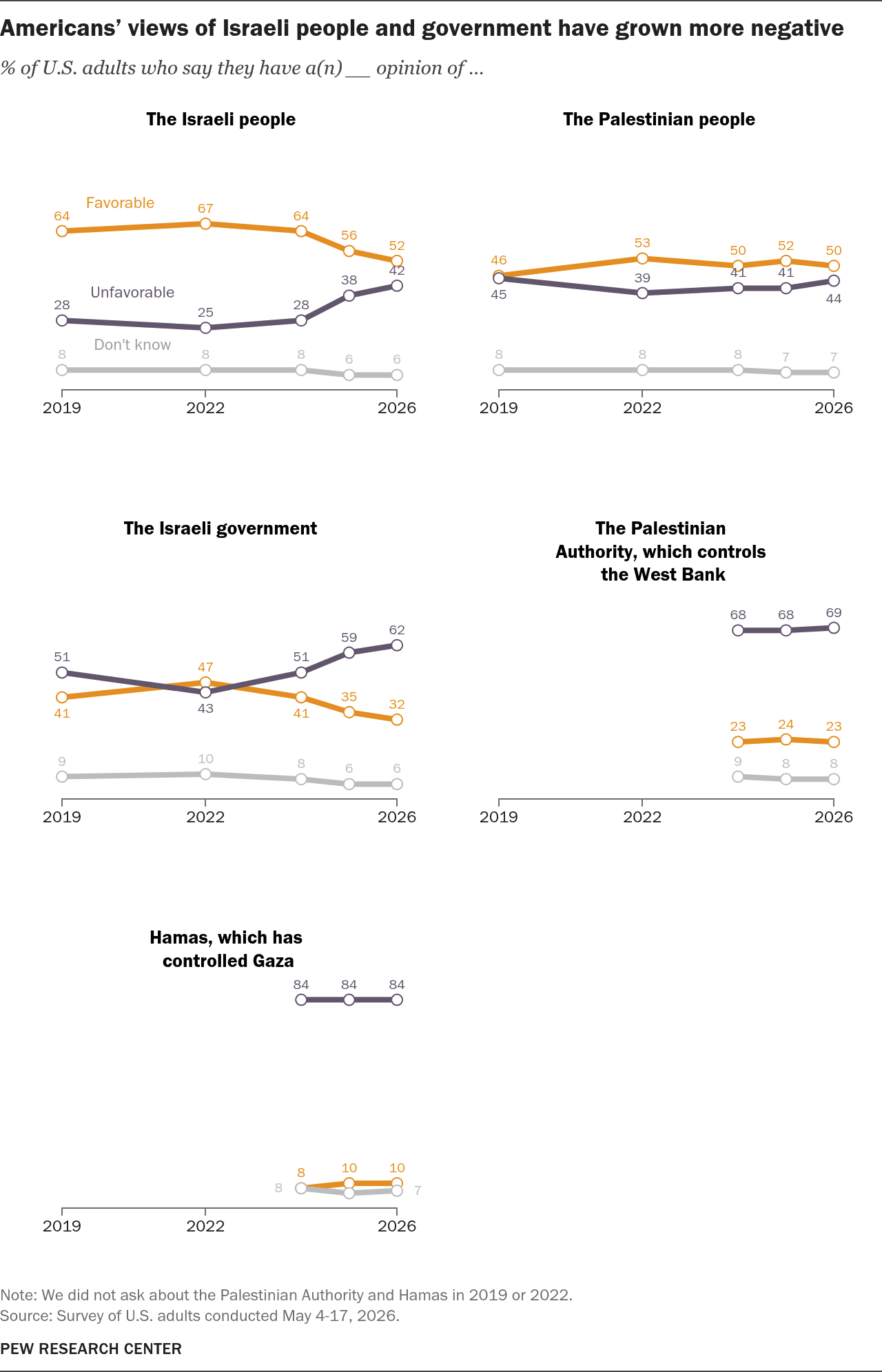
The survey asked respondents to distinguish between the countries’ governments and their people. Across age groups, political parties, and in most religious categories, views of both the Israeli people and the Israeli government had worsened.
According to the data, in 2019, 51% of U.S. adults reported having an unfavorable opinion of the Israeli government. This year, that figure rose to 62%. Similarly, 28% of U.S. adults said they had an unfavorable view of the Israeli people, and now, 42% say the same.
Comparatively, views of the Palestinian people and the Palestinian Authority, which is the internationally recognized government of area and also controls the West Bank, have remained relatively steady.
Meanwhile, the vast majority of U.S. adults (84%) view the paramilitary group Hamas negatively. Hamas controls Gaza and has been designated as a terrorist group by dozens of countries.

Views among U.S. religious groups break down along somewhat predictable political and theological lines.
“Jews and White evangelical Protestants have more favorable views of the Israeli people and its government than other religious groups do,” the report said. “White evangelical Protestants, in fact, are the only religious group in which a majority (57%) have a favorable view of the Israeli government.”
Many white evangelical churches preach Christian Zionism, which teaches that the founding of Israel in 1948 fulfilled Old Testament prophecies and the re-establishing of a sovereign Jewish state is a prerequisite for Jesus’s Christ’s second coming.
“The most compelling points of Christian Zionism are that Israel is of prime importance, that the Jews will eventually convert to Christianity, and that the future of the world permits no middle positions allowing compromise,” wrote William N. Dale for the journal American Diplomacy. “There can be no halfway measures, and those who advocate compromise are siding with the enemy.”
Meanwhile, U.S. Jewish attitudes have also shifted. Forty-seven percent of Jews now view the Israeli government favorably, down from 54%. Perhaps influenced by campus protests and social media discussions, younger Jews (those under the age of 50) are less likely to have favorable views of the Israeli government and Israeli people.
And Muslims, Black Protestants and religiously unaffiliated Americans view the Palestinian Authority and the Palestinian people more favorably than other groups do.
Cassidy Grom is the managing editor of Religion Unplugged. Her award-winning reporting and digital design work have appeared in numerous publications.