
Most Americans Think Their Fellow Citizens Are ‘Morally Bad’
A majority of American adults say their fellow citizens have bad morals and ethics, according to a new report.
The Pew Research Center surveyed thousands of adults in 25 countries and found that 53 percent of Americans said their fellow countrymen had “somewhat bad” or “very bad” morals.
Those findings broke with the international trend: In every other country surveyed, the majority said that others in their country have “somewhat good” or “very good” morals. Take Canada or Indonesia, for example, where residents of both countries said 92% of their fellow citizens have good morals.
“Because we have never asked this question before, we don’t know whether a majority of Americans have long held a skeptical view of the ethics of fellow Americans, or if it’s something new – and if so, what’s driving it,” the report said. “But partisan politics appear to play a role.”
The study also examined how respondents perceived nine different behaviors — including having an abortion and drinking alcohol — to get a broader look at morality around the world.
Homosexuality
There was extreme variation among the respondents when it came to the morality of homosexuality.
Germans and Swedes had an overwhelmingly positive view — with 94% of people in each country saying it was morally acceptable.
At the other end of the spectrum, Nigerians and Indonesians (96% and 93%, respectively) said it was unacceptable.
In many countries, the population's moral leanings seem to align with national law: Same-sex couples cannot marry in either Indonesia and Nigeria.
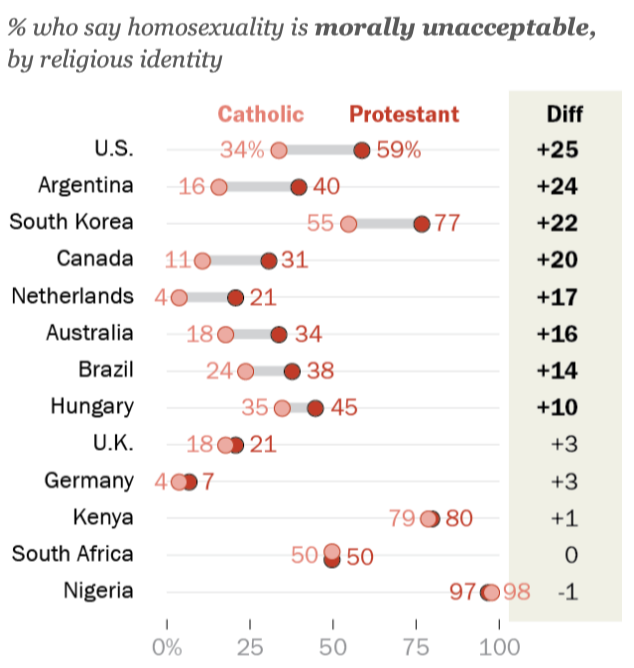
The United States was in the middle of the pack with 39% saying homosexuality was morally wrong. But there was a clear delineation among American Christians: 59% of Protestants said homosexuality is morally wrong, while 34% of Catholics said the same.
This trend generally held up internationally: Protestants are more likely than Catholics in the same country to say that homosexuality is wrong. In addition, people who say religion is very important in their lives are generally more likely than other adults to view various behaviors as morally wrong.
Extramarital affairs and divorce
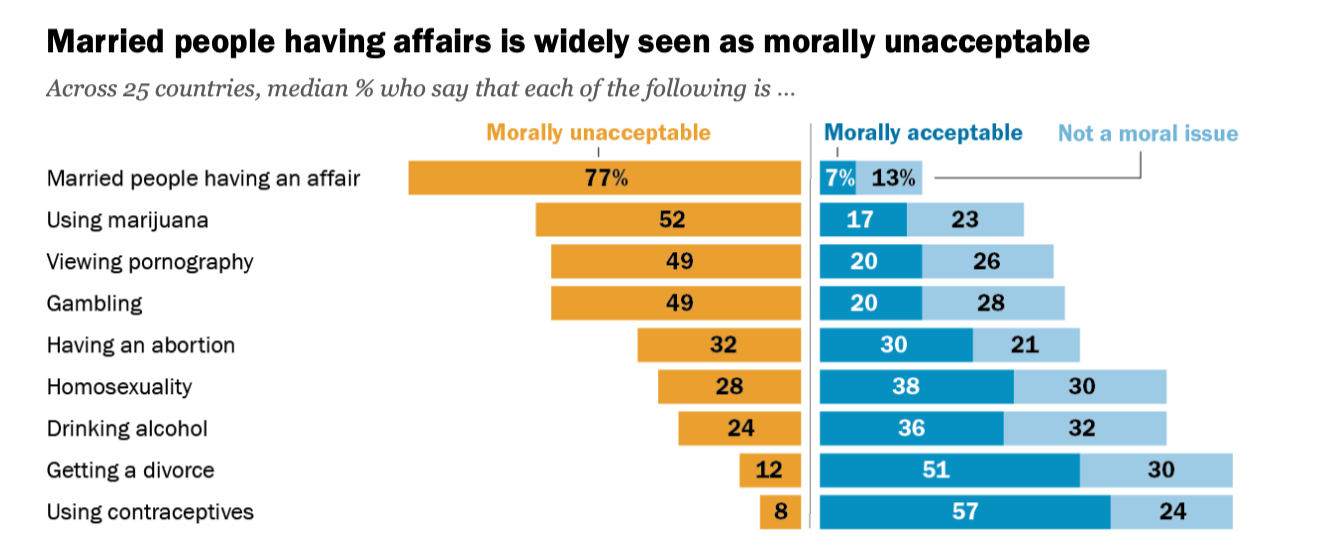
Of the nine behaviors the survey asked about, extramarital affairs drew the strongest overall disapproval.
Across the 25 countries, a median of 77% of adults said that married people having an affair is morally unacceptable.
Divorce, however, was among the most widely accepted behaviors internationally.
The report found that “adults are less likely today than they were in 2013 to say that getting a divorce is morally wrong.”
“Kenya has experienced the largest change,” the researchers said. “In 2013, 59% of Kenyan adults said divorce was wrong, compared with 30% in 2025. And several other countries, including Indonesia and Mexico, have experienced about a 10 percentage point drop in the share saying divorce is morally unacceptable.”
Abortion and contraception
Abortion issues have been making headlines in the United States in the past few years, as President Donald Trump’s administration and Republican-led states have worked to roll back Roe v. Wade. At the same time, Americans seem to be somewhat evenly divided on the issue, with 47% saying it is morally unacceptable.
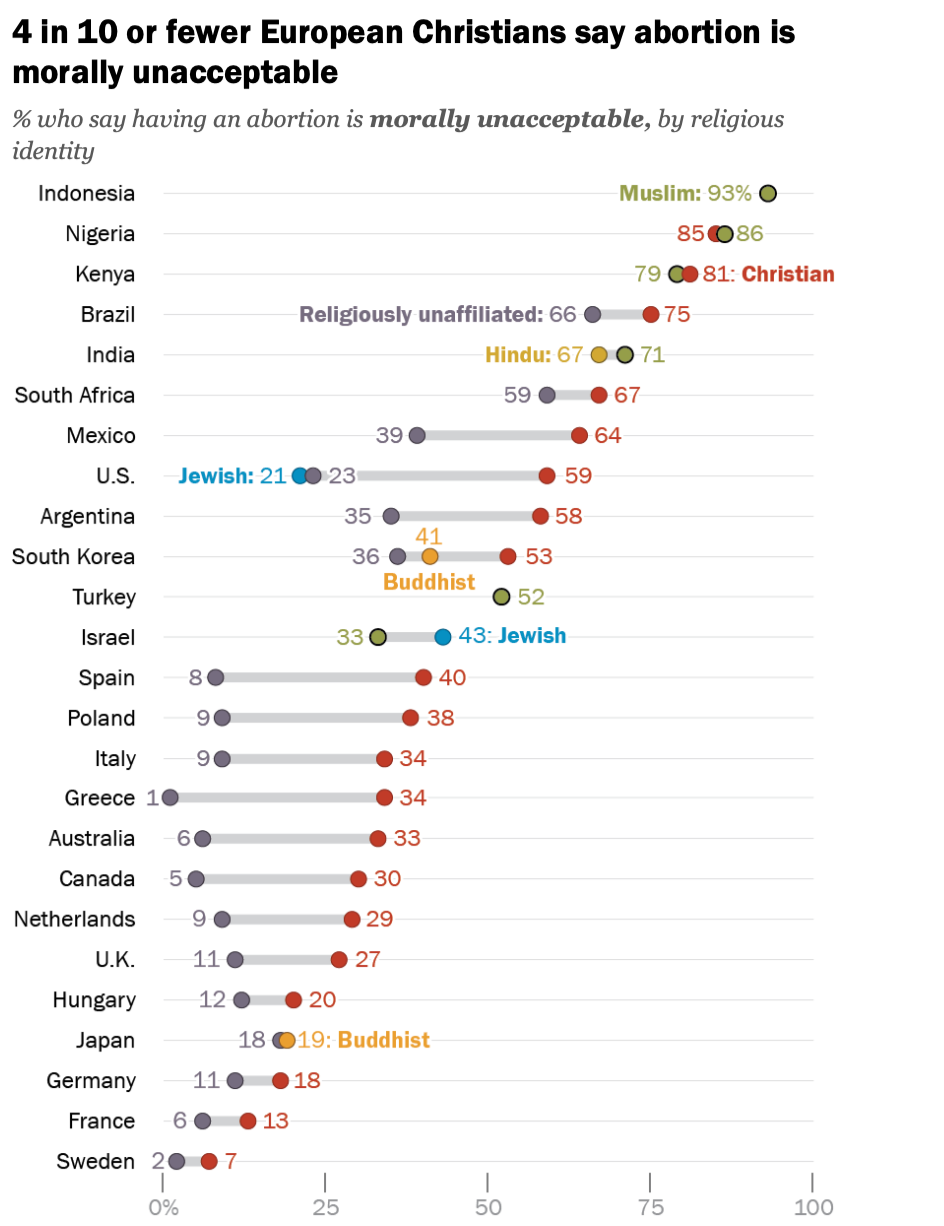
It’s a mixed bag internationally, too. Residents in Latin American and African countries were more likely to say abortions are morally unacceptable. On the other hand, in most European countries, the vast majority of adults view abortions as either morally acceptable or not a moral issue.
The study’s authors point out an “enormous variation” between Christians in different countries: A majority of Christians surveyed in Africa, Latin America and the U.S. said that having an abortion is morally wrong. But in Europe, the share of Christians who argued it is morally wrong ranges from 40% in Spain to as low as 7% in Sweden.
Depending on where they live, Muslims have varying views, too: 93% of Muslims in Indonesia view abortion as morally wrong, but only a third of those living in Israel agree.
On the other hand, contraceptive use is widely accepted internationally, with the majority of respondents in the majority of surveyed countries saying it is morally acceptable or not a moral issue at all.
Nigeria and India, the report added, bucked the trend, with more respondents saying it was morally unacceptable.
Other moral questions
U.S. adults are among the most accepting of two behaviors: Using marijuana and gambling.
Twenty-nine percent of Americans said gambling was morally wrong and 23% agreed that using marijuana was wrong. In most other countries, more than 40% of adults consider these vices morally wrong.
The Pew study also found a correlation between education and moral leanings.
“In Mexico, for example, 70% of adults with less than a secondary education view marijuana use as morally wrong, compared with 39% of Mexican adults who have at least a secondary education,” the Pew study said. “Even in places where relatively few adults say that using marijuana is wrong — like Canada, Germany and the U.S. — those with lower levels of education consistently express more moral objections.”
Since Pew’s 2013-14 study, only a few countries have had significant changes in the percentage of respondents who said drinking alcohol is morally wrong.
In 13 countries, adults today are more likely than they were in 2013 to say drinking alcohol is morally acceptable. In the United States, 55% of people responded it’s simply not a moral issue.
Cassidy Grom is the managing editor of Religion Unplugged. Her award-winning reporting and digital design work have appeared in numerous publications.