
Christian Radio Remains Widespread Despite Streaming Boom
Long before built-in media displays, AUX cords and Bluetooth technology enabled drivers to seamlessly stream their favorite Christian worship bands and podcasters inside their cars, there was religious radio.
A new report released on Thursday from the Pew Research Center found that religious radio stations remain ubiquitous — with 98% of U.S. adults living within the local coverage area of at least one of them.
The report found that an “overwhelming majority” of those stations are Christian. Despite the rise of digital media platforms, 45% of U.S. adults say they’ve listened to religious radio stations, with three-quarters of those listeners tuning in at least occasionally.
The study points out that nearly all of Christian radio’s most popular programs, like “Unshackled,” “Turning Point” and “Focus on the Family” are also offered on streaming services, expanding their reach.
It may not be the glory days of the Billy Graham-style radio broadcasts of the 1950s, when radio was a dominant form of media, but Christian stations today still embrace evangelism over the airwaves as one of their primary missions. The Pew study found that 77% of stations with an “about us” page or mission statement on their website mention spreading the gospel as a key goal.
However, after analyzing more than 400 thousand hours of broadcasts, the researchers found the stations offered more than just sermons or evangelistic content. Many discussed politics and current events, topics like lifestyle and personal development, family and parenting as well as health and wellness. They also offered a large daily dose of “family-friendly” and “uplifting” Christian and worship music.
The biggest Christian artists
Music fills about half of the overall airtime, according to the study’s authors. At first glance, the artists on air seem to be very diverse, with almost 14,000 artists appearing in the sample of 300,000 songs played on religious stations across the country.
However, following a deeper analysis, the researchers found that the most popular 10% of artists account for 87% of all songs played. That means listeners are much more likely to hear songs from established, long-standing Christian groups or artists like MercyMe, Casting Crowns and TobyMac than they would hear local or up-and-coming singers or bands.
Here's the top 10 artists, according to the Pew Study:
— Phil Wickham (2.47% of all songs played)
— Chris Tomlin (1.44%)
— Jeremy Camp (1.42%)
— Zach Williams (1.41%)
— Casting Crowns (1.39%)
— Elevation Worship (1.31%)
— TobyMac (1.23%)
— Bradon Lake (1.22%)
When faith meets politics
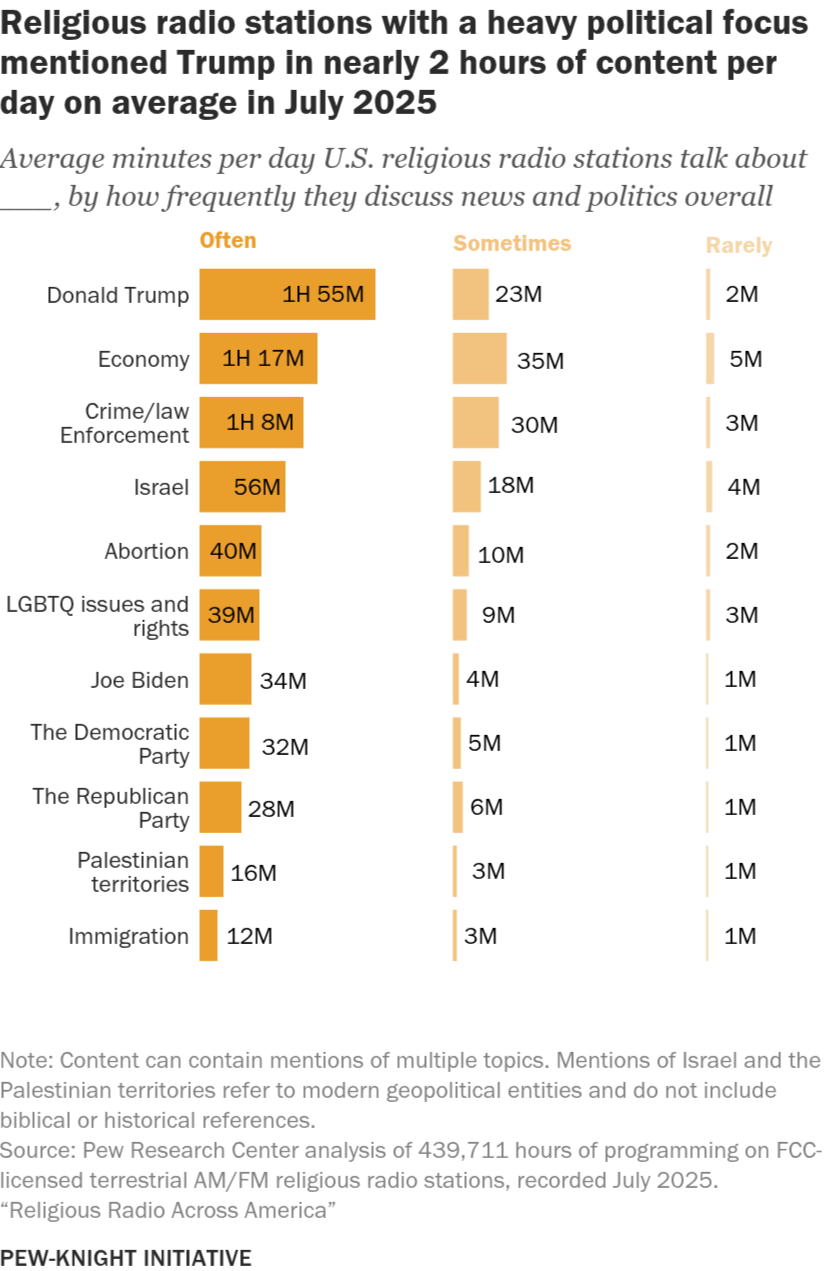
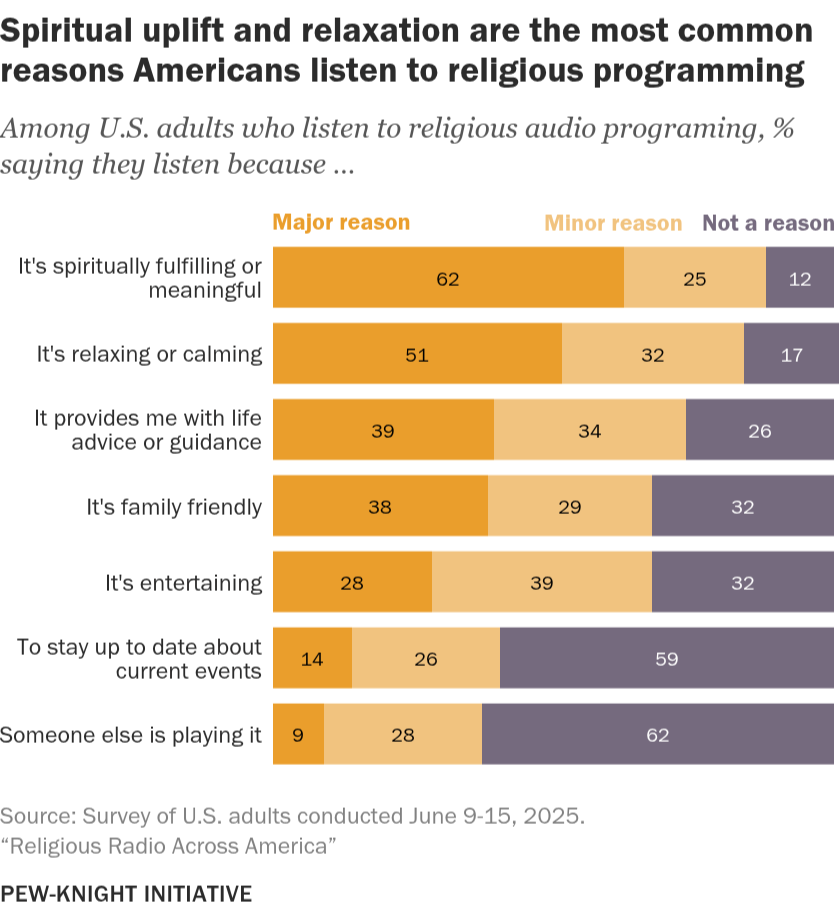
Religious radio stations, on average, spend two hours a day discussing politics, current events and social issues. However, according to the study, only 14% of listeners said that keeping up with the news is a major reason they tune into the station, creating a mismatch between audience expectations and how airtime is used. 40% identified listening to current events as a minor reason they listen.
Most news and politics coverage is “presented in long-form talk radio formats like interviews or host commentary” rather than more unbiased or neutral news reports, the researchers said.
Pew reported on the wide range of time stations spent on these topics. About a third of stations spend less than 30 minutes talking about these issues, but on other stations, the content takes up more than 10 hours a day.
For the stations that spend the most time on coverage of politics in their daily programming, President Donald Trump gets more airtime than any other topic, including the economy and crime. Stations that discuss abortion were almost universally against it, and they were likewise against expanding rights for same-sex couples or transgender people.
At these stations, “around eight-in-10 references to [former President Joe] Biden or to the Democratic Party express negative sentiments,” the report said. “Fewer than 1% of mentions are positive. By contrast, most references to Trump are neutral (47%) or favorable (40%), while 13% are unfavorable.”
What makes Catholic stations different?
Most of the stations the researchers analyzed were identified simply as “Christian” without including a denominational affiliation. However, about 10% claimed a specific Protestant tradition, while 8% said they were Catholic.
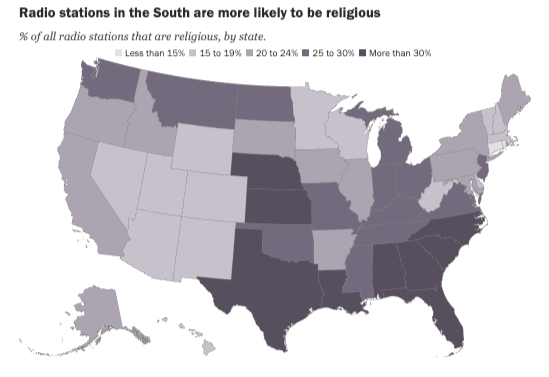
Across all radio stations, both religious and secular, researchers found that stations in the South were significantly more likely to be religious, with North Carolina leading the way, as almost 40% of all stations identifying as religious.
Yet, Catholic stations were concentrated primarily in the Midwest and Northeast, which roughly align with states with larger Catholic populations.
The researchers found that “Catholic stations stand out in several ways.” For example, popular programs like “Turning Point” and “Focus on the Family” almost never air on Catholic stations. Pew observed “essentially no overlap” with non-Catholic stations’ programming schedules.
At the same time, Catholic stations play relatively little music, dedicating just 11% of their time to it. The music they do play is more niche, likely not from widely available studio recordings.
Some additional findings from the study:
— Catholic talk radio is more likely to include caller interaction or audience participation.
— Compared to other Christian stations, Catholic talk radio is more likely to discuss parenting, education and family; it is less likely to talk about pop culture and entertainment.
— Both types of stations mentioned certain books of the Bible more often (including the Gospels, Genesis and Psalms), but “listeners were far more likely to hear references to the Book of Revelation on non-Catholic radio than on Catholic radio,” according to the study.
Cassidy Grom is the managing editor of Religion Unplugged. Her award-winning reporting and digital design work have appeared in numerous publications.