
🎰 Super Bowl Betting Frenzy: Is America’s Ubiquitous Sports Gambling A Problem? 🔌

Weekend Plug-in 🔌
Editor’s note: Every Friday, “Weekend Plug-in” meets readers at the intersection of faith and news. Click to join nearly 10,000 subscribers who get this column delivered straight to their inbox. Got feedback or ideas? Email Bobby Ross Jr.
• • •
If a modern-day Rip Van Winkle woke up this weekend, imagine his shock at the ease and prevalence of online sports gambling.
Keith Stanglin, a Christian preacher and theologian in Austin, Texas, experienced a jolt himself when he discovered it.
“In the last year or two,” Stanglin told me in an email, “I’ve started watching a little more football [NFL and NCAA] again, after taking a nearly total hiatus for many years. So I easily notice how things have changed (in and around the game). One of the most obvious new changes is the ubiquitous advertising and promoting of online sports betting. I find it shocking and horrible; it angers me.”
Americans are expected to wager a record $1.76 billion legally on Sunday’s Super Bowl LX game between the New England Patriots and the Seattle Seahawks, according to USA Today.
For decades, religious opponents waged battles — albeit often unsuccessfully — to prevent legalized gambling. Nearly a quarter-century ago, I covered the fight over a proposed Tennessee state lottery for The Associated Press.
“Since 47 states have gambling, I would have to think God’s not really against it,” Democratic state Sen. Steve Cohen — Tennessee’s chief lottery proponent, who is now a U.S. congressman — told me in 2002.
Based on that logic, God must really love Americans’ ability to click on a smartphone and wager on a live NBA, MLB or NFL game.
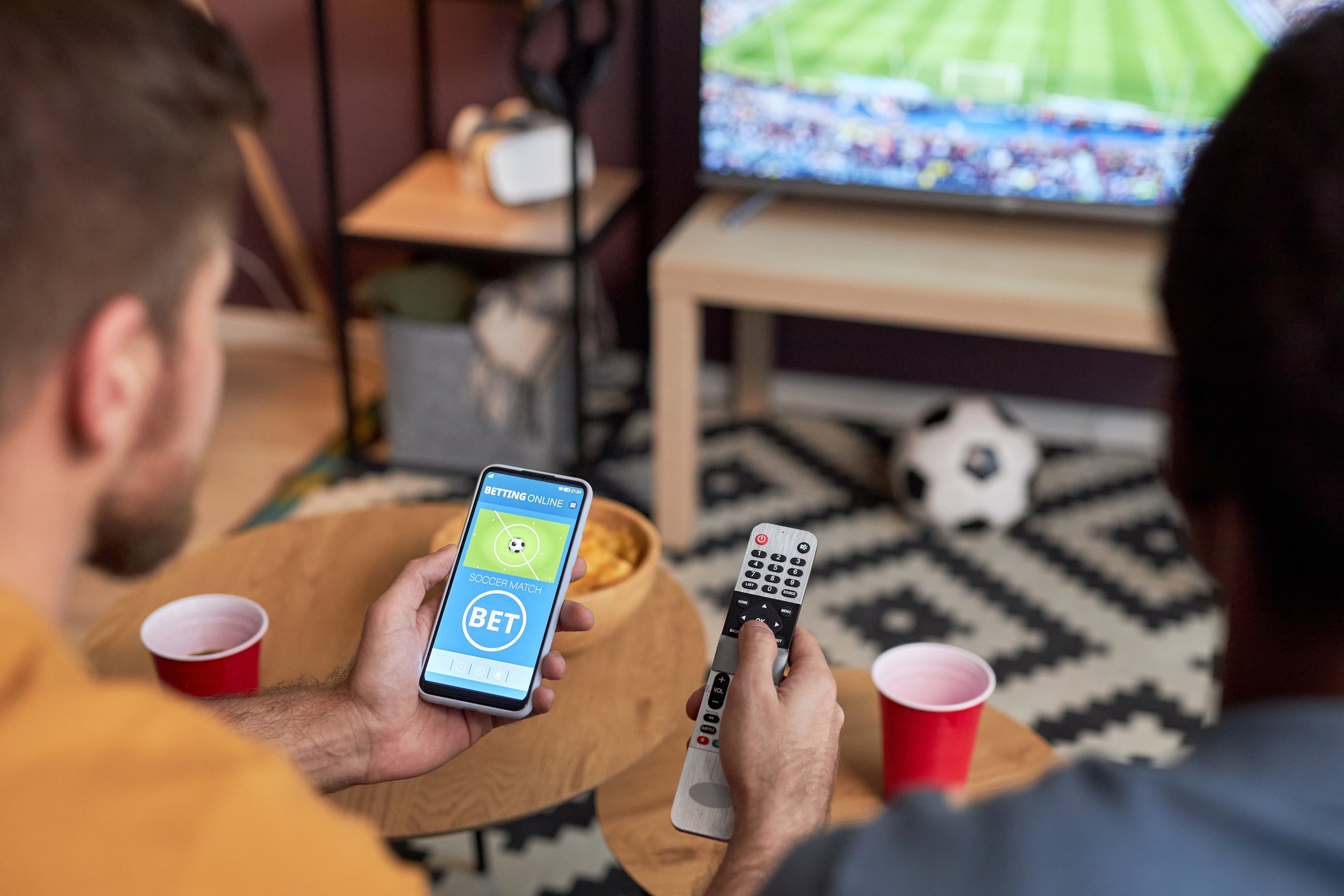
A record $1.76 billion is expected to be wagered on the Super Bowl. (Shutterstock photo)
In 2018, the U.S. Supreme Court struck down a ban on sports betting. That decision opened the floodgates as nearly 40 states rushed to legalize the practice, an AP story noted.
It all happened so quickly — mostly without the fierce religious opposition seen on earlier gambling questions.
Why?
Christianity Today’s Emily Belz’s offered this explanation in a 2024 report:
State-level Christian organizations that tried to fight off the recent legalization of sports betting or put guardrails around it found that there was too much money on the other side of the issue and not much appetite for fighting in the pews.
Few Christians see sports gambling as a problem. A 2016 survey from Lifeway Research found that only 36 percent of Christians thought sports betting was morally wrong. Pastors carry more reservations, with a majority telling Lifeway in 2019 that betting on sports is morally wrong and three-quarters believing it should not be legal.
People responding on social media to critiques of gambling on Desiring God or The Gospel Coalition argued that the authors were being “legalistic” and that betting was no different than investing in the stock market or a 401(k).
Putting bucks on the big game through a few clicks on an app or sports site doesn’t have the social stigma that casino gambling used to carry. The 2020 Gallup figures on the issue showed that 71 percent of Americans said gambling was morally acceptable, the highest level in the 18 years it had done the survey.
But those who continue to be involved in antigambling activism say it’s still harmful.
In a different 2024 story, Religion News Service’s Bob Smietana cited similar reasons “why faith leaders lost the battle against online sports betting.”
Smietana emphasized the speed at which the nearly nationwide defeats occurred:
Some of the nation’s largest faith groups have long considered gambling immoral, or a “menace to society,” as the United Methodist Church social principles put it. But faith leaders like (Baptist pastor Greg) Davis are likely fighting an uphill battle, said longtime Boston College professor and Jesuit priest Richard McGowan.
McGowan, who has been nicknamed “the Odds Father” because of his research on gambling, said faith leaders were caught flatfooted by how fast legalized sports gambling became commonplace.
After New Hampshire started the first state-run lottery in 1964, he said, it took nearly 60 years for 40 other states to follow suit. Legalized sports betting took five years to get that popular — after the Supreme Court struck down a 1992 federal law that limited legal sports betting to Nevada.
Instead of having to jet off to Las Vegas to place a legal bet, in most states, people can pull out their phones and use a popular app like FanDuel or Caesar Sportsbook to place bets on the outcomes of games along with almost anything else that happens in a game.
The ease of legalized betting coincided with what McGowan called “the ethics of tolerance.”
This past fall, Slate’s Molly Olmstead delved into why evangelical gambling critics have “largely gone quiet at the moment the country needs them most.”
Olmstead noted:
To understand why evangelicals appear to have lost their taste for anti-gambling crusades, it's necessary to first look at the ways the sports betting industry has enfeebled its entire opposition.
This issue cannot be understood properly without an acknowledgement of the bogglingly large sums of money poured into it. DraftKings, FanDuel, BetMGM, and other major commercial interests have flooded statehouses with teams of lobbyists who often pitch gambling as a way to fund popular causes, such as scholarships or clean water. And those companies aren't the only big players: The major sports leagues have seen the potential for their own gain—from increased fan engagement, from official paid partnerships, from media licensing, and from licensing the data sold to sportsbooks— and thrown their support behind the legalization bills. That pivot, a complete turnaround from the industry's firm opposition to sports betting back in the '90s, when athletes and league bigwigs testified that betting would corrupt sports, has eliminated one of the last major checks on the gambling industry's lobbying power.
Now, 14% of U.S. adults say they bet on professional or college sports online, according to AP, with a growing list of sports betting scandals making headlines.
More people seem to be asking if legal sports betting is good or bad for America.
In a Pew Research Center survey last year, 43% of U.S. adults said “the fact that sports betting is now legal in much of the country is a bad thing for society.” That was up from 34% in 2022.
An expert quoted by the Deseret News ‘ Dennis Romboy detailed his concerns:
“I just feel like this all happened so quickly for people that they didn’t necessarily have a chance to digest what the stakes were, what the dangers were,” said journalist Danny Funt, who chronicled the rise of American sports gambling in a new book titled “Everybody Loses” due out in January.
“It happened so quickly that the gambling industry and their business partners had such a powerful lobby and public platform to assure people that this was, if not neutral, actually a good thing for sports and society.”
Funt said evidence of rising gambling addiction rates and dangers to public health along personal finance issues such as higher bankruptcy rates, less savings and college students tapping into their tuition fund is trickling in.
“All of these studies and research projects are creating a mountain of bad news,” he said. “I would expect those figures (in the poll) to continue to skew toward more concern than optimism as time passes.”
I have an email list that I sometimes use to seek feedback on topics such as this. So in advance of the Super Bowl, I asked about sports betting.
“It’s three will get you five that you don’t get the truth,” one friend replied, using betting parlance for high odds.
To be sure, no one replied to advocate for betting on Sunday’s game. But others shared thoughtful comments.
“For many Christians, the concern isn’t about a single bet — it’s about the cultural shift,” said Aaron Sayles, a Christian who lives in Newport News, Virginia, and plans to watch the Super Bowl.
“Gambling is now accessible 24/7,” Sayles added. “It is aggressively marketed. It is statistically addictive. It is financially destructive for millions. It subtly reshapes the heart toward risk, greed and escapism.”
Kevin Ward, a church elder and sports radio program director in Tulsa, Oklahoma, said, “People can actually bet on something while the game is going on. I think this has become an epidemic among younger men, especially.
“Because bets are placed in smaller increments, I think a lot of people don’t view it as a big deal,” Ward added. “But then when you look back over time, it likely adds up to the same amount of spending.”
Makenzie Young, a youth minister in Oregon, said she heard a parent exclaim, “Man, I bet $100 on this game!” at a recent kindergarten basketball scrimmage.
“This was at a game where they don’t even keep score,” Young said.
“We talk about it some with our teens, to which most of them ask why it would be bad to go to Vegas only once,” she added. “I think a lot of people see it as a fun ‘once’ thing to do. But in reality, it’s a waste of resources God has given you, and it gives the devil a potentially huge foothold, in my opinion.”
Mitch East, an adult education minister in Oklahoma City, said online sports gambling preys on men.
“If pornography is a vice that enslaves male libido, online sports betting is a vice that enslaves men’s desire for risk and adventure,” East said. “I will not bet on the Super Bowl, and I never want any access to sports betting apps for me or my kids. I think every Christian parent should be worried if they have sons.”
Jake Perkins, a Houston-area minister, said he preached a series last fall called “Raised by a Casino” in which he attempted “to show people how the modern architecture of phone apps is built on the decades-old design of casinos in Vegas and beyond.
“It is definitely a problem,” Perkins said.
“And no, I don’t bet,” he quipped. “I am a preacher. Who has the money to bet?”
Inside The Godbeat
Speaking of the Super Bowl, check out three faith storylines to follow, courtesy of Clemente Lisi, Religion Unplugged’s executive editor.
At Religion News Service, Bob Smietana writes about how the “He Gets Us” ads will be more personal and less political during this year’s game.
The Final Plug
In last week’s column about the faith fault lines in the Minnesota immigration crackdown, I quoted Patrick Doherty, a Twin Cities preacher.
Doherty texted me this week to let me know that ICE — U.S. Immigration and Customs Enforcement — had returned to his suburban neighborhood.
“Not that it matters for any articles or anything at this point,” he said, “but ICE just came and took our next-door neighbors.”
In a follow-up text, he added, “I’m fine, but I guess it is just evidence that it is all still very present.”
Happy Friday, everyone! Enjoy the weekend.
Bobby Ross Jr. writes the Weekend Plug-in column for Religion Unplugged and serves as editor-in-chief of The Christian Chronicle. A former religion writer for The Associated Press and The Oklahoman, Ross has reported from all 50 states and 20 nations. He has covered religion since 1999.