
🚨 Inside The Minnesota Immigration Fight’s Faith Fault Lines 🔌

Weekend Plug-in 🔌
Editor’s note: Every Friday, “Weekend Plug-in” meets readers at the intersection of faith and news. Click to join nearly 10,000 subscribers who get this column delivered straight to their inbox. Got feedback or ideas? Email Bobby Ross Jr.
• • •
Hey, Minneapolis.
You again, huh?
“I don’t know why it feels like it’s always happening in Minneapolis, but I guess we are here for a reason,” Patrick Doherty, a Twin Cities preacher, told me in a text message this week.
By “it,” the church leader meant the city finding itself embroiled — once again — in a major national firestorm.
I first connected with Doherty when I reported on the aftermath of George Floyd’s 2020 murder by a police officer.
Now, of course, the Trump administration’s aggressive immigration crackdown in Minnesota — which has led to confrontations with protesters and two high-profile shooting deaths of U.S. citizens — has dominated national headlines for days and even weeks.
Like a lot of my Godbeat colleagues, I’ve spent time recently delving into faith angles related to the immigration enforcement surge.
READ: Minnesota Churches Pray For Peace After Fatal ICE Shootings
The debate over U.S. immigration policy — and tactics — has raged for years, and President Donald Trump’s comeback second term has ratcheted up the decibel.
Back in 2012, I followed a Chicago-area minister to a federal deportation center and watched a Spanish-speaking woman weep as she said goodbye to her son, an undocumented immigrant. In that story, I reported that the Obama administration had deported a record number of immigrants the previous year.
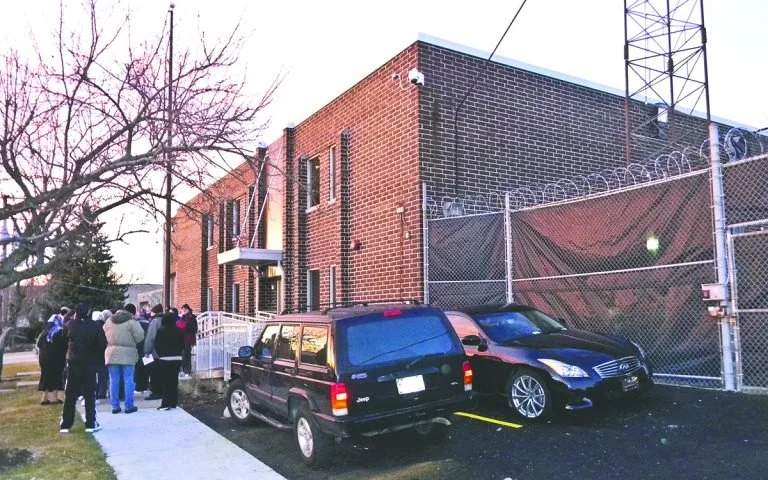
As the sun rises, immigrant advocates gather for a prayer vigil at a Chicago deportation center in 2012. (Photo by Bobby Ross Jr.)
In my Weekend Plug-in column three days after the 2024 election, I listed three major storylines to follow. The first focused on what Trump’s election would mean for immigrants and refugees:
Trump’s tough talk on U.S. border security and his threat of mass deportations were a central part of his successful campaign.
“Some of the president-elect’s proposals seem unlikely, but he has threatened to remove millions of both undocumented and legal immigrants,” Christianity Today’s Emily Belz explained.
In the wake of Trump’s win, faith groups that help migrants and refugees are reaffirming “their commitment to continue their work,” according to Religion News Service’s Aleja Hertzler-McCain.
Before the election, Idean Salehyan wrote for The Conversation that the outcome could help decide the fate of the 70,000 Afghans living temporarily in the U.S.
“A majority of Christian voters supported President-elect Trump, according to the exit polls, but it’d be an error to presume that means that most Christians align with everything that he’s said in the campaign related to refugees and immigration,” Matthew Soerens, vice president of advocacy and policy at World Relief, the humanitarian arm of the National Association of Evangelicals, told RNS.
As a journalist, I’ve had the privilege to meet — and tell the compelling stories of — Ukrainian refugees in Alaska and Texas, Afghan refugees in Oklahoma, Texas and Virginia, Syrian refugees in Canada and Liberian refugees in Rhode Island.
I’ve written, too, about Mexican immigrants — and other Hispanics — who came to the U.S. in search of a better life.
Certainly, border security is a legitimate concern for the American public.
And undoubtedly, immigration is a complicated policy discussion. But it’s not an abstract one: It involves real people and real lives beyond the cardboard caricatures often prevalent in political discourse.
Fast-forward nearly 15 months, and people of faith remain a key part of the immigration story.
To help satisfy my love for alliteration, here are four religion angles to follow — all starting with the letter “F”:
1. Fault lines among religious groups
Even before the anti-ICE demonstrations intensified in Minnesota, various Godbeat pros were exploring the fault lines among religious groups. By the way, for anyone not familiar with the acronym, ICE refers to U.S. Immigration and Customs Enforcement.
Just before Christmas, the New York Times’ Elizabeth Dias and Shannon Sims quoted Lewis Richerson, a Baptist pastor in Louisiana who said he’d refuse to “knowingly extend communion to an illegal immigrant who is visiting our church.”
Dias and Sims wrote:
Mr. Richerson’s church is part of the Southern Baptist Convention, the largest Protestant denomination in the United States, with about 12.7 million members. For years, the denomination has supported immigration reforms, especially given its extensive missionary work and theological commitments to helping “the least of these,” as Jesus says in the gospel of Matthew.
But while Catholic bishops this year have repeatedly rebuked the Trump administration over its deportation actions, Southern Baptists are contending with an increasingly loud contingent in their ranks that, like Mr. Richerson, supports the immigration crackdown. Even as many rank-and-file churches continue to support immigrant ministries, signs of fracture are emerging.
Just before New Year’s Day, The Associated Press’ David Crary, Giovanna Dell’Orto and Tiffany Stanley explained why faith leaders who support immigrants were bracing for a tough year.
More recently, the Washington Post’s Michelle Boorstein noted that Christians are “divided over whether it’s right to protest ICE operations.”
At The Christian Chronicle, guest columnists Jack Wilkie and Kelly Walden presented opposing viewpoints. See “Anti-immigration, pro-love of neighbor” by Wilkie and “ICE has gone too far” by Walden.
2. Forefront of resistance
Religion journalists, including National Public Radio’s Jason DeRose and Religion News Service’s Jack Jenkins, have offered firsthand accounts from Minneapolis of clergy members opposing aggressive immigration enforcement tactics.
DeRose reported earlier this month:
As federal immigration enforcement actions intensify across the Twin Cities, communities of faith are at the forefront of resistance, organizing public witness, mutual aid and political action rooted in long-standing religious commitments.
Faith leaders say their resolve to counter the ICE crackdown has increased since the killing of Renee Macklin Good by a federal immigration agent in Minneapolis (on Jan. 7). Macklin Good's wife Becca Good described her as a Christian motivated by her faith to help others.
EWTN News’ Tessa Gersavini quoted a priest who said Alex Pretti — the civilian shot by federal agents last weekend — was known for his “kindness.” Subsequent news reports noted that Pretti scuffled with federal immigration agents 11 days before the shooting, after shouting expletives at them and kicking out a tail light of their vehicle.
Among a number of on-the-ground stories by Jenkins, he detailed “the effort to organize clergy nationwide to resist ICE.”
AP’s Dell’Orto led the coverage of police arresting about 100 clergy who demonstrated against immigration enforcement at Minnesota’s largest airport last week.
3. Freedom to worship
Dell’Orto — a religion writer based in Minneapolis — also covered the concern that arose over protesters showing up at a Southern Baptist church where an ICE field office leader serves as a pastor:
Several faith leaders called urgently for protecting the rights of worshippers while also expressing compassion for migrants after anti-immigration enforcement protesters disrupted a service at a Southern Baptist church in Minnesota.
About three dozen protesters entered the Cities Church in St. Paul during Sunday (Jan. 18) service, some walking right up to the pulpit, others loudly chanting “ICE out” and “Renee Good,” referring to a woman who was fatally shot on Jan. 7 by an Immigration and Customs Enforcement officer in Minneapolis.
In a separate story — headlined “Protests inside churches are unusual despite long history of civil disobedience in the US” — AP Godbeat pros Peter Smith and Tiffany Stanley offered a deeper exploration of the controversy.
4. Fear in the streets (and pews)
In a tense Minnesota, Christians are helping immigrant neighbors, according to Christianity Today’s Belz.
She noted:
The Trump administration has pointed to a fraud scheme among the Somali community as justification for its recent immigration-enforcement surge in the Twin Cities, but most of those residents are US citizens.
Christians helping immigrants there told CT that enforcement operations have largely targeted the Hispanic community instead. Among their arrests, agents with Border Patrol and ICE (Immigration and Customs Enforcement) have been detaining legal immigrants as well as US citizens—and refugees who have legal status.
That has sparked fear among racial minorities in the Twin Cities that America’s immigration-and-asylum-processing system — and citizenship itself — no longer offers meaningful protection from a degrading or violent detention.
Russell A. Pointer Sr., whom I profiled for The Christian Chronicle in 2021, serves as the senior minister for the Minneapolis Central Church of Christ.
The Black preacher emerged as a key champion for justice after Floyd’s death. Pointer introduced me to Minnesota Attorney General Keith Ellison and connected me with Medaria Arradondo, who was then the city’s police chief.
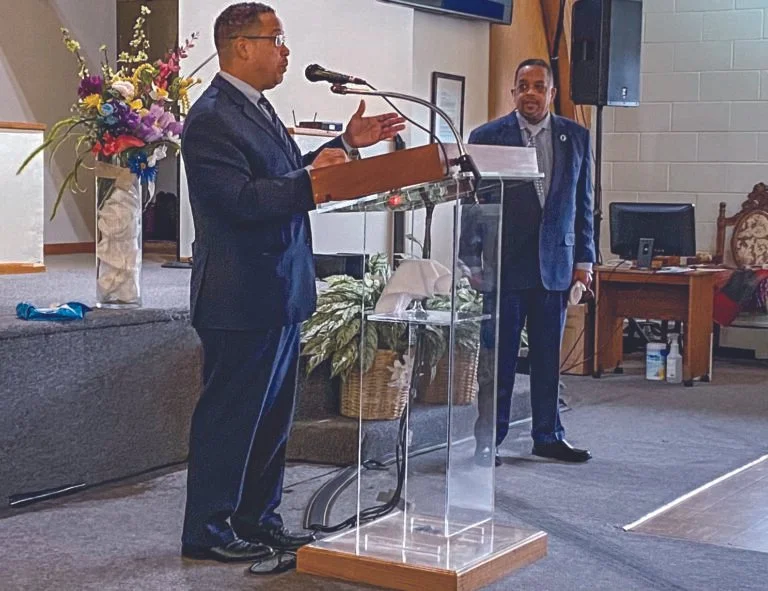
Minnesota Attorney General Keith Ellison, who oversaw Derek Chauvin’s prosecution in the death of George Floyd, discusses the guilty verdict as minister Russell A. Pointer Sr. listens in 2021. (Photo by Bobby Ross Jr.)
This week, Pointer told me his church’s Sunday attendance has declined as members of color — who are U.S. citizens — stay home out of fear of being targeted.
Even Pointer said he’s started working from home most days rather than driving to his church office.
“We feel like a Third World country,” he lamented. “We’ve never seen anything like this before. It’s unprecedented. And so to deal with this, we have to fast and pray.”
Inside The Godbeat
Religion Unplugged’s podcast has a guest this week.
Notice that I didn’t say “special” or “interesting” guest. I like to be accurate in my reporting.
Seriously, the guest is me, and while I refuse to listen to my own voice, host Matthew Peterson asked some insightful questions. I did my best to provide helpful answers concerning my 25 years on the Godbeat.
The Final Plug
Forty years ago, I was a senior at Keller High School, north of Fort Worth, Texas.
I remember Jan. 28, 1986, because our monthly edition of The Wigwam — the student newspaper that I edited — came out that day.
But that morning remains etched in my memory 40 years later because the Space Shuttle Challenger exploded 73 seconds after liftoff, killing all seven crew members.
The crew included schoolteacher Christa McAuliffe.
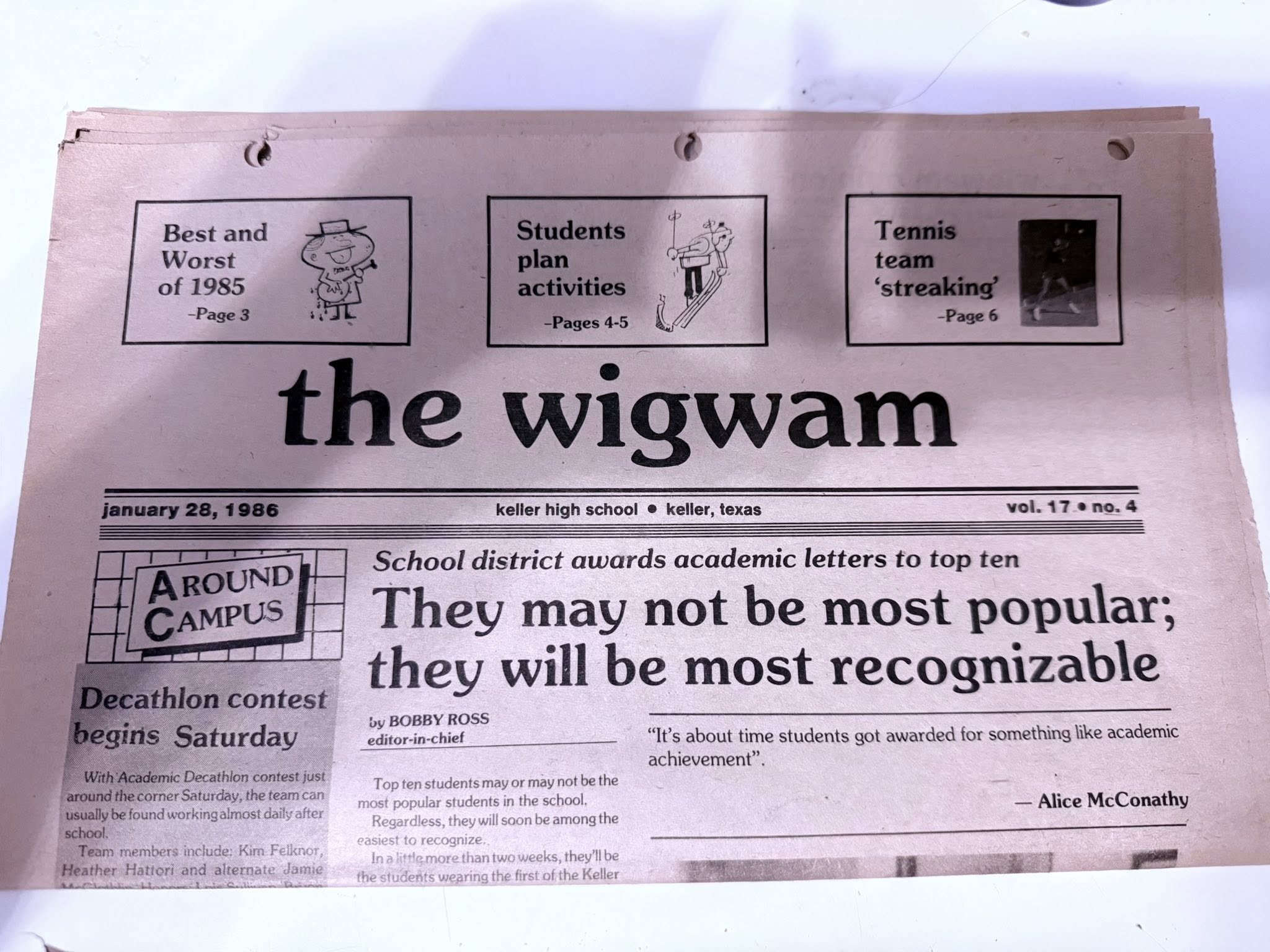
The front page of The Wigwam — the Keller High School student newspaper — on Jan. 28, 1986. (Photo by Bobby Ross Jr.)
“I remember that day, too. Losing a teacher was particularly significant to me,” Janie Crane Burchfield said when I mentioned the anniversary on Facebook.
Burchfield, I should note, was my high school journalism teacher and newspaper adviser. She was the best, most encouraging teacher ever. This is probably a nice time to thank her for launching me on the fulfilling career path I chose all those years ago.
Happy Friday, everyone! Enjoy the weekend.
Bobby Ross Jr. writes the Weekend Plug-in column for Religion Unplugged and serves as editor-in-chief of The Christian Chronicle. A former religion writer for The Associated Press and The Oklahoman, Ross has reported from all 50 states and 20 nations. He has covered religion since 1999.