
Meet Zaffar: Veteran News Reporter Finding Stories Of Hope
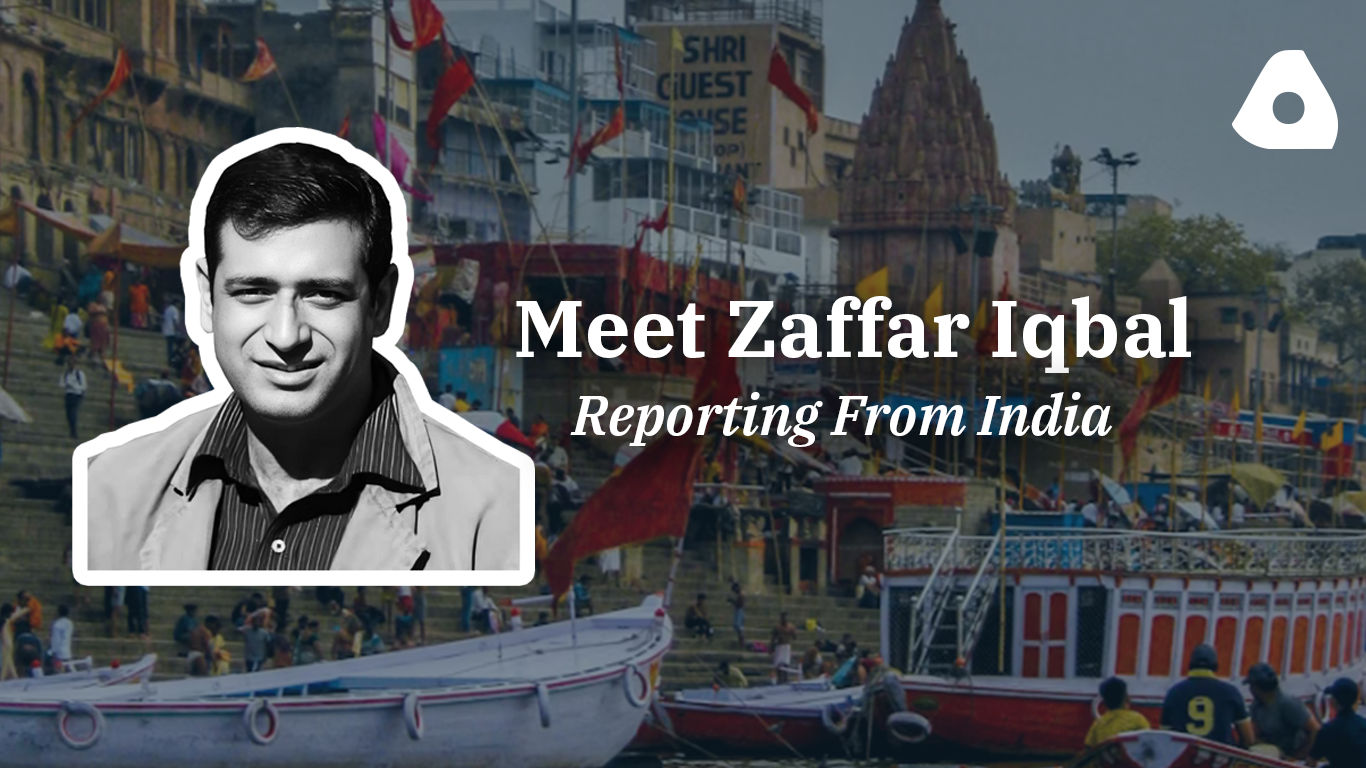
More than 1.4 billion people live in India — and each person has a story to tell.
Zaffar Iqbal has made it his journalistic mission to find those stories, interviewing experts and everyday people, and writing compelling Religion Unplugged articles.
And it’s impossible to tell the evolving story of India without telling the stories of its residents’ religious practices and beliefs. For five years, Iqbal’s reporting for Religion Unplugged has chronicled the rising tide of Hindu nationalism in the country, while also highlighting hopeful stories of interfaith collaboration.
Earlier this year, civilians in Jammu and Kashmir found themselves in the crossfire during a deadly spat between India and Pakistan. Iqbal faithfully reported on the lost lives and damaged infrastructure, but also found the pockets of hope: “When a shell slammed into a madrassa [an Islamic school] housing over 1,200 children, its caretaker, Sayyed Habib, didn’t dial the army or the police. He didn’t call emergency services. He called Pradeep Sharma, a Hindu and former BJP legislator and his best friend since ninth grade.”
Sharma ferried the wounded Muslim children out, “ignoring the fresh volleys of fire overhead.”
Amid a crisis or natural disaster, journalists like Iqbal function as essential workers. Local newspapers, radio stations, TV stations and digital media can help residents understand the basics: Where is it safe to travel? Who is among the wounded or dead? What essential safety messages do government officials want to disseminate to the public?
Over his long career, Iqbal has had his fair share of late nights in the newsroom and dangerous assignments in the field. From his home base in Kashmir, he has reported on armed encounters, environmental issues, crime, politics, culture and human rights — most recently as bureau chief at NDTV.
Perhaps just as important as breaking news are the stories that unfold days after the armed conflict ends or the ambulances leave. As communities grieve and begin to grapple with how to move forward following a crisis, they need true stories that bring them together rather than further tearing them apart. Iqbal’s master storytelling, chronicling unlikely friendships and collaborations, is exactly the medicine communities need to help them heal.
“My stories for Religion Unplugged are important because they offer readers a nuanced understanding of a complex region often reduced to simplistic narratives,” Iqbal said. “The website amplifies original, deeply reported stories that reveal how religion has become central to social and political developments. By going beyond surface-level coverage, these stories help global readers better grasp the intersections of faith, identity and power.”
Iqbal is joined by dozens of Religion Unplugged contributors worldwide, who share true stories from their home countries and continents with our readers. This work is not cheap. It takes time and money for freelancers to travel, interview, research, fact-check and write their articles. Religion Unplugged is committed to making their journalism free for you, the readers — with no advertisements and no paywalls.
And now, we need your help. Please consider donating to our NewsMatch fund. Every tax-deductible donation you make now through Dec. 31 will be doubled, up to $35,000. That means your gift has twice the power to support independent, high-quality journalism at a time when it’s never been needed more.
Cassidy Grom is the managing editor of Religion Unplugged. Her award-winning reporting and digital design work have appeared in numerous publications.