
‘Unmistakable Spiritual Impression’: Buddhist Monks Walk For Peace
Religion Unplugged believes in a diversity of well-reasoned and well-researched opinions. This piece reflects the views of the author and does not necessarily represent those of Religion Unplugged, its staff and contributors.
(OPINION) I did not expect my Methodist heart to be strangely warmed by watching nineteen Buddhist monks walk across America — from Texas to Washington, D.C. — bearing witness to peace, compassion, forgiveness, and healing.
But here I am. Every day. Often twice a day. Checking their livestream on my phone for a minute or two, just long enough to feel some joy.
It has become my alternative to doomscrolling. Instead of absorbing one more news cycle of outrage sliding toward despair, I find myself peace-scrolling — watching venerable monks walking slowly and mostly silently along highways and through small towns, raising hope simply by moving forward.
READ: Amid Stunning Landscapes, A Monk, Zen Priest And Muslim Leader Feel At Home
They carry little with them. Often their hands are open. Sometimes they hold flowers placed there by strangers. They always carry a calm presence that draws people out of their homes and onto sidewalks and courthouse steps.
By the time they arrive in Washington, D.C., sometime next month, they will have walked more than 2,300 miles — day after day, for more than three months. As I write this, the monks have arrived in Raleigh, North Carolina, gathering at the State Capitol in freezing temperatures for a peace rally. Not by loud protest but by soft chanting and peaceful presence.
Along the way, they have faced real setbacks: one monk forced to turn back, their beloved peace dog, Aloka, requiring surgery, and an escort vehicle needing replacement. Their planned public peace demonstration at the State Capitol in Raleigh was canceled due to harsh weather, but neither snow nor ice nor hardship has deterred them from their mission.
Day after day, they continue their mission: to teach the world to chant, to love and bless, to forgive and heal, to stay positive, and to find deep joy in the present moment. They teach not through dogma or debate, but through humble hearts and simple practices: sleep for eight hours, eat healthy food, keep moving your body, be present to the moment, stay positive in your mind and heart.
What first caught my spiritual attention back in October, when they began their long walk, was not the number of “likes” on their Instagram feed — though more than a million people now follow their journey online — but the way the monks embody what they teach.
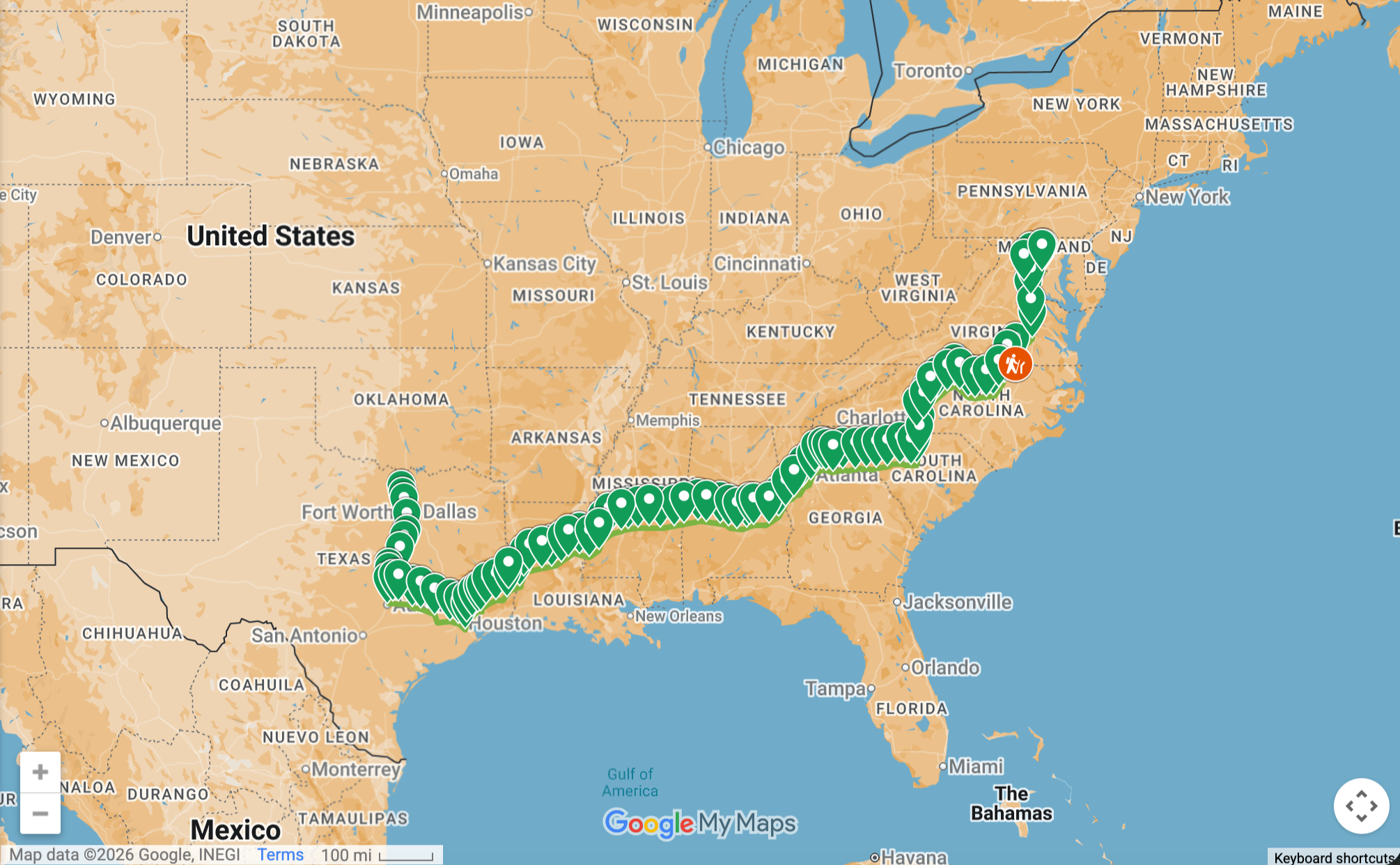
Image courtesy of Google Maps
The venerable monk who leads the pilgrimage, Bhikkhu Pannakara, is young, joyful, and charismatic. He carries a quiet gravity — an aura of holiness that people seem to recognize immediately. I have watched women and men of all ages approach him slowly, some with tears in their eyes, asking for a blessing, and then step away visibly lighter, as if something heavy has been finally set down.
The rhythm of the pilgrimage is simple and demanding. The monks rise before dawn and walk in silence through the early morning hours. They break before noon, often welcomed by a local church, civic group or community center. Food is offered freely — bread, fruit, warm meals for the road.
Short teachings follow: Simple reflections on forgiveness, compassion, joy, healing, and mindful awareness of the present moment. Then the monks walk again until sundown, when another host takes them in. No evening meal during their fast.
As I watch their live feed day after day, I see people standing bundled in coats and scarves, waiting patiently in cold and snow just to catch a glimpse. I see spiritually hungry strangers hoping for a blessing — for themselves, for loved ones, for healing. I see volunteers offering hot drinks, food, and quiet gratitude.
I see the monks respond with gentle words and attentive silence. Walking faithfully alongside them is Aloka, padding through slush and snow, a small and joyful reminder that peace can walk on four legs.
The monks’ teachings are never complicated. One recent reflection on forgiveness has stayed with me. Forgiveness, they explained, is not forgetting harm or denying pain, but choosing not to carry hatred forward. It is releasing what poisons us so that healing can begin. Watching people receive that teaching — some nodding, some weeping — I was struck by how rarely such wisdom is offered in public without argument, blame, or agenda.
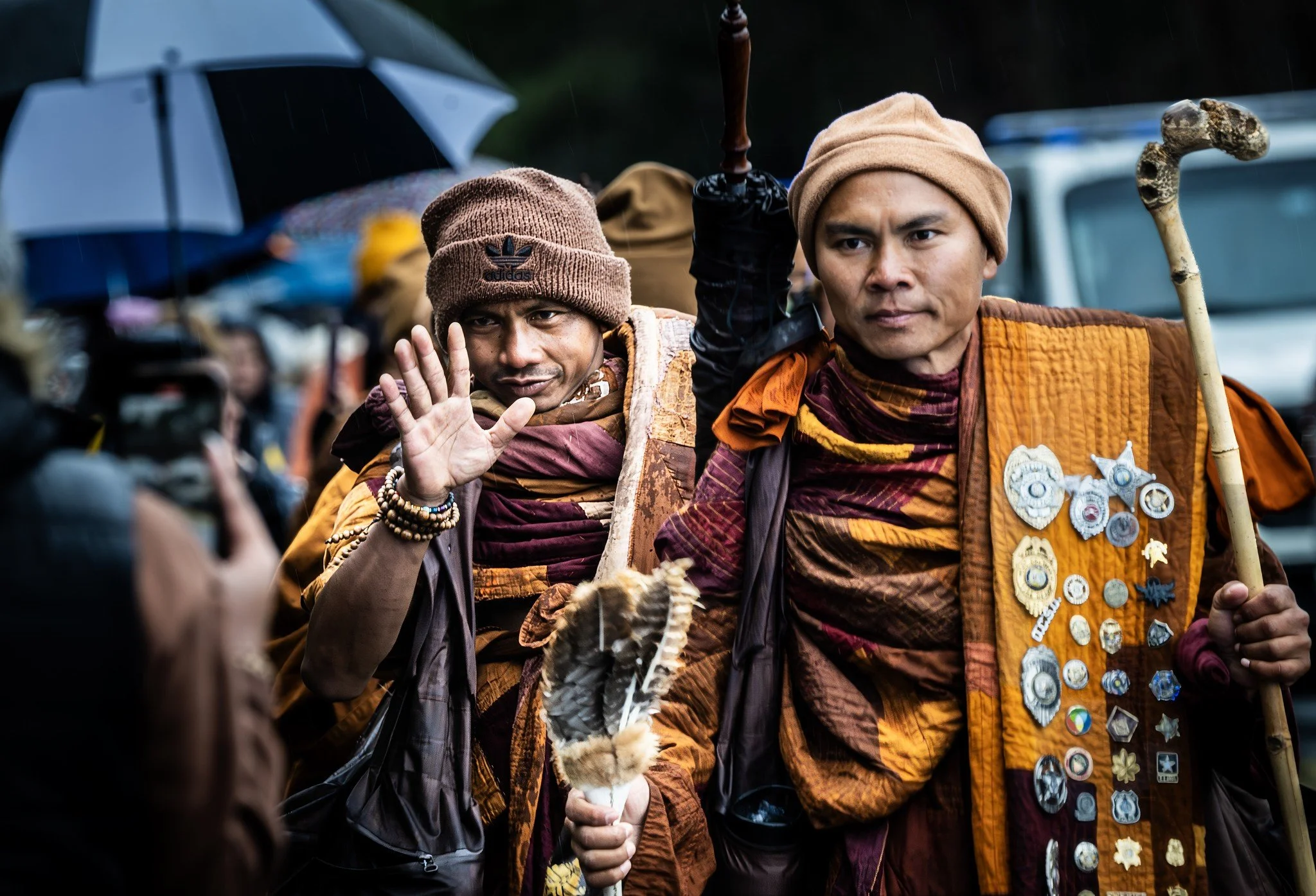
Buddhist monks walking in silence, carrying a powerful message of peace and mindfulness. (Handout photo)
Another short practical teaching I heard one day from the Venerable Pannakara was on how to get better sleep: “Please put down your smartphone an hour before bedtime. If you don’t, you are cheating on your partner ...”
After a light giggle, he added, “Let the mind rest. Come back to the breath.”
He said that when your phone is the last thing you touch at night, the mind remains agitated. Sleep, he taught, is not merely physical recovery but a continuation of practice. Setting the phone aside is therefore an act of non-attachment, a way of allowing the body to settle and the mind to return home.
“Peace begins simply,” he concluded, “when we know how to stop and sleep.”
Some may say I’ve become obsessed with following these peace pilgrims on social media. But peace scrolling is better than doom strolling. I prefer to think God may be up to something — doing a “new thing” in the world right now — and I don’t want to miss it.
What we are witnessing is not politics or social protest. Not public policy or propaganda. It is virtue made visible. Peace practiced rather than pronounced. Compassion offered without condition or agenda.
Watching these venerable monks walk the talk, I am not encountering something alien to my tradition. I am seeing a family resemblance: faith on the move, social holiness, spiritual discipline embodied publicly. The best of the Methodist spirit in saffron robes.
As a Methodist minister, I am grateful for the Buddhist monks — to be reminded, through this unexpected witness, that peace walks, grace moves, and holiness takes hold in those who are ready to receive it.
These venerable monks are making an unmistakable spiritual impression in America — in a dark time, across faith traditions, and among many who claim no religion at all.
Perhaps we need to wait and see what fruit this pilgrimage bears. Perhaps God is at work here, walking slowly among us.
Rev. Michael J. Christensen, Ph.D. is an ordained minister in the United Methodist Church, a professor of Theology at Northwind Seminary, and author of C.S. Lewis on Scripture and other books Christian faith and practice.