
800 Years After St. Francis Of Assisi’s Death, His Story Gets A Vivid New Restoration
(ANALYSIS) There is a certain irony in the fact that the frescoes now being celebrated as a revelation were, for roughly 250 years, considered not worth looking at. When 18th-century’s tastemakers judged Giotto’s “Stories of St. Francis” as outdated, they didn't simply neglect them — they whitewashed over them with lime, treating some of the most consequential paintings in art history as decor in need of updating.
That the works have now reemerged, freshly restored and recently unveiled ahead of the 800th anniversary of St. Francis's death. It is as much a story about the fragility of cultural memory as it is about art conservation.
The frescoes, painted in the Bardi Chapel of Florence’s Basilica of Santa Croce between 1317 and 1325, occupy a major place in Christian art relative to their physical footprint. Giotto is routinely credited as the artist who broke decisively from the flat conventions of Byzantine-influenced medieval painting and introduced something recognizably modern: Figures with weight and volume, faces capable of conveying lots of emotion and compositions that used architectural space to give viewers meaning.
READ: Keep An Eye Out For London’s ‘Church Watchers’
Calling Giotto one of the greatest European artists ever isn’t hyperbolic so much as a fairly literal description of the artistic lineage that followed him. Indeed, without Giotto’s innovations in the early 14th century, the pictorial language later perfected by Michelangelo and the rest of the Renaissance simply wouldn’t develop the way it did.
What makes this restoration effort so significant isn’t just that it returned the frescoes to public view. It has returned the artwork closer to Giotto’s actual intentions, which had been obscured by centuries of accumulated damage and clumsy intervention. A restoration that merely cleans a surface is maintenance, but this work allowed scholars to better interpret the figures that were previously flattened by grime and old varnish is closer to recovery — an uncovering of the artist’s original argument about how a painted scene should function.
The restoration’s own history reads almost like a case study in how not to treat historical artwork, followed by a corrective. The 18th-century whitewashing was standard practice for an era that considered pre-Renaissance paintings crude. The 1851 removal of that whitewash — undertaken while the chapel was being prepared for redecoration — damaged the frescoes further in the process of trying to reveal them. It’s a reminder that good intentions and adequate technique are not the same thing.
Emanuela Daffra, superintendent of the Opificio delle Pietre Dure, told The Associated Press that the restoration removed layers of film that allow people today to better see the figures represented and other details.
“Today, we can clearly interpret the gazes,” she said. “He knew how to orchestrate them within spaces that emphasized the meaning of the scenes.”
The famed basilica is one of the largest Franciscan churches in the world. It also houses the tombs of Michelangelo, Galileo and Machiavelli.
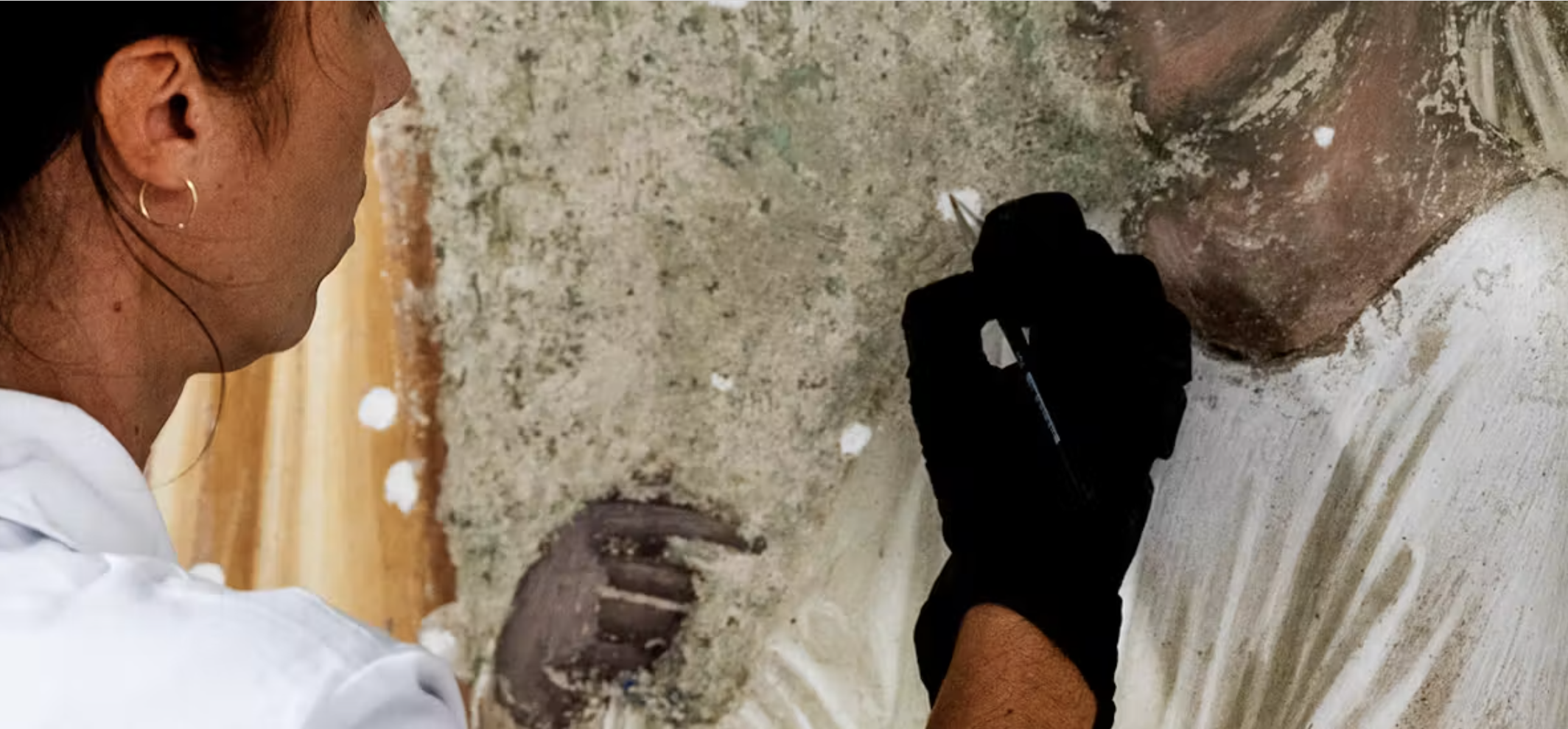
Restoration of Giotto’s frescoes inside Florence’s Bardi Chapel cost upwards of $1.5 million. (Basilica of Santa Croce)
A round of mid-20th-century decisions followed, adding its own layer of alterations before conservators finally arrived, in 2022, with a fundamentally different tools: Ground-penetrating radar, thermal imaging and laser scanning capable of generating a full 3D model of the chapel without ever touching the plaster. The gap between 1851’s damage-inducing cleanup and 2022’s non-invasive diagnostic imaging says as much about the evolution of conservation science as anything about Giotto himself.
There’s also something worth noting in how the project was funded. The Bardi family, who originally commissioned the work, were among the wealthiest banking dynasties in Europe at the time. The 21st-century equivalent is quite different: Roughly 250 private donors contributing a combined $800,000 towards the $1.5 million total cost. That shift, from a single dynastic patron to a distributed network of donors, mirrors a broader change in how cultural heritage gets preserved today.
The timing of the unveiling — arriving just before the 800th anniversary of Francis's death on Oct. 4 — adds a layer of resonance that goes beyond art history. The frescoes were never simply aesthetic objects. They were designed as devotional images and meant to show viewers in the key episodes of the saint’s life, from his renunciation of worldly wealth to his legendary offer to walk through fire to convert the Sultan of Egypt.
Restoring the clarity of these scenes at this particular anniversary means visitors aren’t just seeing a technically superior restoration; they're encountering the images closer to how their original 14th-century audience would have read them, at a moment explicitly designed to invite that kind of reflection on Francis’ life and legacy.
Clemente Lisi serves as executive editor at Religion Unplugged.