
From Unfinished Icon To Sacred Landmark: Barcelona’s Sagrada Familia Enters Final Chapter
(ANALYSIS) Barcelona’s Sagrada Família has spent more than a century as Christianity’s most famous unfinished church. Tower cranes have long hovered above Antoni Gaudí’s masterpiece like permanent fixtures in the skyline, reminders the basilica existed in a constant state of construction.
When Pope Leo XIV inaugurates the Tower of Jesus Christ during his visit to Spain from June 6-10, the narrative surrounding this immense basilica will fundamentally change. The ceremony marks more than the completion of its central tower. It signals the start of the end of one of the most ambitious religious construction projects in modern history.
The Vatican had announced that Leo XIV will visit to Spain, stopping in Madrid, Barcelona and the Canary Islands. While the trip includes meetings with political leaders and a tour a migrant reception center — a nod to Pope Francis’ longstanding concern for refugees — the spiritual and cultural centerpiece will undoubtedly be the pope’s appearance at the Sagrada Família on June 10, marking the 100th anniversary of Gaudí’s death.
READ: Why 2 Saints Are At The Center Of A Church-State Legal Battle
There, the pope will celebrate Mass and formally inaugurate the towering central structure that now defines the basilica’s silhouette.
The Tower of Jesus Christ has already transformed Barcelona’s skyline. Installed in February, the structure finally brought the basilica to the height Gaudí originally envisioned more than a century ago. Famously, the architect designed it to stand slightly lower than Montjuïc hill because he believed no human creation should surpass God’s natural work.
Yet despite reaching its intended height, the basilica remains unfinished. Construction, which started in 1882, continues in several areas, including the massive Glory Façade, which has generated debate because of the urban redesign it could require in the surrounding neighborhood. Still, the completion of the central tower changes the meaning of the overall project itself.
For generations, the unfinished nature of the Sagrada Família became inseparable from its identity. Tourists marveled not only at Gaudí’s architectural style and Christian imagery, but also at the notion that they were witnessing a cathedral still under construction. The building became a metaphor for faith, patience and artistic ambition all rolled into one.
For much of its existence, the basilica represented incompletion. Construction delays caused by war, financial hardship and technical challenges turned the church into an emblem of perseverance. Gaudí himself embraced the slow pace, famously remarking, “My client is not in a hurry,” in a reference to God.
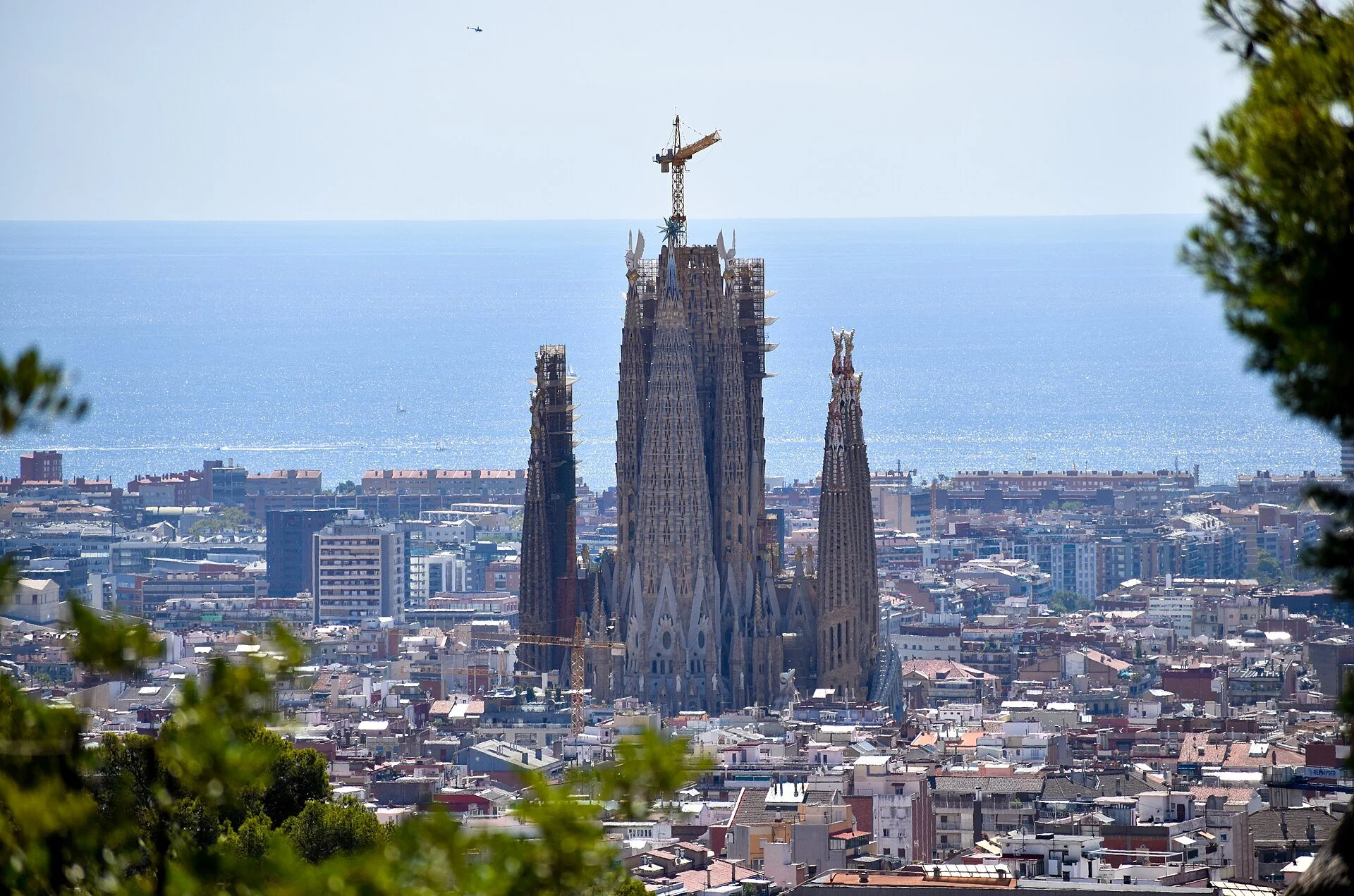
A view of Sagrada Familia in Barcelona. (Wikipedia Commons photo)
An act of devotion
Now the conversation is shifting from whether the basilica can ever be completed to what completion will actually mean. That question carries with it a series of theological questions as well as architectural importance.
Gaudí conceived the basilica as an act of devotion. Every column and tower was designed to communicate Christianity through stone, light and geometry. The central Tower of Jesus Christ serves as the theological apex of that vision — the vertical axis around which the entire basilica centers. Its completion therefore represents not merely an engineering achievement, but the realization of the building’s symbolic center.
When Pope Benedict XVI consecrated the Sagrada Família in 2010, he elevated the basilica from an extraordinary construction project to a sacred space fully dedicated to worship. Leo’s inauguration of the central tower builds upon that legacy by effectively endorsing the ongoing effort to finish Gaudí’s masterpiece.
That endorsement matters because the project has not been without controversy. Critics have argued that modern-day architects cannot truly complete Gaudí’s vision because so much of his original work was destroyed during the Spanish Civil War. Others question whether modern engineering techniques remain faithful to an architect whose methods relied heavily on handcrafted models.
Defenders of the project, meanwhile, have countered that cathedrals have always evolved across generations. Medieval churches routinely changed during construction as architects adapted plans to new technologies, budgets and artistic realties. In that sense, the Sagrada Família is participating in a deeply Catholic architectural tradition: The notion that sacred spaces are living works shaped over centuries by successive hands.
Current chief architect Jordi Faulí has repeatedly framed the work not as reinvention, but as interpretation — an effort to complete the basilica according to Gaudí’s spiritual and artistic principles. The Vatican’s involvement strengthens that claim.
As a result, organizers have planned 31 commemorative activities between 2025 and Christmas 2026. More than 4,000 people are expected to attend the papal Mass inside the basilica, while thousands more will gather outside to watch the ceremony on large screens.
The scale of the celebration alone reflects an awareness that the Sagrada Família is entering a new chapter.
Clemente Lisi serves as executive editor at Religion Unplugged.