
📖 Preacher, Educator, Coach: 5 Life Lessons From A Hoops Legend 🔌

Weekend Plug-in 🔌
Editor’s note: Every Friday, “Weekend Plug-in” meets readers at the intersection of faith and news. Click to join nearly 10,000 subscribers who get this column delivered straight to their inbox. Got feedback or ideas? Email Bobby Ross Jr.
ANN ARBOR, Mich. — My amazing friend Garth Pleasant texted me a few months ago.
“Bobby, I can get tickets for the Oklahoma game,” he informed me. “Are you in?”
Let’s see: Pleasant’s Michigan Wolverines vs. my Oklahoma Sooners at the Big House on a picture-perfect Saturday in September.
Of course I was in!
So I made the 1,000-mile journey from my home in Oklahoma City and joined the crowd of 111,240 — including Pleasant, his son Klint and our friend Randy Harris from Abilene, Texas — who witnessed last Saturday’s battle of college football blue bloods at Michigan Stadium.
Regular readers may recall my 2024 column on Pleasant, a legendary small-college basketball coach who won 720 games and four national championships in 38 seasons at Rochester Christian University, north of Detroit.
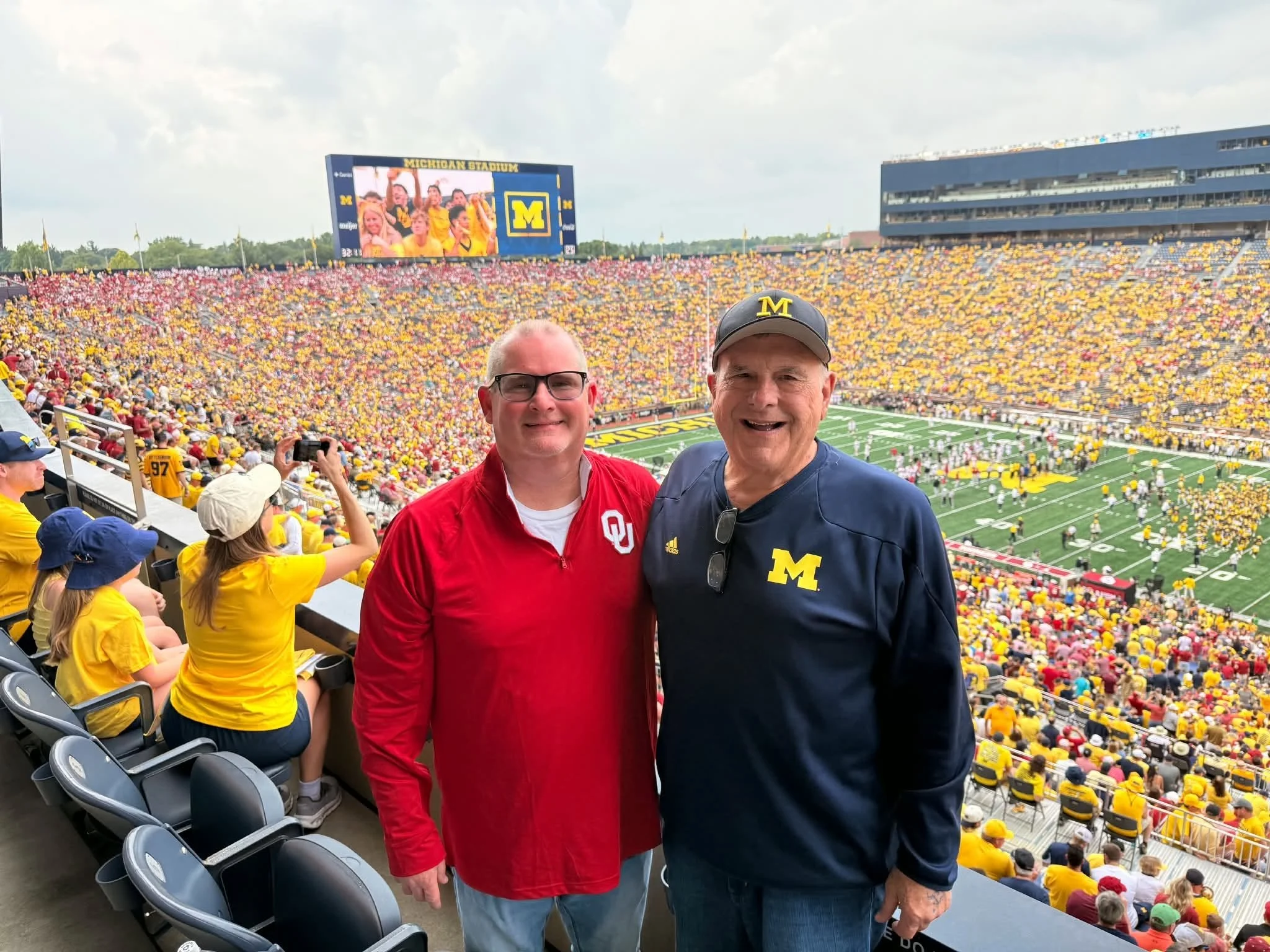
Bobby Ross Jr. and Garth Pleasant at the Oklahoma-Michigan game at Michigan Stadium. (Photo by Randy Harris)
I love spending time with Pleasant — who was featured in the documentary “COACH: Make the Big Time Where You’re At” — and soaking in his simple wisdom.
While hanging out with me last weekend, he indulged my request to share life lessons from his 77 years on planet Earth.
To make it easier, I asked him to reflect on five roles where he’s excelled:
1. As a preacher
This past Sunday, I got to hear Pleasant deliver his next-to-last sermon as a regular minister.
After a half-century in various pulpits, he’s retiring this weekend as the preacher for the Horton Road Church of Christ in Jackson, Michigan, and moving to Florida with Pat, his wife of 55 years.
“I don’t consider myself a theologian,” Pleasant stressed to me. “I don’t have a master’s in theology or anything like that.”
Which is why he found it strange when he heard a prominent biblical scholar encourage ministers to leave congregants wondering, “What in the world did he just say?”
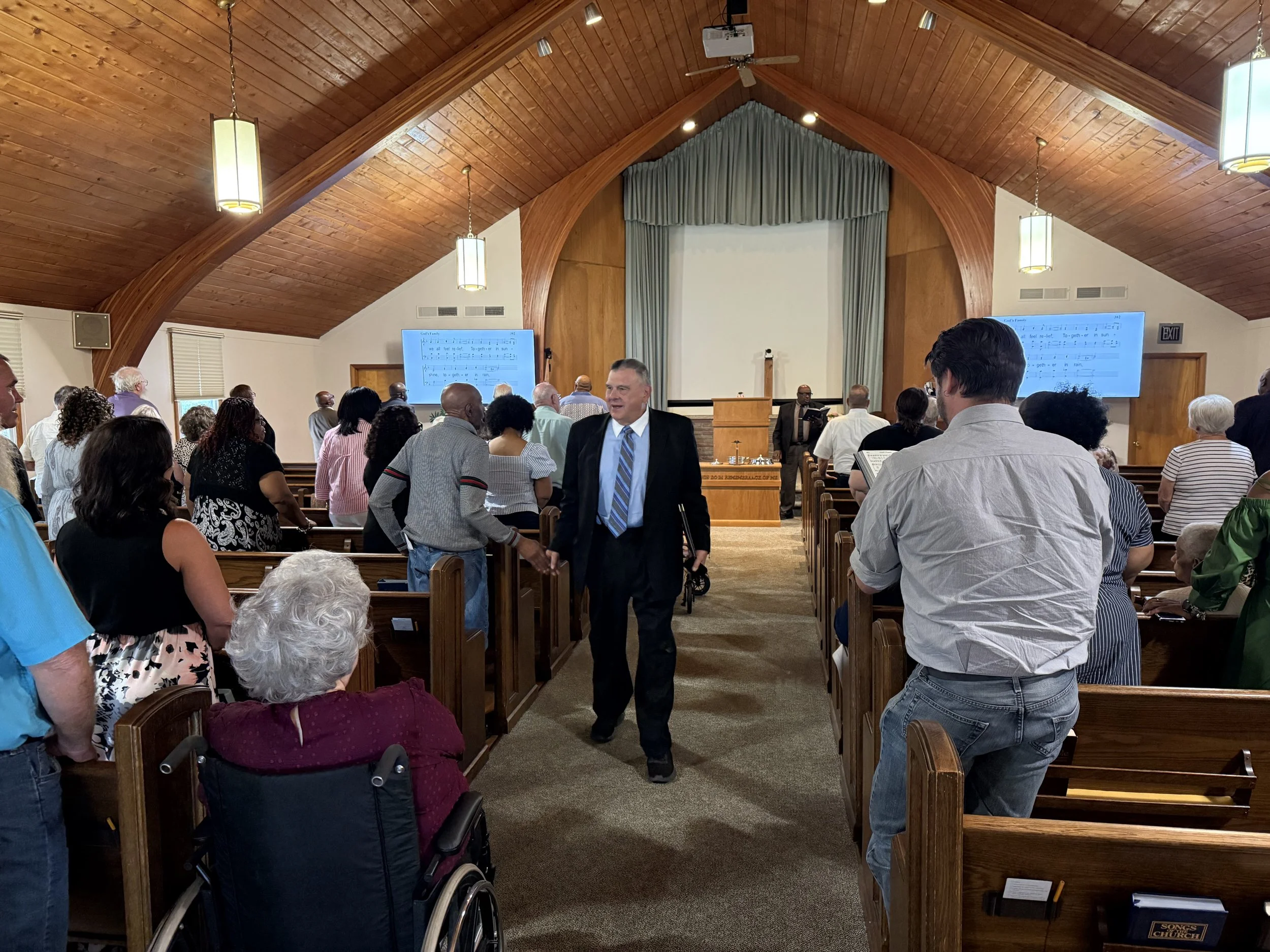
Garth Pleasant to the back of the auditorium after preaching Sunday at the Horton Road Church of Christ in Jackson, Michigan. (Photo by Bobby Ross Jr.)
“So there was a question-and-answer period, and I raised my hand,” Pleasant recalled. “I can’t believe I did it.”
But he took issue with the scholar’s advice, noting his own situation at the time:
“I said, ‘I’m in the pulpit, and I’ve got this husband and wife to my left whose son is incarcerated in Texas. And then back here to the left is a lady with her two young boys whose husband just left her. And over here to my right, I have a mother and a father and a daughter, and the daughter is dying of brain cancer. Why do I want them to go home thinking, “What in the world did he say?”’
RELATED: Small-College Coach Garth Pleasant Never Made Excuses — And He Became A Legend
“I always said, ‘I’m preaching to myself.’ I tried to talk on topics that I thought people might be struggling with. I’m really bad at exegesis, and that’s probably because of not being trained. I always tried to begin with a story that led into the sermon. I always tried to have a little humor and make a point that would help people with what they were going through. I didn’t want to go over people’s heads.”
2. As an educator
For about 50 years, Pleasant taught courses at Rochester — formerly known as Michigan Christian College — in areas such as sports and society, and principles and practices of sports administration.
“First of all, I’ve loved the classroom,” he told me. “I love the classroom more than anything in education.
“Somebody told me recently that they were in a class, and when they got to the final exam, the instructor really hadn’t covered anything. He said, ‘Just read my book.’”
Pleasant, on the other hand, focused more on interpersonal communication and experiences — such as field trips to explore sports arena management — than lectures and book learning.
“First of all, I was always there before anybody else was there, and I was always singing some crazy song,” he said. “And then I tried to make my class where students wanted to learn. Like, in my principles and practices class, I spent a lot of time on critical thinking. I feel like (too often) in education, we don’t teach kids the critical thinking — we indoctrinate them.”
3. As a coach
“You have to understand, coaching has changed dramatically from when I started to what it is now,” Pleasant emphasized. “I used to run drills that I would not run at the end of my coaching career. I had the NBA — No Babies Allowed. It was a brutal drill. At the end, I didn’t run that.”
He changed, too, in the enforcement of his “Don’t come to practice late” mantra:
“A boy came late to practice, and I said, ‘Leave.’ He said, ‘But coach.’ I said, ‘Leave.’ Well, he came in late because his dad had a heart attack, and he had to take him to the hospital. Now, do you think I changed my philosophy? Yeah, I changed my philosophy.
“I (originally) was a coach who was a dictator. I became a coach who let players get involved and things like that. Now, that happened gradually.”
One thing stayed the same: Coaching was always about more than basketball:
“I said, ‘I’d rather be with all of you in heaven and not win national championships than win national championships and not be with one of you.’ I always tried to teach lessons. I didn’t allow profanity.
“I also never quit learning. There was a high school girls’ program that was tremendous at 3-point shooting. I went over to their practice and watched their 3-point drills. Another girls’ team was great at defense. They had a great coach, and I’d go over and watch his drills.
“Even at the end, I went to a coaching clinic. And I walked out, and there was a young kid that was in his second year of coaching. I said to him, ‘You learning a lot?’ He said, ‘Nah, I know most of this stuff.’ And I had taken copious notes. But, you know, I was probably like him my second year of coaching.”
4. As a family man
“Basketball never came before my family,” the husband, father and grandfather said.
That focus was part of why he coached at Rochester Christian for four decades and never pursued fame or accolades at a larger, more prestigious university.
“I took my family with me,” Pleasant said of out-of-town games. “My boys rode on the bus with me. I’d get them out of school, and it was a family affair. Wins should not come before your family. Now, I was in a position where I probably wasn’t going to get fired if I didn’t win. That’s why it was such a great job.
“And then, don’t take out your frustrations of the game on your family. I walked in the house one day after a tough loss, and I yelled at my daughter. So then (after that) I had a bush at our house that was my whooping bush. And I took everything out on the bush before I went in the house.”
“I have too many friends in coaching who climbed the ladder of success, but they don’t have their family.”
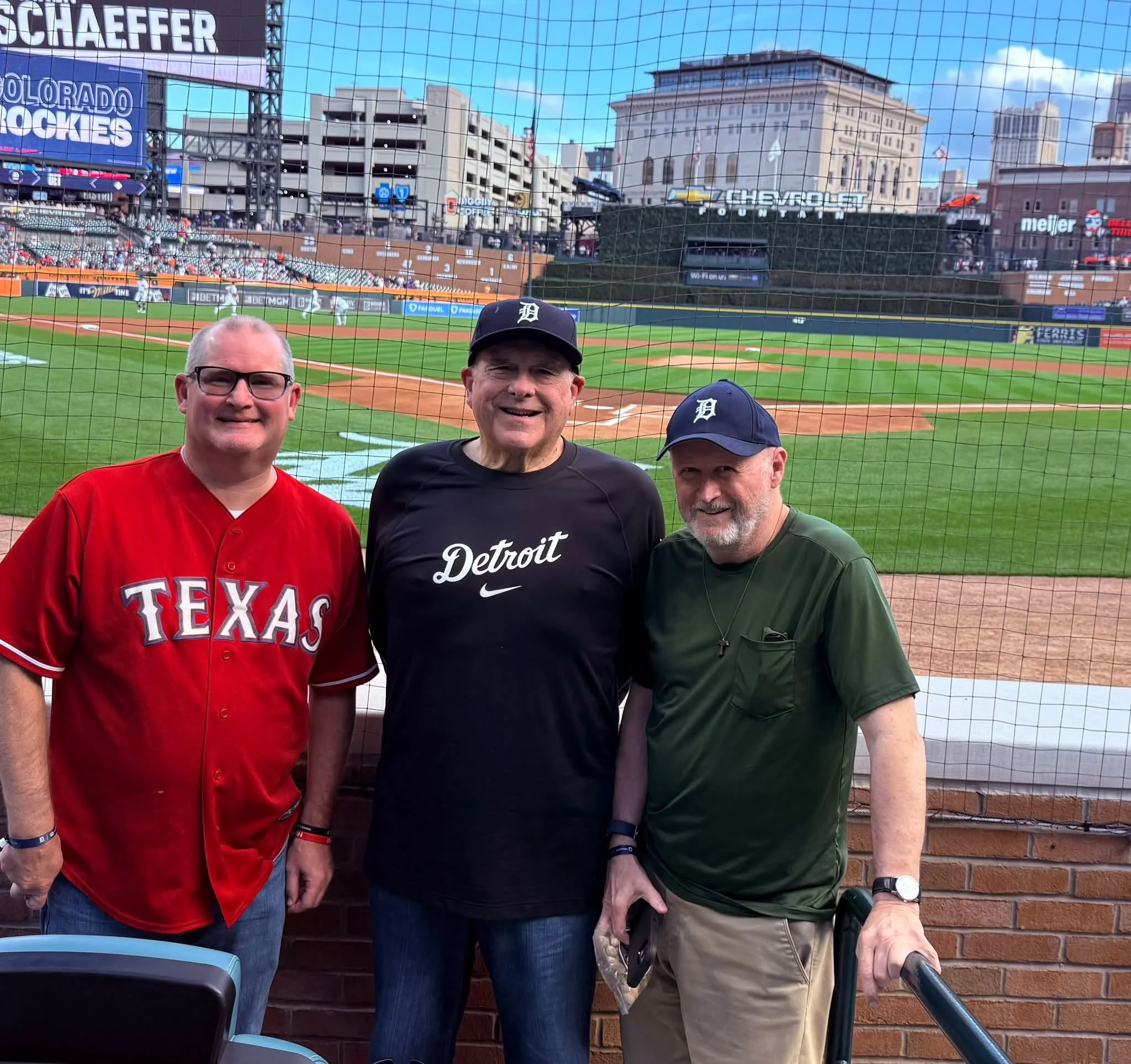
Bobby Ross Jr., Garth Pleasant and Randy Harris at Friday night’s Rockies-Tigers game at Comerica Park in Detroit. (Photo provided by Bobby Ross Jr.)
5. As a sports fan
I didn’t include this one just so I could mention that — besides the Oklahoma-Michigan tickets — Pleasant snagged us seats two rows behind home plate at last Friday night’s Detroit Tigers game.
I mean, that wasn’t the only reason.
As a young man, Pleasant remembered, he’d take his favorite teams’ wins and losses too seriously.
“I was a Michigan fan, and it would kill me — it seemed like every year they lost one game they shouldn’t have lost,” he told me. “You can probably empathize with that.”
RELATED: A Pitch To Follow Jesus: Baseball Fans Embrace Players’ Faith Testimonies
Yes, after my friend’s Wolverines defeated my Sooners, 17-10, I definitely understood what he was saying.
But Pleasant has mellowed in his sports fandom.
“I think it’s an age thing,” he said. “Sometimes I might just watch half the game. I turned on Texas and Ohio State (on Saturday night), and at the end of the first quarter, I switched to ‘Little House on the Prairie.’”
I know a few Buckeyes fans who might wish they’d done the same.
Inside The Godbeat
In last week’s column, I recounted the 9/11 experiences of Religion Unplugged’s editors and contributors.
After I filed my piece, Associated Press religion writer Peter Smith shared his 25th anniversary memories with me:
I was working for the Courier-Journal in Louisville, Kentucky. That morning, I had planned to cover a presbytery meeting, but I headed into the office instead once the news of the attacks came in. I recall the shock and the sickening feeling as the enormity of the attacks became clear.
I interviewed clergy and others from various faith communities, who were wrestling with a range of issues — rage, grief, the desire for vengeance, the questioning of why God would allow such an attack. I went to at least one vigil, at the Catholic Cathedral of the Assumption in Louisville. ‘It’s hard to know what to do and say,’ the archbishop said, and that seemed to sum up a lot of reactions.
Several of my colleagues attended other services in the region and sent me feeds for an article rounding up religious reactions to the attacks. The vigils were packed with people looking for solace, or at least to be in community with others.
The days and weeks to come were busy covering various religious angles on the post-9/11 world, but those are some of my memories of working on that day.
Thank you, Peter!
In case you missed it, check out all of Religion Unplugged’s 9/11 anniversary coverage.

Religion writers Peter Smith, Frank Lockwood and Bob Smietana pose for a photo earlier this year while covering the Southern Baptist Convention’s annual meeting in Orlando, Florida. (Photo provided by Bob Smietana)
The Final Plug
In a special report for Religion Unplugged, Maddy Fry and Kate Salmon go inside an unconventional Anabaptist group’s “third way” Christianity.
Kudos to them as well as illustrator Andrea Levy, executive editor Clemente Lisi and project manager and designer Cassidy Grom for a fantastic story and presentation.
Happy Friday, everyone! Enjoy the weekend.
Bobby Ross Jr. writes the Weekend Plug-in column for Religion Unplugged and serves as editor-in-chief of The Christian Chronicle. A former religion writer for The Associated Press and The Oklahoman, Ross has reported from all 50 states and 20 nations. He has covered religion since 1999.