
Are Americans Hearing More About Politics From The Pulpit?
Christian rhetoric and Biblical references — whether used out of context or in good faith (or sometimes both) — have become a regular part of U.S. local and national political discourse.
However, is the reverse true? Are churchgoers hearing about political issues from the pulpit?
A new Pew Research study released Wednesday shows that at least some political messages emerge during sermons or formal teaching from clergy, but most churchgoers aren’t aware of their clergy’s political leanings.
READ: New Study Shows Christians Trust AI For Their Spiritual Growth
The survey included people of all faiths, but there were not enough responses from Jews, Hindus, Muslims and other religious minorities to be properly analyzed, Pew said.
Two-thirds of U.S. churchgoing adults said they’ve heard their clergy speak about one political or social issue in the past few months. Abortion, Israel and homosexuality were the most common topics.
The clergy’s perceived political leanings were mixed. Clergy appeared to be more likely to speak out against abortion (30%) and homosexuality (20%) in line with traditional conservative values, but speak in support of welcoming immigrants (15%) and protecting the environment (15%), which many consider more liberal values.
U.S. churches have long been community cornerstones, allowing others to find politically like-minded people and rally for causes they find connected to their religious values.
Leaders and congregants from Black churches were essential to the Civil Rights Movement in the 1960s. In more recent decades, conservative churches have deeply supported the anti-abortion movement by volunteering to stop patients at abortion clinics, organizing rallies and funding anti-abortion centers.
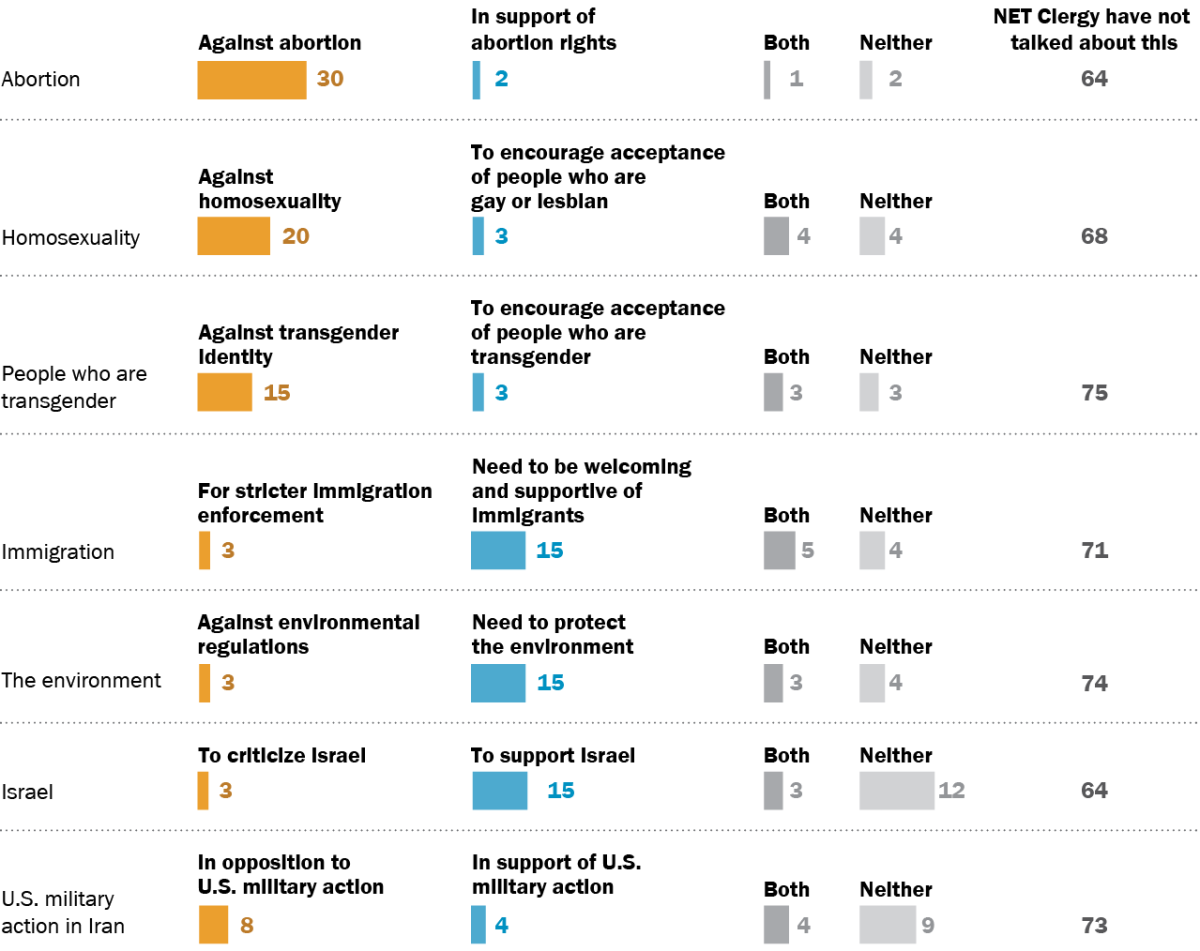
Chart courtesy of Pew Research Center
A post-Johnson Amendment world
Congregants had more leeway to organize among themselves, but for many decades, clergy walked a finer line. As part of their tax-exempt status under the Johnson Amendment, clergy, when representing their church or organization, were free to discuss political and moral issues from the pulpit, but had to stop short of endorsing candidates or campaigning on their behalf.
The Johnson Amendment has been put to the test in recent years, with President Donald Trump’s administration arguing that houses of worship should be able to endorse political candidates to their congregations without risking losing their tax-exempt status.
For now, the Johnson Amendment is still technically in place, but it is unclear whether the IRS, under the Trump Administration, would actually enforce any penalties for infractions.
It’s common for churches, especially large, influential ones and those in swing districts, to host politicians as guest speakers during campaign season. Some politicians choose to announce their run for office at large gatherings at other religious non-profits, as Ted Cruz did at Liberty University, where he announced his 2016 presidential run.
Whether influenced by the Johnson Amendment or simply because they decided not to mix politics with Sunday service or mass, most clergy appear to only tiptoe into political waters. According to the survey, the majority of churchgoing members say clergy have not mentioned any of the topics Pew asked about, including US military action in Iran, homosexuality, and the environment.
There are some nuances: Among all Christian groups, Catholics and white evangelical Protestants are most likely to hear about abortion from the pulpit; Catholics are most likely to hear immigration discussed in their church; and white evangelicals are the least likely to hear about the environment.
As for the men and women who serve as clergy, according to their congregants, their personal political leanings remain either mixed or elusive. On average, 44% of regular church attenders weren’t sure about their clergy’s political affiliation.
Cassidy Grom is the managing editor of Religion Unplugged. Her award-winning reporting and digital design work have appeared in numerous publications.