
Spain’s Historic Church Sex Abuse Compensation Marks First Step Toward Reparation
The left-wing Spanish government and the country’s Catholic Church recently signed a historic agreement to compensate victims of sexual abuse committed by members of the clergy.
The arrangement concerns time-barred cases or cases where the perpetrator is deceased and comes after years of reluctance and a lack of transparency from the church hierarchy.
“This was a very difficult deal to reach,” said Juan Cuatrecasas, from the Associació Infància Robada (Stolen Childhood Association), an organization that helps victims of sexual abuse. “The church is an institution that has spent decades covering up pedophiles and even sheltering them within its ranks. It is thanks to pressure from the Vatican and the Spanish government that this agreement was reached.”
READ: Religious Freedom Faces Growing Pressures Worldwide
Spanish victims of sexual abuse will be able to request compensation directly through an administrative mechanism, without going through the courts. The Catholic Church has committed to contributing financially to this compensation, while the Spanish government will oversee the process to ensure fairness.
“The damage is irreparable, but we can do everything we can to alleviate the immense suffering endured,” said Fernando García Salmones, who was sexually abused by a religious education teacher and spiritual advisor. Salmones was only 14 years old and was going to the Claretian Missionaries of Madrid.
“He abused me for a year. He raped me. He made me feel guilty and forced me to come back every day under the threat of telling my parents everything. I endured it all and felt guilty. He kept telling me: ‘Look what you’re making me do!’ [and] to shift the blame onto the child. At 14, you don’t understand that it isn’t your fault.”
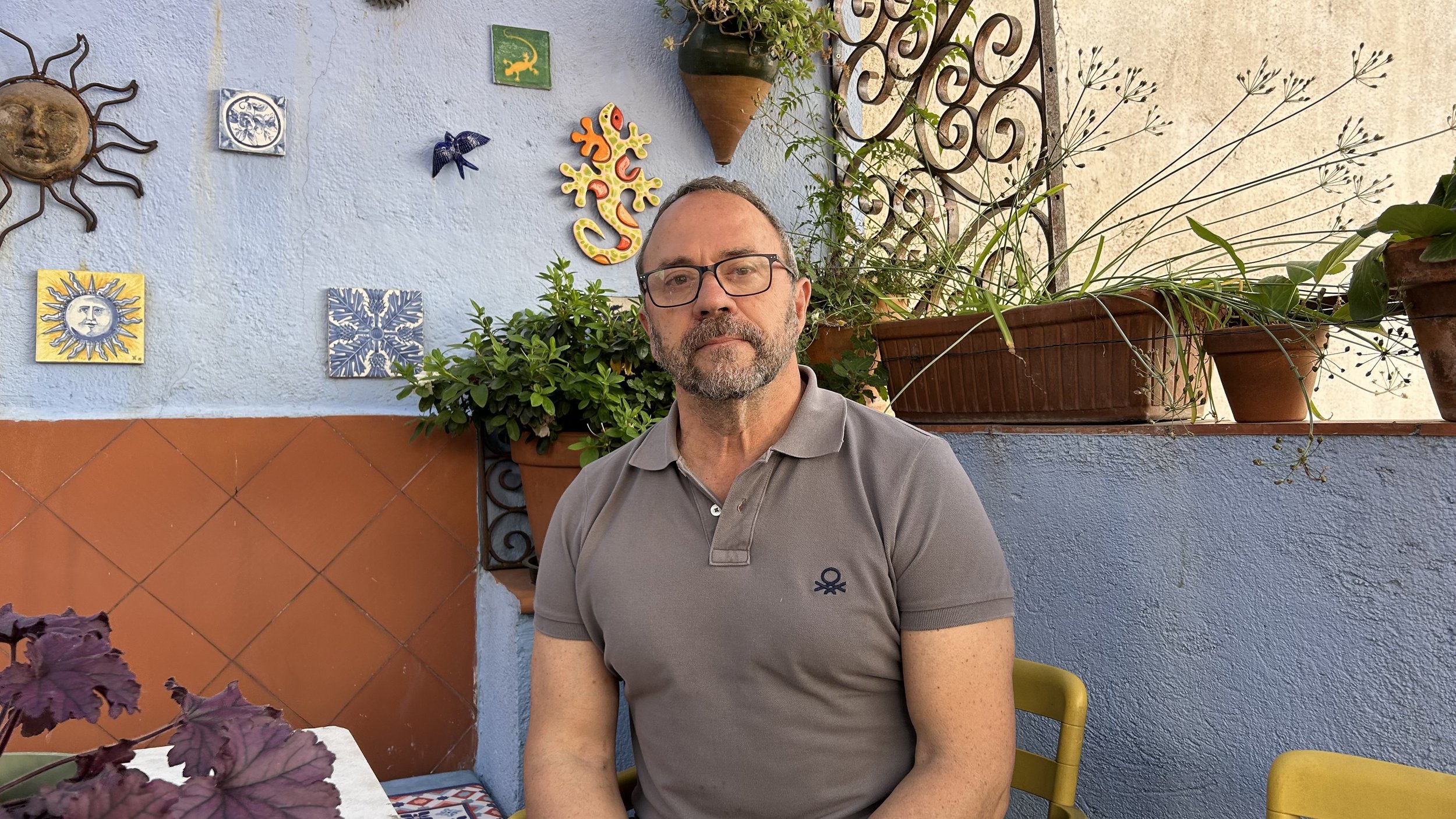
Fernando García Salmones was sexually abused by a religious education teacher and spiritual advisor at age 14. (Photo by Romain Chauvet)
Many victims come forward
“This is a positive agreement because it stems from the demands made by victims’ associations,” said Ciro Molina, a victim of sexual abuse made by a parish priest in his town in Tenerife, in the Canary Islands.
Molina — only 9 years old at the time — said, “We focus a lot on compensation or financial reparation, but I believe this goes far beyond that; it will allow many victims to feel believed for the first time in their lives.”
Molina said that when he reported these abuses, he was subsequently harassed.
“I was a victim of what I call psychological intimidation: threatening phone calls to my home and ostracism from my friends at church,” said Molina, 37. “This entire process of revictimization that occurs after reporting abuse is extremely painful.” Since then, post-traumatic stress has never left him. “I’ve had suicidal thoughts, constant self-loathing, and above all, now, a lot of anxiety.”
In a report published in 2023, the Spanish Ombudsman estimated that since 1940, more than 200,000 minors may have suffered sexual abuse at the hands of Catholic clergy. The figure would rise to 400,000 if abuse committed by laypeople in religious settings were included. For its part, the church commissioned an audit by a law firm that identified at least 2,056 victims.
“The church’s strategy has always been to buy time, to let perpetrators and their accomplices die, and to let victims, like us, suffer mental exhaustion until we give up, drained both physically and psychologically,” Molina said. “It’s extremely painful because not only are you not helped or supported, but you’re also blamed, pointed at, and condemned to oblivion simply for denouncing a priest who abused children.”
Spanish churches have been rocked by the clergy sex abuse scandal in recent years. (Unsplash photo)
A pioneering agreement?
The arrangement marks an attempt to confront a systemic pattern of abuse and institutional silence that has persisted for decades.
“A deal between three parties — the Ministry of Justice, the ombudsman and the church — is, I believe, unprecedented; it has never happened before,” said Cuatrecasas, adding that more than 300 applications have already been filed in just a few weeks since the agreement was signed.
Compensation will be assessed on a case-by-case basis through a procedure involving the government, the church and the Spanish Ombudsman. At the end of this consultation process, the State will make the final decision. Despite its historic scope, critics argue that the agreement leaves key questions unanswered, particularly regarding transparency and institutional accountability.
“The ombudsman should establish specific scales for cases of child sexual abuse in all areas of society,” Cuatrecasas said. “It would also be desirable for an institution that, for decades — and this as an objective and proven fact—has covered up such crimes.”
Even if the agreement is welcomed as a first step in the right direction, much work remains to be done, according to some victims.
“Moral redress should also be considered,” Molina explained. “This could take the form of a public apology, sanctions against these priests, and access to documents and archives that are not publicly accessible.”
Salmones is calling for major changes within the church, arguing that accountability must go beyond financial compensation.
“Abusers must go to prison, there should be a reevaluation of celibacy in the church, and education should no longer be the responsibility of the church,” he said. “I’m fighting to ensure that this never happens to anyone again.”
Romain Chauvet is a French-Canadian journalist based in Madrid.