
🚨 ‘Predictable As Original Sin’: In San Diego, Hate Targets Another House Of Worship 🔌
Weekend Plug-in 🔌
Editor’s note: Every Friday, “Weekend Plug-in” meets readers at the intersection of faith and news. Click to join nearly 10,000 subscribers who get this column delivered straight to their inbox. Got feedback or ideas? Email Bobby Ross Jr.
• • •
Jeff Cohen heard the news while at work: Two teenage shooters had opened fire on a mosque and slain three men — including the Islamic Center of San Diego’s security guard.
Once again, an attack linked to hate had targeted a house of worship.
“It’s just another one of these, and they’re as predictable as original sin, as my old mentor used to say,” Cohen said of Monday’s violence by gunmen who died of self-inflicted wounds a few blocks from the mosque.
The Texas engineer speaks from personal experience.
On Jan. 15, 2022, he survived a hostage standoff at his Reform Jewish synagogue in the Fort Worth suburb of Colleyville. The 10-hour ordeal ended when Cohen and two other remaining hostages escaped, and the FBI’s tactical team gunned down the pistol-wielding captor.
“Literally, it made me sick to my stomach,” Cohen said of the San Diego attack, more than 1,300 miles from his office. “It brings back everything.”
The Los Angeles Times reports:
The gunmen who killed three people at the San Diego Islamic Center left behind a 75-page document that preached hate, anti-Islam ideology and antisemitism and promoted violence and chaos, law enforcement sources familiar with the investigation told The Times.
The manifesto was titled “The New Crusade: Sons of Tarrant” and made reference to Brenton Tarrant, who killed 51 people and injured 89 more in an attack on a mosque and an Islamic center in Christchurch, New Zealand, in 2019, according to the sources. The FBI confirmed Tuesday that it is examining a manifesto, but did not verify the one circulating online that purports to be the attackers’ writings.
The victims in San Diego were Muslim.
The captives at Congregation Beth Israel — the congregation where Cohen now leads the security committee — were Jewish.
But in each case, the culprits spewed hate.
Cohen blames the anti-Muslim sentiment and antisemitism alike that are so prevalent in 21st century political discourse.
“It’s these tropes. It’s this rhetoric,” he said. “This is what happens when people who are a little bit unhinged already … hear this from their leaders, or from people they trust, over and over again. We can’t let this continue.”
• • •
IN THE WAKE of the San Diego attack, the focus turns — once again — to protecting houses of worship.
This coverage from last October by the Deseret News’ Mariya Manzhos remains relevant:
Violence that targets houses of worship can force faith leaders to grapple with a delicate balance — protecting congregations while also making sure churches, synagogues and mosques remain open and welcoming.
Some religious leaders have been reassessing their safety protocols — or introducing them for the first time — by training staff and volunteers, and weighing whether safety measures like metal detectors, expanded camera systems or firearms belong inside sacred spaces.
Should faith communities invest in measures once reserved for government buildings and airports?
These questions have gained new urgency after the recent attack on a meetinghouse of The Church of Jesus Christ of Latter-day Saints in Grand Blanc, Michigan, that left four people dead; a stabbing outside a synagogue that killed two in Manchester, England; and a fire set to a mosque in East Sussex.
Still pertinent, too, is this 2025 report by Religion News Service’s Jack Jenkins. When a mass shooting claimed two children’s lives at a Catholic church in Minneapolis, Jenkins delved into security firms, seeing an influx of interest from faith groups.
After Monday’s killings, the Council on American-Islamic Relations, a Muslim civil rights and advocacy group, urged police nationwide to step up security at mosques.
“This horrific terror attack is the deadly consequence of years of anti-Muslim hate, demonization and dangerous rhetoric targeting American Muslims and other marginalized communities,” Nihad Awad, CAIR’s national executive director, said in a statement.
“Mosques and Islamic institutions across the country are facing heightened threats, and local law enforcement agencies must act immediately to increase patrols and coordinate with community leaders to help protect worshipers,” Awad added. “We also urge elected officials and public figures to stop fueling hatred and division that inevitably inspire acts of violence.”
In the nation’s capital, Religion News Service’s Yonat Shimron notes:
Amid increasing attacks on U.S. Jews and institutions, two U.S. senators introduced a sweeping, bipartisan bill on Tuesday (May 19) aimed at combating antisemitism.
But the Jewish American Security Act, if passed, could also help other religious institutions. Its key provision is a $1 billion investment in security resources for the federal Nonprofit Security Grant Program, which is open to all faiths. That program is currently funded at about $300 million annually.
Authorities said the San Diego victims — including Amin Abdullah, who worked at the mosque as a security guard for a decade — died while saving roughly 140 children who were in the building.
Also killed, according to The Associated Press, were Nadir Awad, 57, and Mansour Kaziha, 78, who was known as Abu Ezz.
“We call them our brothers in the community,” Imam Taha Hassane said in the AP story. “We call them our martyrs and our heroes.”
• • •
NEARLY 4½ YEARS after surviving the hostage standoff at his synagogue, Cohen emphasizes the importance of situational awareness training for individuals as well as institutions.
“There’s no hyperbole here,” Cohen said. “The training that I had gotten before the event saved our lives. Period.
“I mean, I knew what to do,” he added. “The reason we escaped is because I and others prepared to run. … When Rabbi Charlie (Cytron-Walker) threw the chair … he didn’t do so with the idea of hitting this guy on the head and knocking him out, so we could hogtie him and be superheroes. That’s not what it’s about.
“It’s much closer to the old Lynyrd Skynyrd song ‘Gimme Three Steps.’ Well, throwing that chair — that gave us three steps, and we were out the door, because throughout the day we had moved closer to the door.”
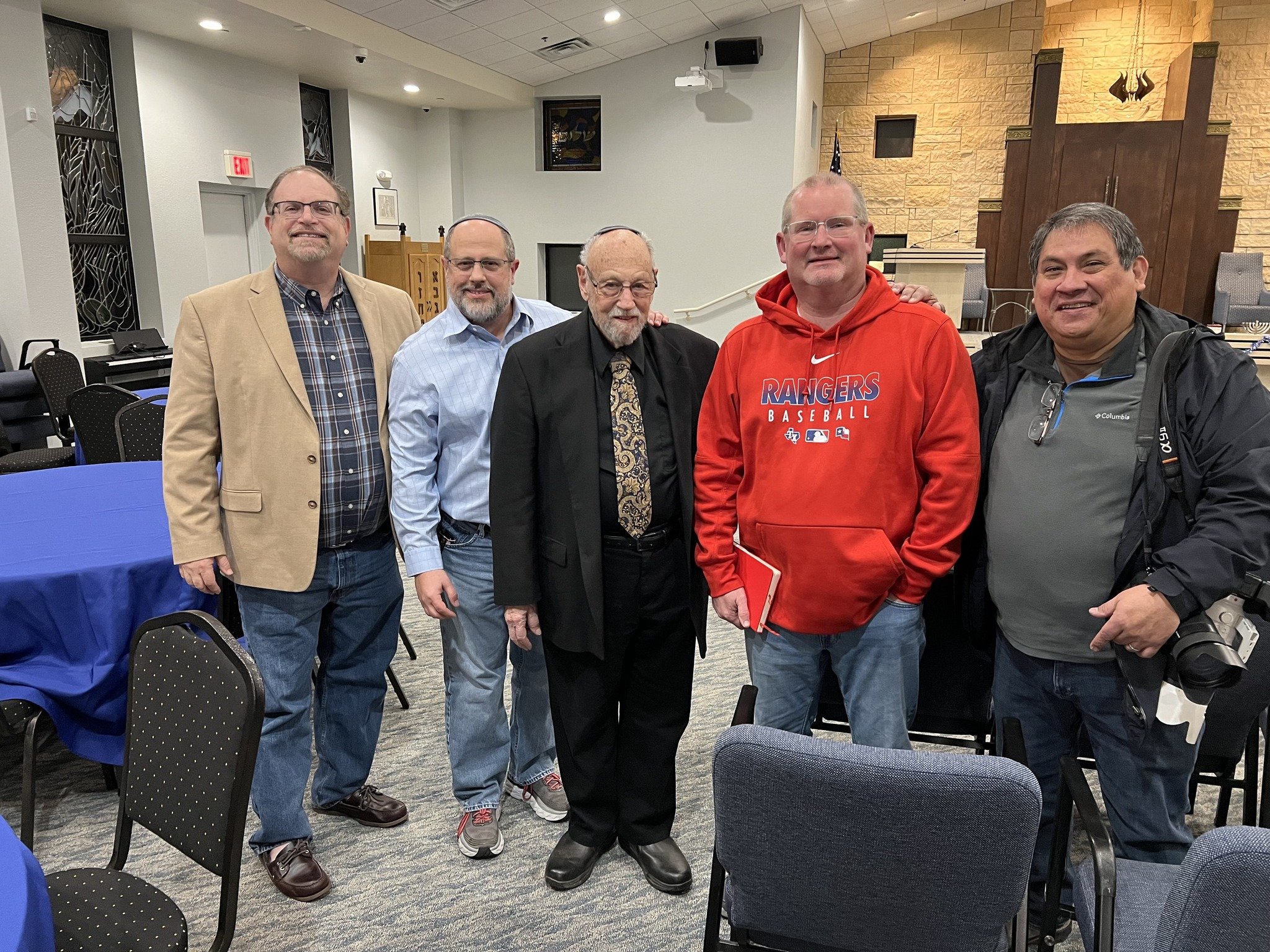
Jeff Cohen, Shane Woodward and Lawrence Schwartz — who survived a hostage standoff at their Texas synagogue — pose for a 2022 photo with Bobby Ross Jr. and Associated Press photographer Tony Gutierrez. (Photo provided by Bobby Ross Jr.)
Cohen’s bottom line: “I don’t care if you’re Catholic or Protestant or Unitarian Universalist or Muslim or Jew, you need this training, and you need to have your organization do this training.”
Congregation Beth Israel had security precautions in place before the 2022 standoff, but strengthened them afterward.
No longer can anyone enter the synagogue without encountering a security officer.
No longer can anyone bring in a bag without facing questions.
“If I don’t know you, I’m going to ask to look in your bag,” Cohen said. “And we’re going to tell people, ‘We’d rather you kept your bag locked in your trunk.’ But if you’ve got to bring it in — like a diaper bag — well, we’re going to lock it in the office.”
• • •
IN THE NOT-SO-DISTANT past, Cohen and other Jews developed relationships with Muslims in North Texas.
The two groups built bridges despite differences in their faiths.
“I’m sorry,” Cohen said as he reflected on that time. “I’m a little emotional on this one.”
That’s because the Jews and Muslims he knows aren’t close like they used to be.
“Unfortunately, due to a lot of the rhetoric that happened around the Arab-Israeli wars, a lot of that fell apart,” he said. “I mean, accusing all Jews of genocide — or even, really, Israel of genocide — when it’s not a genocide but a war after an attack, that’s a problem.”
Still, in light of the San Diego tragedy, he’s reaching out to Muslims he knows.
He has a message for them.
“In times of — I don’t know — sadness, distress,” Cohen said, “I want them to know we’re here. We’re still friends. We can disagree, but we’re here.”
Inside The Godbeat
Religion Unplugged has published multiple stories this week on the San Diego mosque attack.
Executive editor Clemente Lisi explains how the deaths “highlighted the rise in Islamophobia that has spread across the United States over the last few years.”
Via a Religion Unplugged media partner, Anisah Bagasra writes for The Conversation on “how online hate contributes to Islamophobia.”
The Final Plug
I use a lot of em dashes — yes, I do — and I don’t apologize for it.
Even if that might get me accused of using artificial intelligence to help me write.
But here’s the deal: I’m old. I don’t know how to use AI to help me write. I don’t intend to learn.
However, I did chuckle when reading this quote in a recent Wall Street Journal story about writers going to extremes to prove they didn’t use AI:
“I was reading the Bible the other day, and there were em dashes in the book of James, and I was like, hmm, is this AI-generated?,” Johnson said. “And it’s just funny, of course, no — good writers do this, so chill out.”
On a more serious note, check out Religion Unplugged’s AI policy.
Happy Friday, everyone! Enjoy the weekend.
Bobby Ross Jr. writes the Weekend Plug-in column for Religion Unplugged and serves as editor-in-chief of The Christian Chronicle. A former religion writer for The Associated Press and The Oklahoman, Ross has reported from all 50 states and 20 nations. He has covered religion since 1999.