
Young Urban Pastors More Likely To Use AI
As the prevalence of artificial intelligence grows in the broader culture, some within the church are skeptical of downloading AI into the ministry.
Both U.S. Protestant pastors and churchgoers have a mixed view of artificial intelligence, according to a Lifeway Research study. They aren’t completely opposed to it, but they have concerns about how AI is implemented and its potential influence on Christianity.
“Caution is an instinctive reaction to new things, and pastors and churchgoers share some concerns around AI,” said Scott McConnell, executive director of Lifeway Research. “The majority of younger churchgoers would welcome hearing biblical principles applied to AI in a sermon to help them shape their perspective on it.”
Pastors’ practice
Less than half of U.S. Protestant pastors say they are using AI, but fewer are actively avoiding or ignoring the technology.
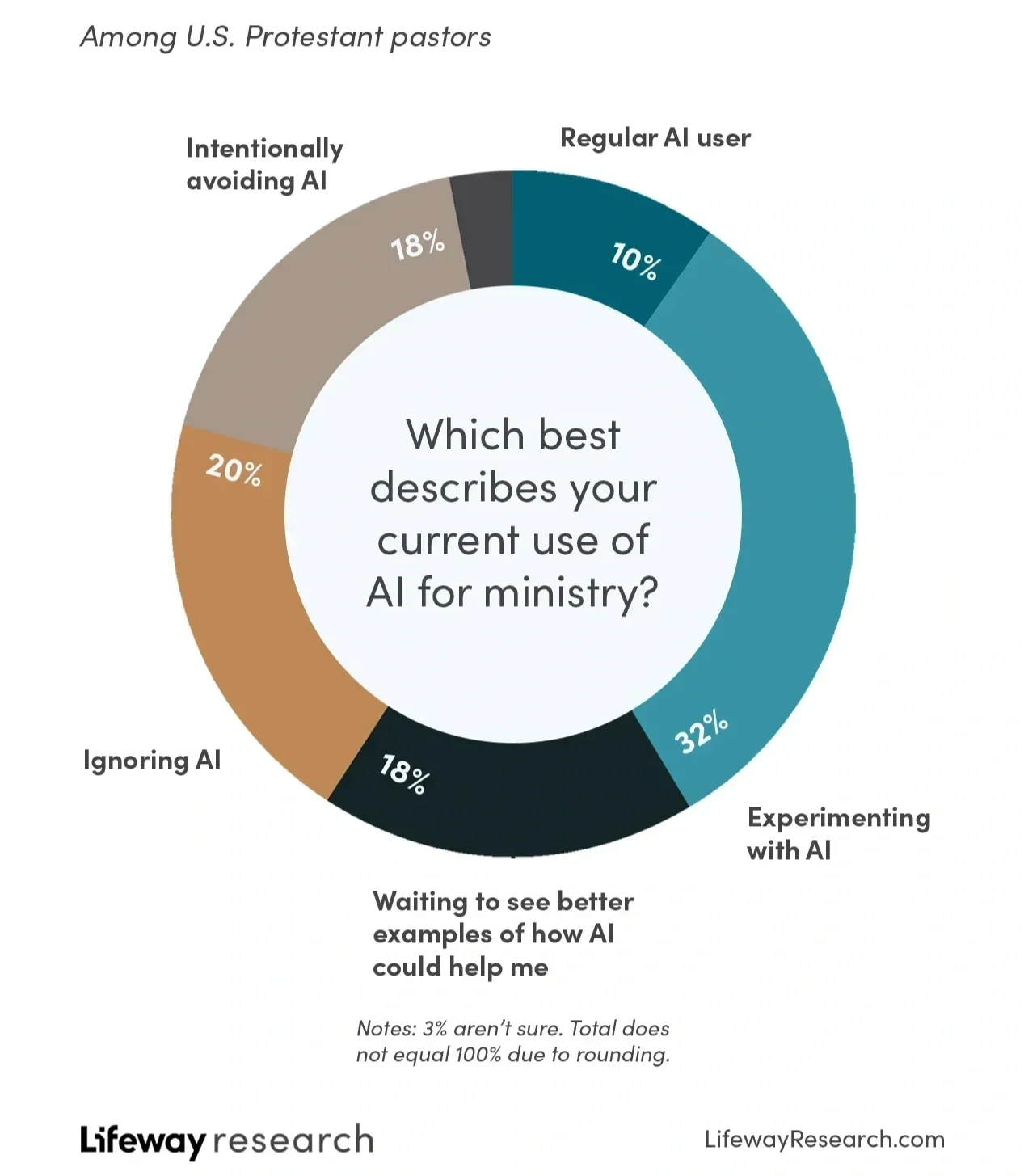
One in 10 pastors (10%) say they are regular users of artificial intelligence, while a third (32%) are experimenting with it. Almost one in six (18%) say they are waiting to see better examples of how AI could help them.
On the other end of the AI adoption spectrum, close to two in five pastors are either intentionally avoiding it (18%) or simply ignoring artificial intelligence (20%).
“AI is embedded in many tools we use every day, so some pastors may be using AI technology without even knowing they are,” said McConnell. “Pastors’ use of AI for ministry reflects a typical spread of technology adoption with a few avid users and plenty testing it out in different ways.”
In general, younger pastors, those in urban settings, those with more formal education and those leading larger churches are more likely to be AI adopters.
Pastors ages 18 to 44 (40%) and those 45 to 54 (37%) are more likely than those 65 and older (23%) to say they are experimenting with AI. Meanwhile, those 65 and older (4%) are the least likely to say they are a regular user of artificial intelligence.
Those at churches in an urban area are more likely than those in rural areas to say they are regular users of AI (11% vs. 5%), while those at rural churches are more likely than those at urban churches to say they are ignoring the technology (27% vs. 18%).
Pastors with a master’s (10%) or doctoral degree (14%) are more likely than those with no college degree (5%) to say they are regular users of AI. Those without a college degree (25%) are among the most likely to say they are ignoring it.
Denominationally, Lutherans and Baptists are the most skeptical of AI, while Holiness pastors are among the most likely to be adopters.
Lutherans and Baptists are among the most likely to say they are ignoring it (22% each) and intentionally avoiding it (24% and 20% respectively). Holiness pastors are among the most likely to say they are experimenting with AI (43%) and are regular users (18%).
Pastors of congregations with 250 or more in attendance are among the most likely to say they are experimenting with AI (43%) and are regular users (15%). Those at churches with fewer than 50 are the most likely to say they are ignoring the technology (28%).
Pastors’ perspective
Even with most pastors either being current users of artificial intelligence or open to it in the future, almost all U.S. Protestant pastors have some clear concerns about implementing the technology in their work.
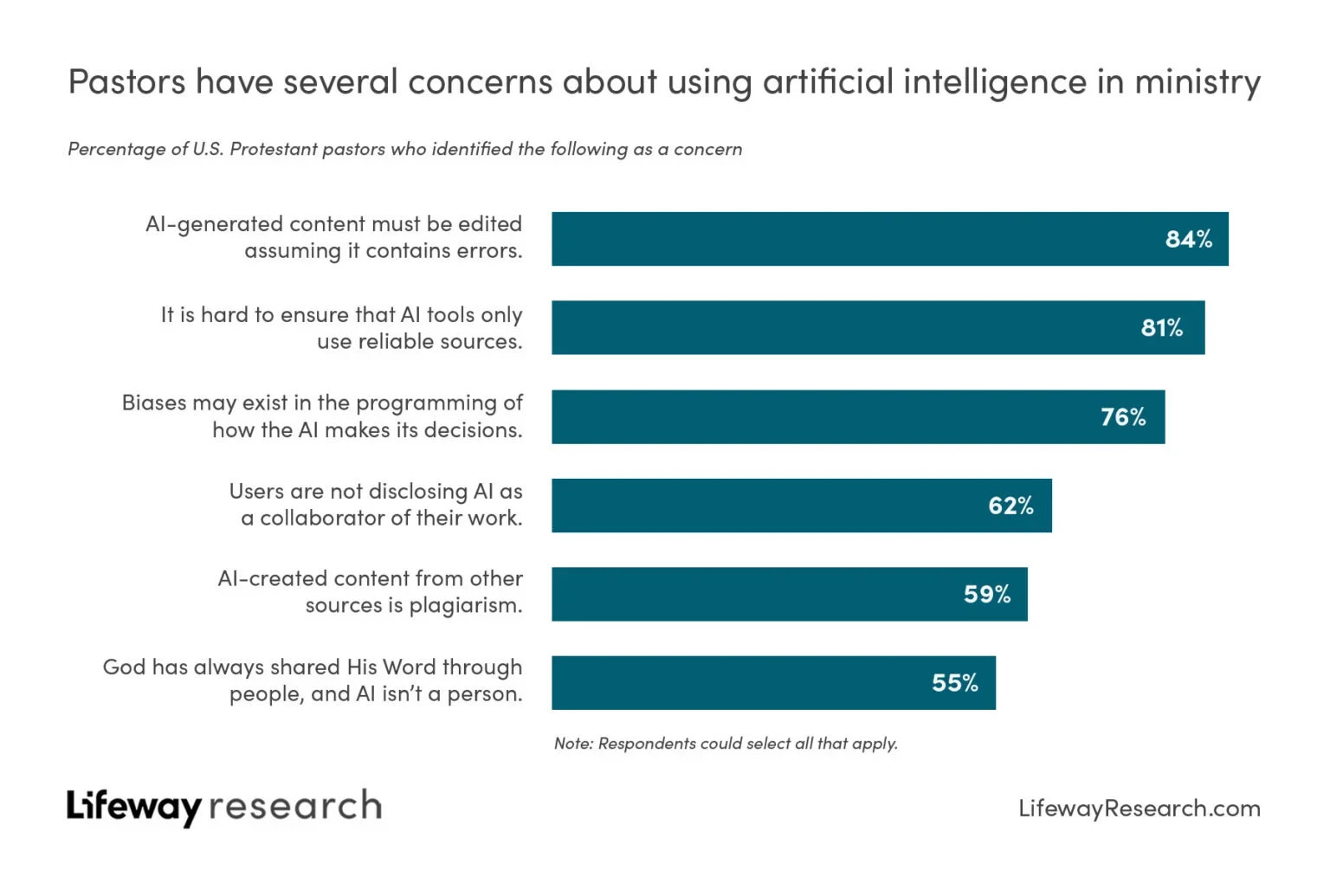
When presented with six potential issues with using AI tools in their ministry, most pastors are concerned about each.
More than four in five pastors say they’re worried AI-generated content must be edited, assuming it contains errors (84%). A similar percentage (81%) believe it is hard to ensure AI tools only use reliable sources. Three in 4 (76%) say biases may exist in the programming of how the AI makes its decisions.
Three in five (62%) worry AI users are not disclosing the technology as a collaborator in their work. Slightly fewer say they’re concerned AI-created content from other sources is plagiarism (59%) and God has always shared His Word through people, and AI isn’t a person (55%).
Few (4%) say none of these or that they aren’t sure (1%).
“Pastors’ highest concerns are tied to how trustworthy AI’s information is, but the majority of pastors are also concerned with honesty in the use of AI content and potential weakening of personhood especially in handling God’s Word,” said McConnell.
Evangelical pastors are more likely than their mainline counterparts to raise concerns about God sharing His Word through people and AI not being a person (58% vs. 51%). Meanwhile, mainline clergy are more likely than evangelical pastors to worry about AI-created content from other sources being plagiarism (65% vs. 56%).
Churchgoers’ confusion
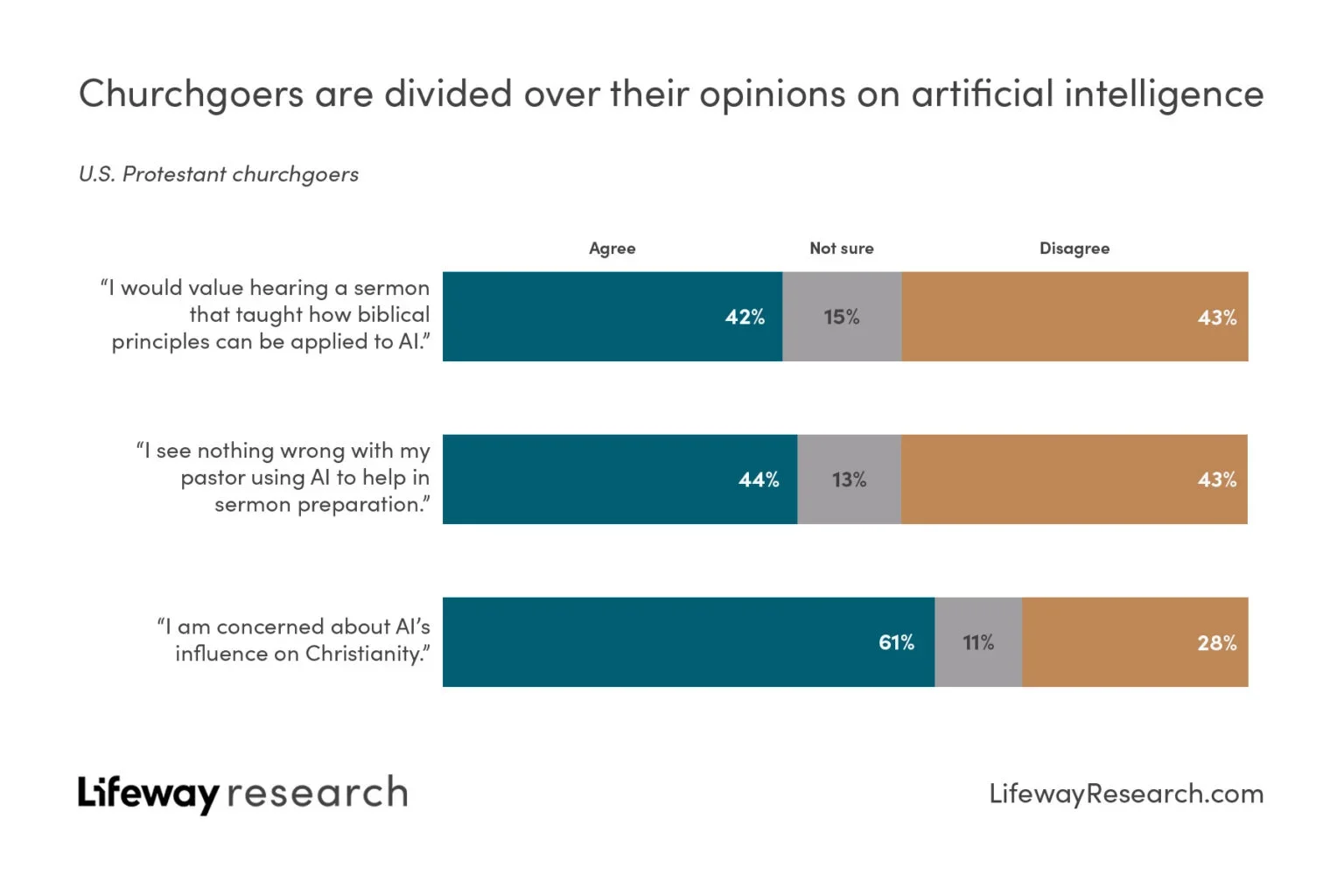
U.S. Protestant churchgoers are split over AI and sermons. Pastors won’t find a consensus among churchgoers on using artificial intelligence to help with sermon preparation. More than two in five (44%) don’t see anything wrong with pastors using it in sermon prep, but 43% disagree, including 24% who do so strongly. Around one in eight (13%) aren’t sure.
Those who attend less frequently, one to three times a month, are more likely than those who attend four times a month or more to support AI-assisted sermon prep (48% vs. 42%). Churchgoers without evangelical beliefs are also more likely than those with such beliefs to be supportive (49% vs. 40%).
Not only are churchgoers divided on hearing a sermon prepared with the help of AI, but they’re also divided on hearing a sermon about AI. While 42% would value a sermon about applying biblical principles to AI, 43% disagree, including 25% who strongly disagree. Almost one in seven (15%) aren’t sure.
Younger churchgoers are most likely to find this beneficial. Those 18 to 29 (50%) and 30 to 49 (53%) are more likely than those 50 to 64 (38%) and 65 and older (33%) to say they would value hearing a sermon that taught how biblical principles can be applied to artificial intelligence.
“Churchgoers are evenly split on whether it is right or wrong to use AI in sermon preparation. While only a quarter strongly reject this use, more than five in six have some pause on whether pastors should have a free pass on its use. The caution may be from a desire to limit its use to certain activities or from not yet giving its morality much thought,” said McConnell.
Churchgoers’ concerns
U.S. Protestant churchgoers find consensus in their AI concerns. Three in five (61%) say they’re concerned about the technology’s influence on Christianity. Fewer than three in 10 (28%) disagree, while 11% aren’t sure.
Churchgoers with evangelical beliefs are more likely than those without such beliefs to express concern (67% vs. 55%). Baptists (62%) and Presbyterian/Reformed churchgoers (64%) are more likely than Methodists (48%) to have those worries.
On the other end, men are more likely than women to disagree and say they aren’t concerned (31% vs. 25%). Middle-aged churchgoers, those 30 to 49 (33%) and 50 to 64 (29%), are more likely than those 65 and older (23%) to disagree.
Additionally, those who attend one to three times a month are more likely than those who attend more frequently to say they don’t have concerns about AI’s influence on Christianity (31% vs. 26%).
“While both the availability and use of AI are spreading rapidly, several surveys have shown many Americans have concerns about it. Churchgoers are no exception as they think of its influence on Christianity,” said McConnell. “Just as every new technology requires some investigation to use it well, Christians have the opportunity to investigate AI’s uses biblically.”
For more information on the study, view the complete pastors report and churchgoers report.
Aaron Earls is the senior writer at Lifeway Research.