
Pastors Back Legal Immigration, But Split On Enforcement
Pastors overwhelmingly view legal immigration positively but are more divided over the proper response to those who are in the United States illegally.
Additionally, U.S. Protestant pastors say they favor a path to citizenship for certain undocumented individuals but want to see border security increased, according to a Lifeway Research study sponsored by World Relief.
“This new study confirms what we’ve found anecdotally as we partner with churches across the United States,” said Myal Greene, president and CEO of World Relief. “Pastors nearly universally believe legal immigration has been a blessing to the country and to the church. As churches have been directly affected by immigration enforcement over the past year, pastors affirm the need for secure borders and deportation of those convicted of violent crimes, but they want to see more humane, family-unity protecting alternatives for other categories of immigrants.”
Priorities and perspectives
Pastors want an approach to immigration that balances a secure border and respect for the law with respect for the individuals affected and a pathway to citizenship.
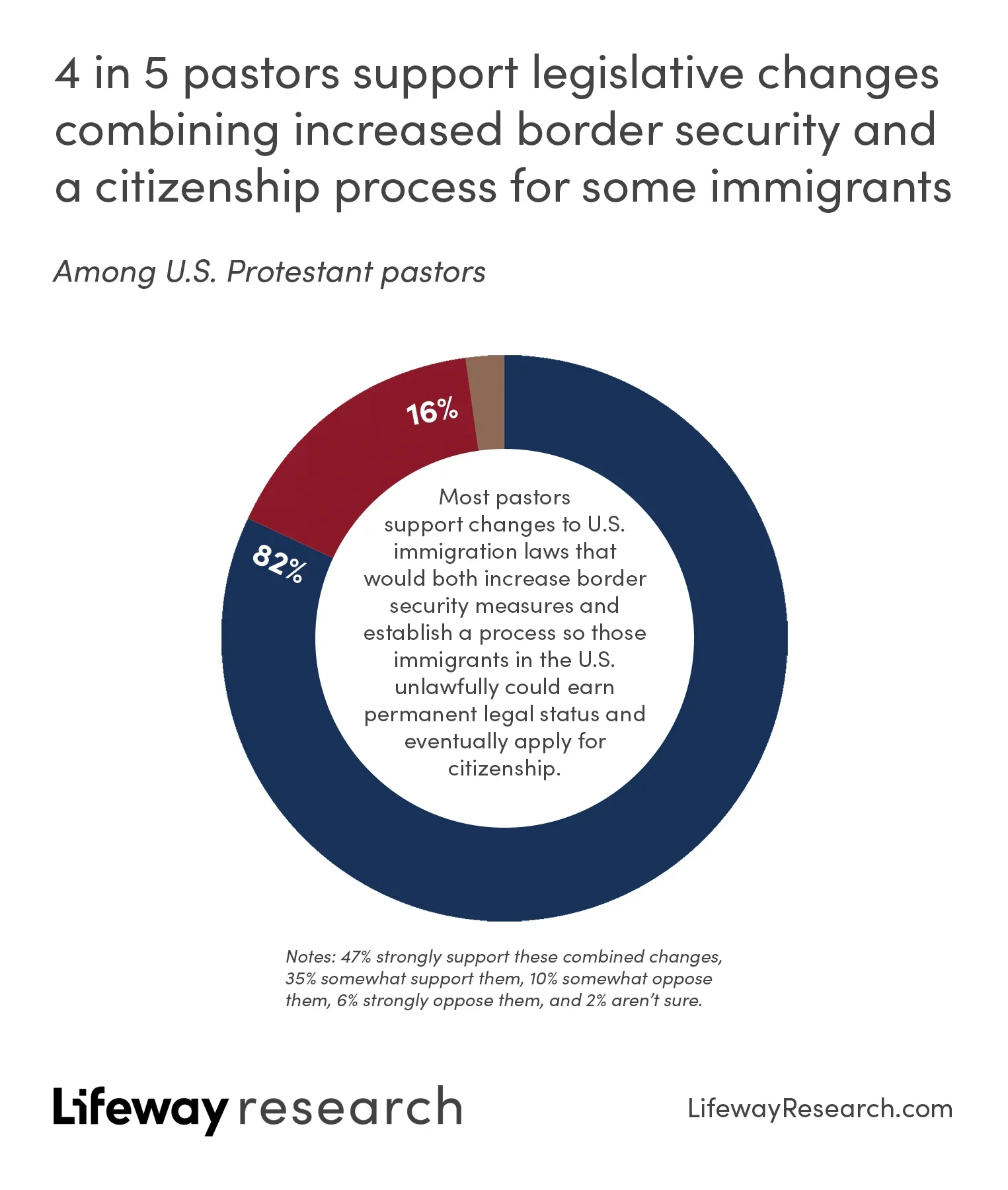
Four in five U.S. Protestant pastors (82%) would support changes to immigration law that increase border security and establish a process to earn legal status and apply for citizenship, including 47% who strongly support those combined changes. Around one in six (16%) disagree, and 2% aren’t sure. In a 2025 Lifeway Research study, 76% of U.S. evangelicals supported similar changes that would accomplish both goals.
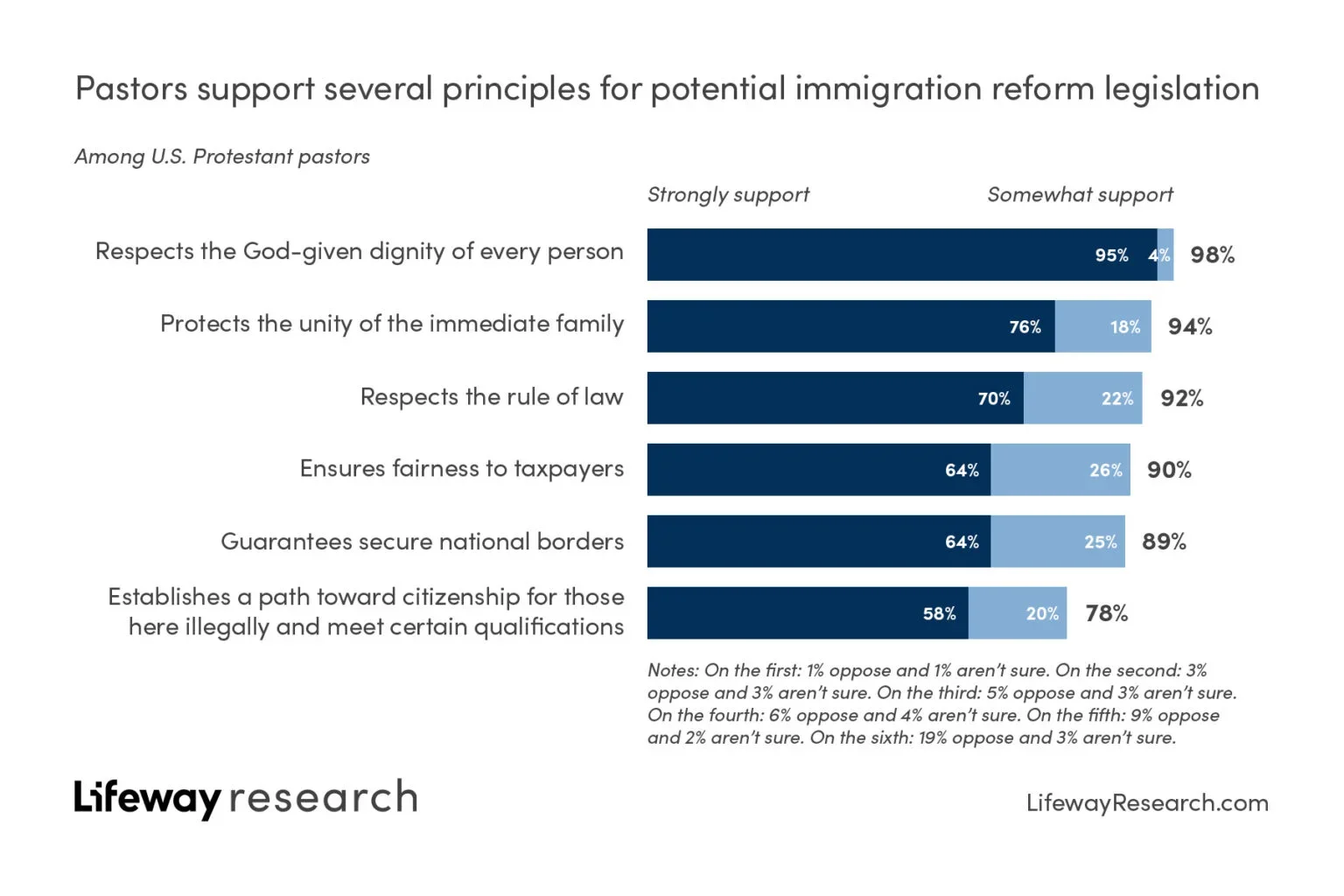
As far as specific principles guiding immigration legislative reform, almost every pastor (98%) supports legislation that respects the God-given dignity of every person. Close nine in 10 also say they support legislation that protects the unity of the immediate family (94%), respects the rule of law (92%), ensures fairness to taxpayers (90%) and guarantees secure national borders (89%).
Almost four in five pastors (78%) specifically support immigration legislation that establishes a path toward citizenship for those who are here illegally, interested and meet certain qualifications for citizenship. The 2025 study also found broad support for each of those principles among U.S. evangelicals.
“Pastors are largely united on principles of legislative reform, signaling they believe changes are needed in America’s immigration laws,” said Scott McConnell, executive director of Lifeway Research. “While they clearly want laws to be followed, they also find fault with the laws that are on the books.”
Pastors likely share both the political perspective and personal experience of their congregations. Three in five pastors (59%) describe their political views as conservative, 19% moderate and 19% liberal. Two in three (66%) say the average member of their congregation is conservative, 20% moderate and 13% liberal.
Around half (47%) of Protestant pastors say they have at least some first-generation immigrants in their church. Half of U.S. evangelicals (52%) said the same in a 2025 Lifeway Research study.
Immigration attitudes
As pastors think about immigration, 98% believe legal immigration is helpful to the United States. Specifically, 53% say we should increase the number of legal immigrants approved in a year. More than a third (35%) believe legal immigration is helpful, and we should maintain the current number.
One in 10 (10%) believe it is helpful but currently too high, and we should decrease the number approved. Just 2% believe legal immigration is harmful, including 1% who believe the U.S. should completely stop approving legal immigrants.
Pastors are more split on the government’s approach to immigrants already in the country. As the number of immigrants who have been detained and deported has increased in the past year, 38% of U.S. Protestant pastors believe the current level of deportation is too high and should be reduced. A quarter (24%) believe the level is right and should be sustained, while 18% say it is too low and should be increased. Few (4%) believe no immigrants should be detained or deported. Around one in six (16%) aren’t sure.
Considering those who are in the U.S. unlawfully or have overstayed a temporary visa, pastors want the government to prioritize those who have a violent past or pose a security threat. Almost nine in 10 (89%) believe individuals who have been convicted of violent crimes should be prioritized for deportation. Four in five (80%) point to those reasonably suspected to present a threat to national security.
Fewer say deportation efforts should prioritize individuals who entered the country in the last five years (30%), who are unwilling or unable to pay a monetary fine as restitution for their violation of the law (27%), who entered the country more than five but less than 10 years ago (15%) or who entered the country more than 10 years ago (13%).
Fewer than one in 10 U.S. Protestant pastors believe the U.S. government should prioritize for deportation individuals who would be willing to pay a monetary fine as restitution for violating the law (8%), who were brought to the country unlawfully when they were children (7%), who are the parents of at least one U.S. citizen child (7%) or who are married to a lawful resident or U.S. citizen (3%). Few say none of these should be prioritized (2%) or aren’t sure (3%).
“Difficult immigration decisions have long been deferred in America, and that makes the solutions less clear. While pastors are divided on the volume of deportations that should be taking place, they are more united on who should and should not be prioritized for deportation,” McConnell said. “More than nine in 10 pastors rebuff the idea of dividing families or deporting those willing to pay a fine as restitution for not having legal residency.”
Pastors specifically oppose the deportation of Afghans who had converted to Christianity or who supported the U.S. military. Recently, some of these individuals were told their legal protections were being withdrawn, and they should self-deport or face the risk of forcible deportation.
Three in four pastors (75%) oppose the deportation of those individuals, including 54% who strongly oppose it. Around one in seven (15%) support this group’s deportation, and 10% aren’t sure.
Congregation responsibilities and reaction
In the last decade, the number of people globally who have been forced to flee their homes because of persecution or conflict has nearly doubled, with more than 120 million currently living displaced. Most pastors believe the U.S. government has a responsibility to refugees, and many say their churches are already serving these individuals.
More than four in five pastors (82%) believe the U.S. has a moral responsibility to accept refugees, those who are fleeing persecution due to specific factors such as their race, religion or political opinions, including 78% of evangelical pastors and 90% of mainline Protestant pastors. Seven in 10 evangelicals agree, according to the 2025 study.
Christians who have fled persecution should be a top priority for refugee resettlement, according to 84% of pastors. Other refugees whom most pastors said should be a priority for resettlement include those who have family members already resettled in the U.S. (70%), Afghans who face persecution because of their service to the U.S. military (63%), those who have fled persecution on account of their race or ethnicity (60%) and those who have fled war in countries such as Ukraine, Sudan and the Democratic Republic of Congo (57%). Half (51%) felt those fleeing gang violence should be prioritized.
Fewer cited individuals who have fled political persecution (46%) or those fleeing persecution on account of non-Christian religious traditions (44%). Only 18% said the members of the Afrikaner ethnic minority group from South Africa should be a priority for resettlement, and almost no pastors (2%) believe no refugees at all should be admitted to the United States.
“The administration’s suspension of all refugee resettlement early in 2025 and then its narrow reopening of refugee resettlement only for ethnically white individuals from South Africa are starkly out of touch with the views of both evangelical and mainline Protestant pastors,” observed Matthew Soerens, vice president of advocacy and policy for World Relief. “If they wanted to appeal to pastors, they would do well to prioritize other groups of refugees, such as those persecuted for their Christian faith, those seeking reunification with family members already in the United States and Afghans at risk because of their service to the U.S. military.”
When those refugees arrive, many congregations look to assist them. Two in 5 churches (41%) currently have or have previously had a ministry that serves refugees or other immigrants, including 24% of pastors who say their church has an active current ministry.
More than a third of pastors (36%) say the American church should be on the forefront of responding to the increase in global displacement. Almost half (48%) believe the church should be concerned with the increase, but it is not a top priority. Few say the church should leave it to governments to address the issue (7%) or aren’t sure (9%).
When asked what three global issues they consider to be the most urgent, pastors place discipleship (71%) and evangelism (62%) at the top. Beneath those primary issues, pastors were divided over a third topic.
A quarter (25%) say refugees, forced displacement and immigration need the church’s focus. One in 5 say religious persecution (20%) and orphans and vulnerable children (20%). Fewer point to hunger (18%), war and violent conflict (16%), changing attitudes toward gender and sexuality (15%) or human trafficking (14%). Fewer than one in 10 believe the church should prioritize climate change (9%), global health (6%) or the wellbeing of women and girls (4%). Almost one in seven (15%) say some other issue, and 2% aren’t sure.
The issues pastors tackle in sermons often mirror their prioritization but deviate in some key ways. Almost all say they’ve addressed discipleship (95%) or evangelism (88%) in their sermons or teaching. Most have also spoken about religious persecution (64%), war and violent conflict (59%) or changing attitudes toward gender and sexuality (58%). Almost half talked about hunger (49%), orphans and vulnerable children (49%) or refugees, forced displacement and immigration (47%). Fewer mentioned the wellbeing of women and girls (39%), human trafficking (34%), climate change (19%) or global health (17%).
“Being asked to pick only three urgent issues on such a list of global needs is difficult. Pastors, no doubt, were trying to balance the size of the need and the fit with the ministry of their churches. The existence of many global Christian ministries addressing these needs allow churches to partner in such work without much effort if they are willing,” said McConnell.
Considering recent cuts to government funding for foreign assistance impacting food, health and humanitarian disaster response programs, almost half of U.S. Protestant pastors (46%) say their churches have stepped up to do more to address these needs, while 6% say they haven’t done so yet but will.
One in five (21%) pastors say they have encouraged or will encourage their elected official to restore the funds, and 14% have spoken or will speak to their congregation about advocating for the restoration of the funding.
Other pastors support a reduction in foreign aid. More than one in five (22%) say they fully support the government funding cuts to foreign assistance, while slightly fewer (19%) say they believe some cuts were appropriate but these went too far.
Around a quarter (26%) say the church cannot fill the gap left by the reduction in government funding. Almost one in eight (13%) aren’t sure.
“Abrupt reductions to foreign assistance have been devastating to vulnerable communities around the world, and I’m not surprised relatively few pastors fully support these cuts. At World Relief, we’ve been encouraged to witness many churches stepping up both to advocate and to partner with us and peer organizations to respond directly to humanitarian crises with lifesaving interventions,” said Greene.
For more information, view the complete report.
Aaron Earls is the senior writer at Lifeway Research.