
Young Men Redefine Adulthood As Economic Pressures Grow
NEW YORK — Young men are entering adulthood later, redefining what it means to be a man and facing mounting economic and social challenges that shape how they see their future, according to a new survey released on Monday.
The report, conducted by Institute for Family Studies, paints a complex picture: Many young men in the United States feel uncertain or discouraged about their progress in life — yet remain hopeful about work, family and personal growth.
Traditional milestones like marriage and parenthood no longer dominate young men’s ideas about becoming adults, the report found. Instead, they increasingly emphasize psychological traits like responsibility, independence and personal decision-making.
READ: Gen Z and Millennial Men Driving New Church Attendance Trend
In 2002, about 65% of young men said completing education was extremely important to becoming an adult. By 2025, that number had dropped to 31%. Only 9% today say marriage is an essential milestone — down slightly from 13% in 2002.
Instead, the 74-page report said, many define adulthood in more internal terms: More than half say accepting responsibility and making independent decisions are key signs of maturity.
Still, social roles retain some influence. Married men and fathers are significantly more likely to say marriage and children are important parts of adult life.
Highlights from the report include:
— 68% of unmarried young men want to get married, with another 21% unsure.
— 59% are not currently in a romantic relationship.
— Young men's No. 1 role model is their mother (79%), followed by their father (69%).
“The defining standards of adulthood have continued to change for young men. Once conventional benchmarks, like marriage and parenthood, long ago moved to the bottom of the list,” the report said. “But in the past two decades, the formerly central place of completing formal education has slipped as well, now considered extremely important by only 31% of young men, far below newer standards like being independent personally (51%) and financially (53%).”
As a result, many young males report struggling with their sense of progress. Nearly half of men ages 18 to 23 — 46% — said they feel somewhat or very much like a failure. Among men aged 24 to 29, that number drops slightly to 38%. Only about a third of men between 18 and 29 reject the idea that they have failed.
In response, many churches have reported a revival, where some young men are returning to traditional, structured religious institutions — specifically Catholic and Eastern Orthodoxy — seeking stability and moral clarity.
Rather than turning towards spirituality, this trend is driven by a desire for discipline and a tangible community that offers a clear of purpose and “battleground for reclaiming virtue.” However, experts have said they skeptical that this constitutes a widespread resurgence, noting that younger generations remain less religious overall.
Researchers also linked these negative feelings about life and the future to economic uncertainty, difficulty finding stable work and an extended transition into adulthood. Many young men said they feel “stuck,” unsure whether they have truly reached adulthood — especially if they are unemployed or still living with their parents.
Despite shifting social expectations, financial independence remains one of the most important goals. More than two-thirds of young men claim earning enough to support themselves — and eventually provide for others—is central to being an adult.
Employment levels vary by age. About 74% of men aged 24 to 29 work full-time or are self-employed, compared with 42% of men aged 18 to 23. Overall, roughly three-quarters work at least part-time.
Unemployment stands at about 15%. Most unemployed respondents said they are actively looking for work. Those who do have jobs generally report high satisfaction: 42% are very satisfied, while 46% somewhat satisfied with their work.
Still, the report said the biggest challenge is not joblessness but low wages, which make it difficult to achieve financial independence.
College doubts and trade schools
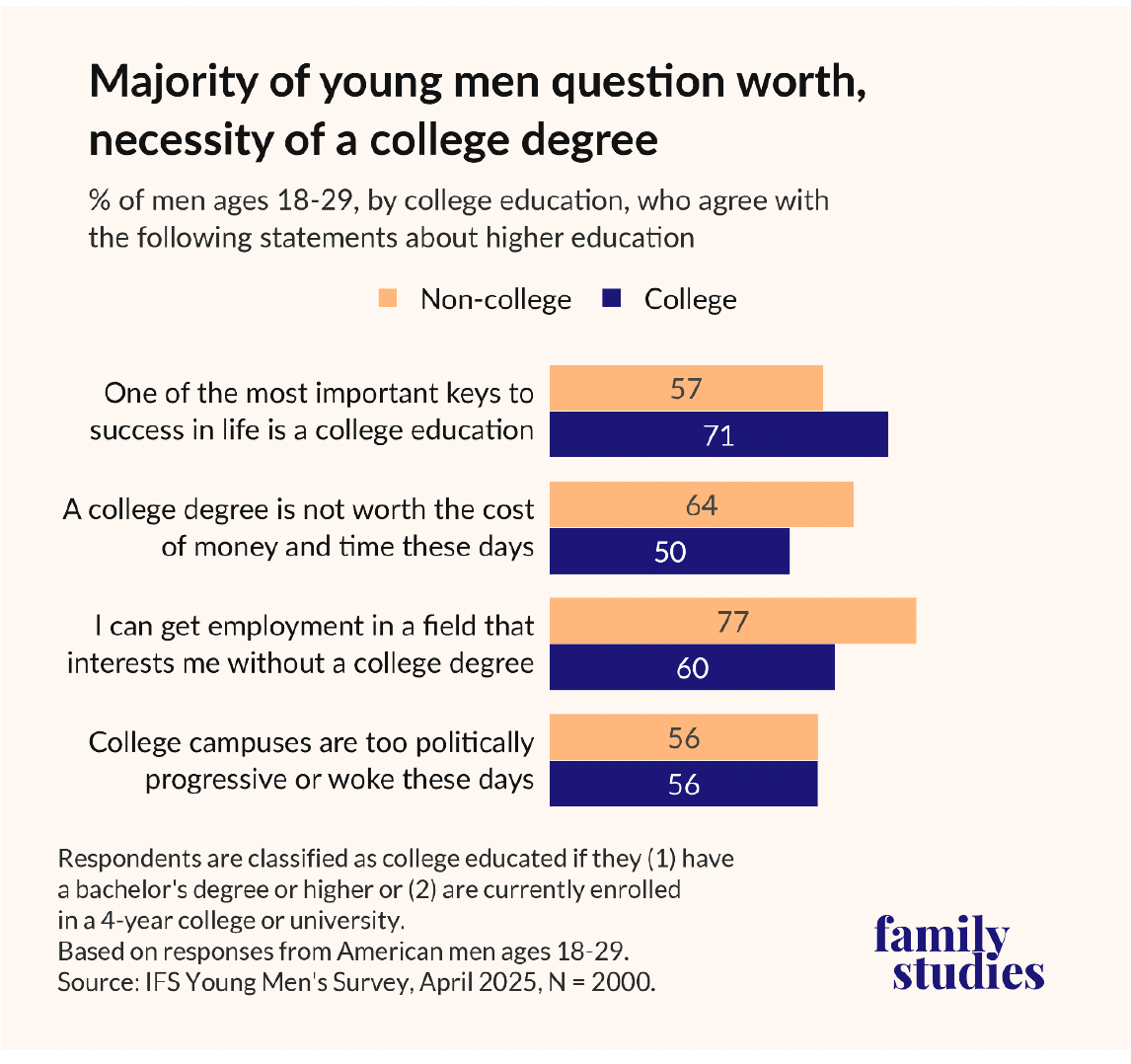
Young men, meanwhile, remain divided on the value of higher education. While more than 70% said college remains important for success, nearly half believe it may not be worth the time or money. Financial barriers are a major obstacle. About 61% say they lack the resources to attend college and half say they doubt they would succeed academically.
As a result, trade schools and apprenticeships are gaining appeal at a time when AI threatens white-collar jobs. Employment rates for people who complete these programs are about 77%, nearly matching the 80% employment rate for college graduates.
Trade programs also appear more accessible to students with learning differences such as ADHD or autism, who often struggle in traditional college environments.
Masculinity and marriage
Many respondents said society views masculinity negatively and agree that defining manhood has become more difficult.
About 70% agree that society often portrays manhood negatively (using terms such as “toxic masculinity”), while a similar share said it is harder to define today than it was decades ago.
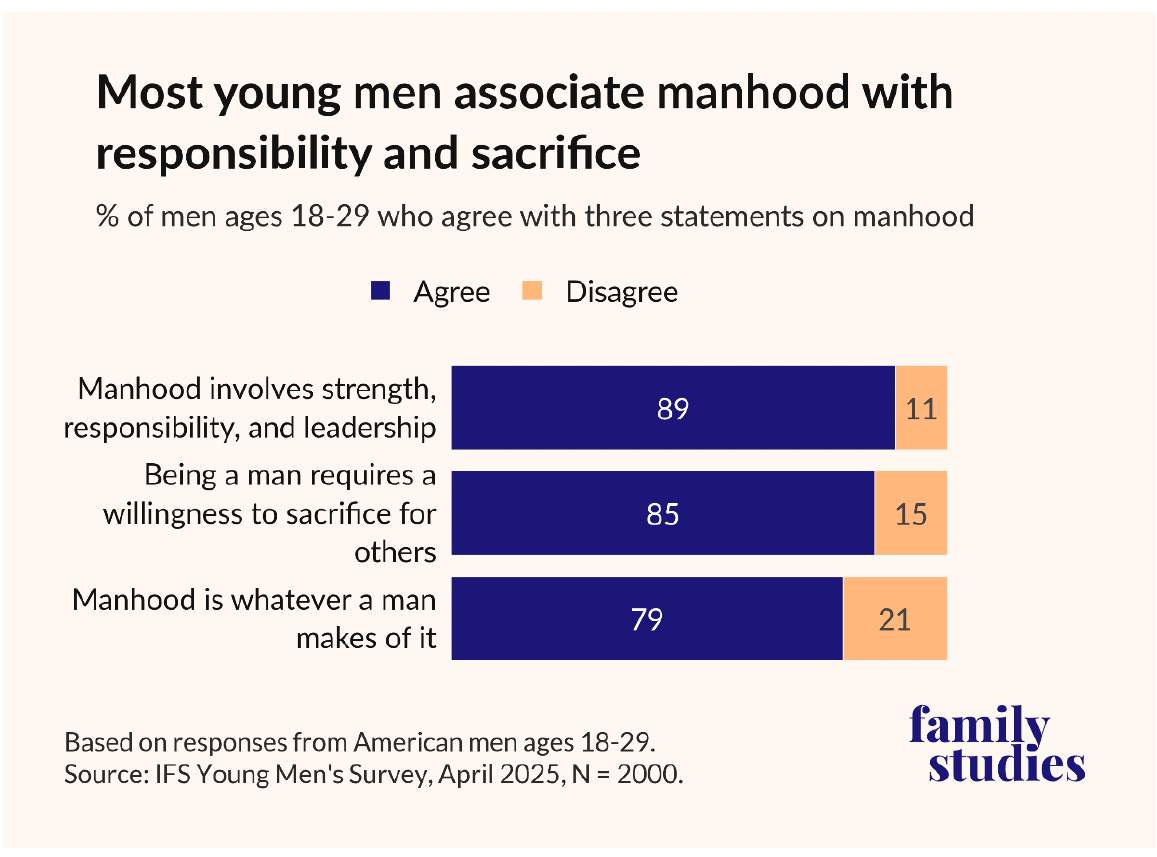
Yet most young men still associate masculinity with positive qualities. Nearly 90% responded that being a man involves sacrifice and 85% link manhood to strength and responsibility.
Four out of five also said protecting women is an important part of masculinity, though views vary along political lines.
Asked about role models, most point to parents (mothers and fathers), teachers and sports coaches. Online influencers — like Andrew Tate — ranked last.
“When we asked who they most looked up to as role models, mothers (79%) and fathers (69%) topped the list, followed by coaches and teachers (57%),” the report said. “Among prominent figures from the worlds of tech, politics, entertainment and religion, the most admired role model was former president Barack Obama, whereas the least was online influencer Andrew Tate.”
Even as traditional milestones lose their central role in defining adulthood, many young men still hope to marry and have children. About 68% of unmarried men say they want to marry someday, while 82% say they want children.
Financial insecurity remains the biggest barrier. Among those delaying marriage, 44% said they lack a stable job; 33% say they lack financial stability.
Currently, about 16% of respondents are married, while 30% are fathers. Among fathers, more than half are unmarried. Marriage remains more common among college graduates and among men who report strong religious ties.
“As we analyzed the results of the survey, what stood out was not indifference or a lack of worthy aspirations but the trying circumstances facing today’s young men,” the report said. “Their ambiguous and socially marginal position is taking a heavy toll on them. Young men are not where they want to be, often feel trapped, and are unsure of what to do. At least in the near term, they are not optimistic that things will get much better.”
Clemente Lisi is executive editor at Religion Unplugged.