
Italy’s Giorgia Meloni As An ‘Angel’: When Sacred Space Becomes A Political Mural
(ANALYSIS) The sudden appearance, and subsequent disappearance, of a cherub’s face from a Roman basilica might seem like a simple act of restoration. In reality, the erasure of the so-called “Angel Meloni” from the Basilica of San Lorenzo in Lucina exposes a recurring tension in Italy — and across many part of the word — over where religious faith ends and politics begins.
The controversy began when a painting of a cherub, unmistakably resembling Italian Prime Minister Giorgia Meloni holding a scroll with the map of Italy on it, was spotted in one of Rome’s oldest churches. The image quickly went viral after the Italian daily La Repubblica featured it on Saturday, drawing crowds of visitors and turning a quiet basilica into the latest flashpoint for public debate.
Within days, however, the angel’s face had been erased, hastily covered with plaster in what appeared to be an emergency effort to contain the fallout.
READ: On LA’s Skid Row, Portraits Of The Unhoused Are Turned Into Sacred Art
At stake was not the preservation of an ancient masterpiece. The fresco, dating back just 26 years, and the cherub itself had already undergone restoration following recent water damage. Instead, the uproar revolved around symbolism: The presence of a living political leader’s likeness inside a sacred space, rendered not as a donor or historical figure, but as an angelic being.
Meloni, whose office is a short walk from the basilica, had made light of the whole thing.
“No, I definitely don’t look like an angel,” she posted on social media with a laughing/crying emoji alongside a photo of the work.
Cardinal Baldassare Reina, the pope’s vicar for Rome, stated bluntly that a political figure had no place in church art. That assertion reflects a longstanding principle within Catholic tradition: Sacred imagery is meant to point beyond the temporal world, not mirror its earthly power structures.
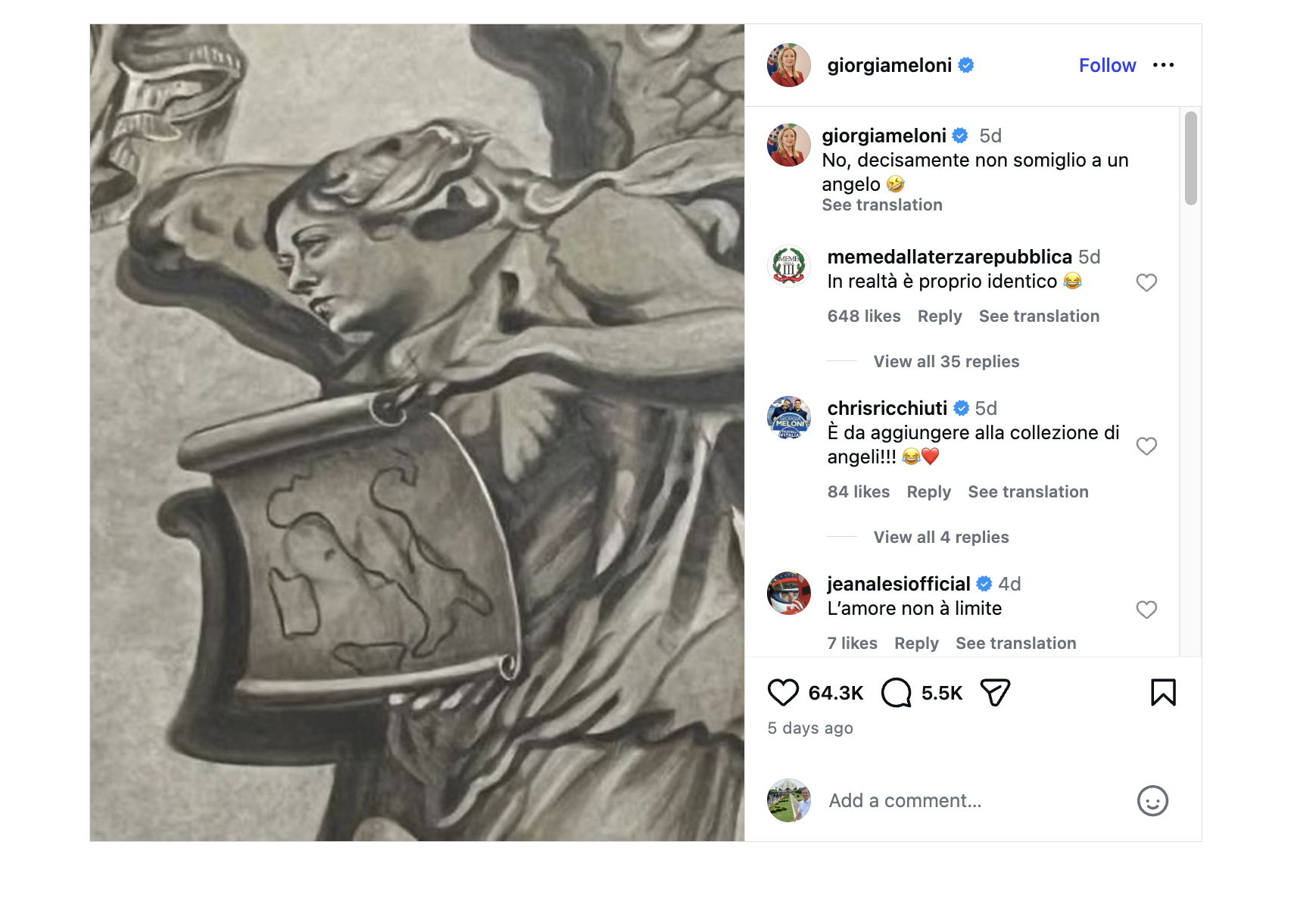
Expressing his “disappointment over what happened,” Reina added that “images of sacred art and Christian tradition cannot be misused or exploited.”
The artist, Bruno Valentinetti, 83, at first denied the claims. Within days, the BBC reported that he admitted that it was indeed the prime minister's face. He insisted that it was similar to the original.
In a statement on Wednesday, Italy’s Ministry of Culture established a set of rules going forward: If the basilica plans to repaint the angel’s face, it needs prior authorization from the government and the diocese of Rome.
The act, however, reveals how porous the boundary between faith and politics has become. The cherub originally formed part of a decorative mural that had already blended nationalism, monarchy and Catholicism.
Kneeling with a map of Italy before a bust of the last king, Umberto II, the figure was never ideologically neutral. Updating its face to resemble the prime minister merely made explicit what had long been implicit: Religious art can be mobilized to comment on political identity.
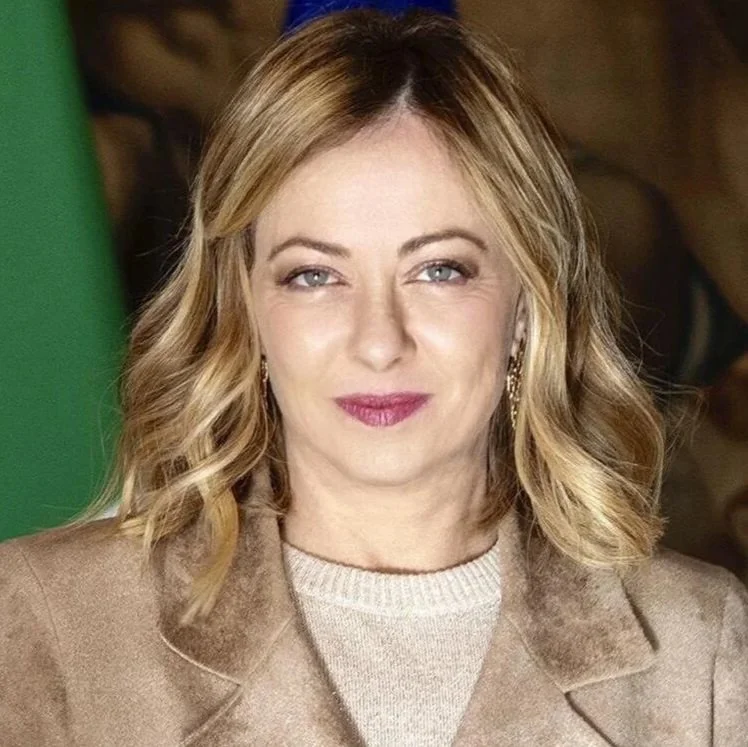
Italian Prime Minister Giorgia Meloni (Wikipedia Commons photo)
The state’s involvement underscores this entanglement. The Culture Ministry and the diocese of Rome both launched investigations, not over blasphemy, but over process and authority. Who gets to decide what appears in a church that is owned by the state and operated by the church?
The ministry’s insistence that any future repainting be approved in advance — and accompanied by a sketch — signals an effort to reassert some famous Italian bureaucratic control over symbolism that spiraled beyond institutional comfort.
Public reaction to the likeness of the right-wing leader, meanwhile, highlighted how quickly politicized religion captures attention. Tourists and locals lined up to photograph the cherub, sometimes disrupting Mass. The basilica became famous not for prayer or history, but for another matter.
Why did the image resonate so widely in the first place? When religion is politicized, it amplifies power. Sacred spaces carry moral weight, historical continuity and emotional authority. Insert a current political leader into that frame and the result is a visual symbol of what divides us.
Clemente Lisi serves as executive editor at Religion Unplugged.