
US Religious Attendance Holds Steady, With Mixed Results For Young Adults
NEW YORK — Religious participation in the United States is showing signs of stability after years of decline, but new research also suggests that reports of a religious revival among young adults may tell only part of the story.
A new analysis released by the Pew Research Center on Wednesday, based on surveys conducted in 2025 and this year, found that Americans’ religious practices have largely stabilized since 2020. Meanwhile, attendance at religious services has risen from pandemic-era lows, reaching its highest levels since Pew began tracking the measure in July 2020.
For example, 34% of U.S. adults said they had attended religious services in person during the previous month. That figure rose to 45% when respondents who watched services online or on TV were included. Nonetheless, the study’s conflicting findings present a more complicated picture among younger Americans, whose religious habits have attracted attention amid widespread talk of a possible resurgence of faith, particularly among young conservative men.
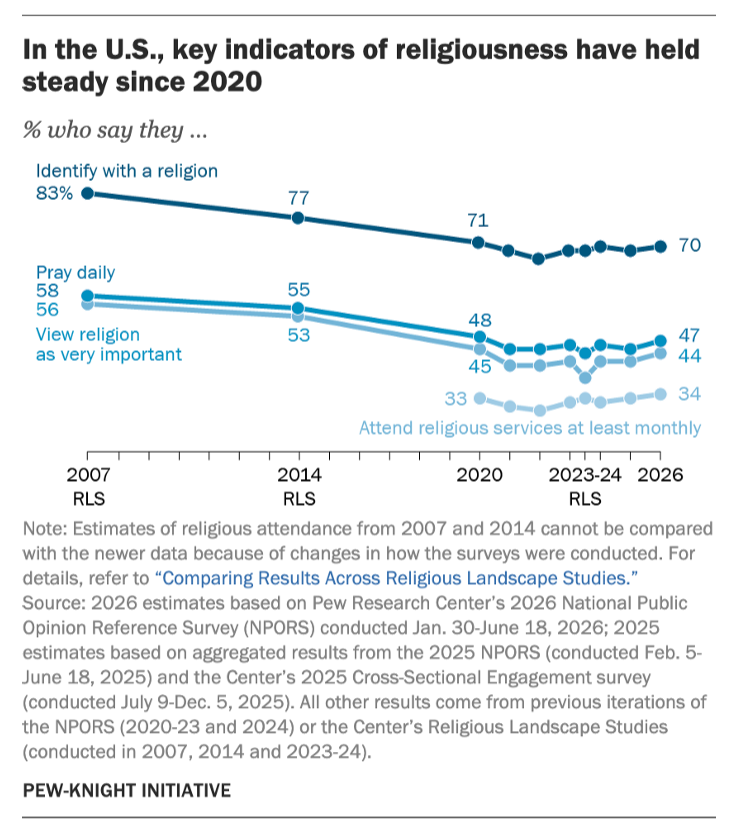
Researchers are also examining whether recent patterns reflect a rebound from the disruptions of the COVID-19 pandemic rather than a lasting change in religious behavior.
Previous Pew surveys have sometimes found that the youngest adults entered adulthood with relatively high levels of faith engagement, only to become less religious with time. Whether this current generation will follow that pattern remains unknown.
For now, Pew’s findings point to a recovery in religious attendance alongside continued long-term uncertainty about faith in America. Pew said that determining whether today’s youngest adults represent a lasting turning point or a temporary fluctuation will require more years of data.
Pew said their “latest surveys contain mixed signals about what is happening among young adults.”
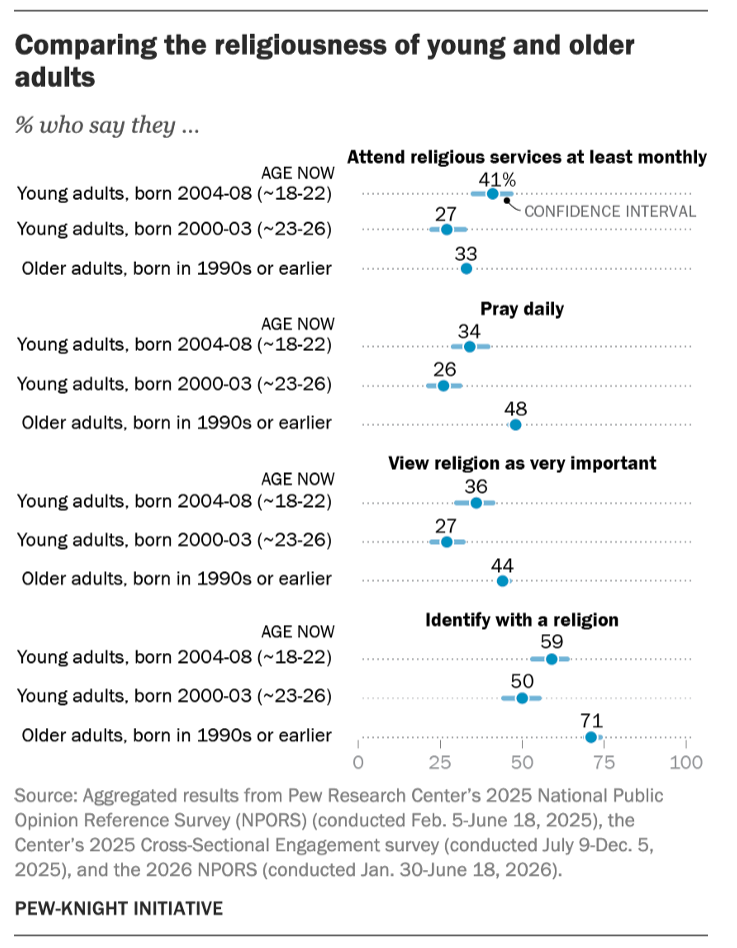
Pew’s analysis found that the youngest adults – roughly between the ages of 18-22 – “stand out” for their comparatively high rates of religious attendance. But their slightly older peers, ages 23 to 26, rank among the least religious groups across several measures, including prayer, religious affiliation and the importance they attach to religion. The contrast suggests, Pew said, that a broad-based religious revival among young Americans remains unproven.
“But they are less distinctive in other ways, such as their rates of religious affiliation and how often they say they pray,” the report added.
Among Americans born between 2004 and 2008, 41% said they attended religious services at a church, synagogue, mosque or another house of worship at least once or twice a month. That compares with 33% of the overall U.S. adult population.
The youngest adults’ attendance rate exceeds those of people born between the 1960s and ‘90s. By contrast, only 27% of adults born between 2000 and 2003 said they attended services at least monthly, placing this group near the bottom among age groups surveyed.
The youngest adults’ comparatively high attendance does not translate into similarly elevated levels of religious commitment across the board. Their rates of daily prayer, religious affiliation and saying religion is very important in their lives are generally lower than those of many older Americans.
On these measures, however, the youngest adults are more religious than the 23-to-26 age group, which registers the lowest levels of religiousness across all four of Pew’s core indicators.
The research also challenges the idea that young Americans have become more religious in recent years. Adults ages 18 to 22 today are about as religious as people of the same age were in 2014, while those ages 23 to 26 are less religious than their counterparts were at that time. Both groups are substantially less religious than young adults of similar ages were in 2007.
No clear evidence of a broad revival
Once again, Pew found little evidence that any generation it has tracked over time has become more religious in recent years.
The research center compared responses from 5,835 adults who answered religion questions in both 2020 and 2025. The analysis found no clear signs of either increasing or declining religiousness within birth cohorts.
Among adults born between 2000 and 2003, attendance has risen slightly since 2022, possibly reflecting a rebound from a pandemic-era low. But the proportions who pray daily, consider religion very important or identify with a religion have remained broadly stable.
Adults born in the 1990s are somewhat more likely to say religion is very important to them than they were in 2020. Other indicators for this group, as well as for older generations, show more stability than change.
The findings underscore the distinction between a recovery in participation and a broader shift in religious belief or commitment. Pew said the religiosity of young people has “tended to fade with time.”
Gender and politics
The data also reveal differences among young adults by gender and political affiliation.
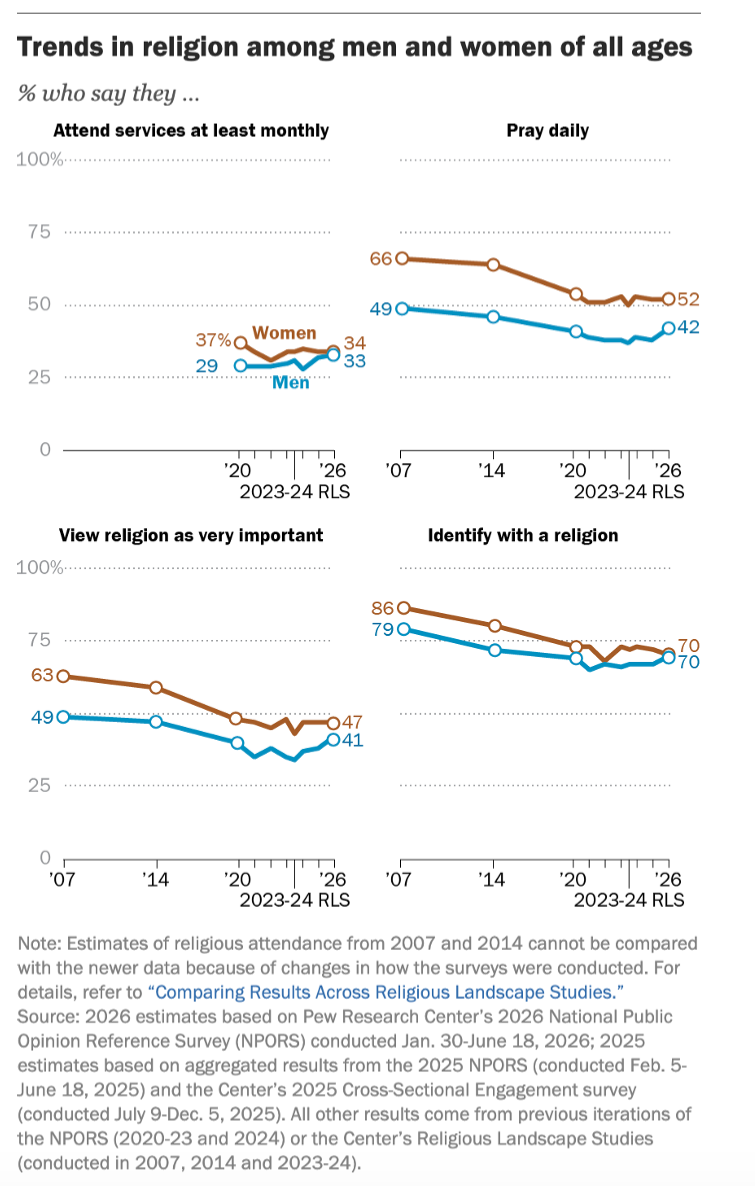
Historically, women in the U.S. have tended to be more religious than men, particularly in prayer frequency and the importance they assign to religion. That gap has narrowed over time, however, as religious engagement has declined among both sexes, with a larger drop among women.
Pew found that men born between 2004 and 2008 now report attending religious services more frequently than women of the same age, a pattern not previously seen in the center’s surveys.
Young women also attend at relatively high rates compared with older female age groups. About 35% of women ages 18 to 22 reported attending services at least monthly, roughly matching the rates among women born from the 1950s through the 1980s.
Political affiliation also matters. Young people and adults who lean Republican are substantially more religious than their Democratic counterparts, reflecting a broader pattern across age groups.
Among Republicans ages 18 to 22, 55% reported attending services at least monthly. That was higher than in every other Republican age group except the oldest.
The trend, Pew added, is not limited to conservatives. Young Democrats also reported relatively high attendance compared with Democrats born in the 1970s through the early 2000s. Their attendance rates were roughly comparable to those of Democrats born in the 1960s or earlier.
The results therefore do not support the conclusion that higher religious attendance among the youngest adults is exclusively a Republican phenomenon.
At the same time, Pew cautioned that the youngest adults are difficult to study reliably. Some still live with their parents, while others are attending college, entering the workforce or establishing independent households. These circumstances can complicate efforts to obtain representative survey samples.
The center’s 2025-26 surveys included 443 respondents born between 2004 and 2008. For that group, the margin of error was plus or minus 5.7 percentage points.
Clemente Lisi serves as executive editor at Relgion Unplugged.