
New Hispanic Congregations Expanding Attendance And Evangelistic Impact
Despite potential barriers within the congregation, the community and the broader culture, new Hispanic churches in the U.S. are reaching new people and welcoming new faces.
Working with 16 denominations or similar groups, Lifeway Research surveyed leaders at almost 300 new Protestant Hispanic church works to gain an understanding of the current landscape. The study, sponsored by Exponential and the Church Planting Leadership Fellowship, follows up on a similar 2019 study.
“A large number of new church works today are Hispanic congregations,” said Jason Stewart, executive director of mobilization at Exponential. “It is important to have an accurate understanding of these congregations and the approaches they are using to allow denominations, church planting networks and sponsor churches to better support these ventures.”
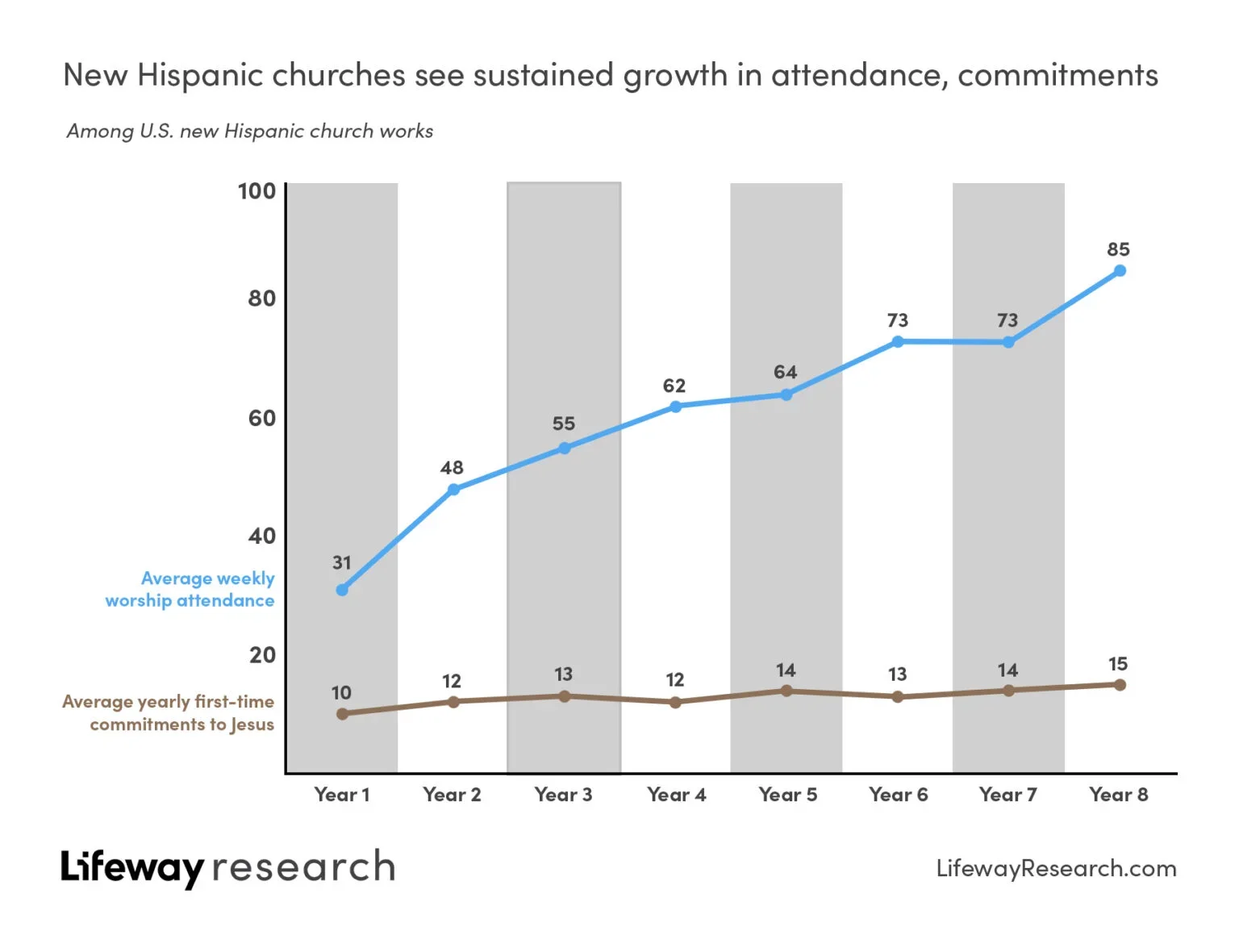
The average new Hispanic church work starts with 31 people in attendance in the first year but grows consistently. By the eighth year, the church sees an average of 85 people at the weekly worship service.
Additionally, new church works are reaching new people. In their first year, the average congregation sees 10 people make a first-time commitment to Jesus. Over the next six years, the average fluctuates between 12 and 14 before reaching 15 in year eight.
“The immediate evangelistic impact of new Hispanic congregations is remarkable,” said Stewart. “As the congregation grows, the number of new commitments to Jesus Christ per attendee begins to decline, but the overall evangelistic effectiveness is consistently strong.”
Congregational snapshot
Nine in 10 congregants (90%) in these churches are Hispanic or Latino. Two in three (65%) are first-generation Americans, having been born outside of the United States; a quarter (24%) are second-generation, meaning they were born in the United States to at least one parent born elsewhere, and 11% are third-generation, having been born in the United States to parents who were also born in the U.S.
Of their pastors, 91% are Hispanic or Latino. More than three in four (77%) are first-generation, 12% are second-generation and 11% are third-generation.
A third (36%) of new church works say the largest number of attendees have Mexican origins, 27% say more people in their churches identify equally with multiple countries and 11% say the plurality of their attendees are from Puerto Rico, while far fewer point to other Latin American nations.
Most pastors of these churches say they are attempting to reach all Hispanic people (63%). Around three in 10 (29%) are aiming for a cross-cultural or multiethnic group. Few say they’re trying to reach a specific Hispanic group like Mexicans or Cubans (6%) or none of these (2%).
Half (50%) of the new church works are in the three U.S. states with the most Hispanic and Latino people: Texas (25%), Florida (15%) and California (10%).
More than a third of attendees in these congregations (35%) are under 30, including 17% who are under 18. Another 39% are between 30 and 49, while 26% are 50 or older. These age demographics are statistically the same as all U.S. Hispanic Protestant churches, according to a 2022 Lifeway Research survey, and much younger than the average Protestant church in America.
“There is much diversity in Hispanic congregations in the U.S. among both the people and their churches’ ministries,” said Scott McConnell, executive director of Lifeway Research. “While Latino churchgoer stories vary, they reflect the reach of the gospel today as they gather in new churches across the country.”
Additionally, most of the attendees are relatively new to Protestant churches. Around one in five say they previously attended Catholic churches (21%). Few attended groups such as Jehovah’s Witnesses or The Church of Jesus Christ of Latter-day Saints (1%). Another 1 in 5 never attended church at all (19%), while 16% had not attended church for many years before coming to their current church.
Around a third (32%) previously attended other Protestant or non-denominational churches, and 10% are children born to people who attend the church.
“New Hispanic congregations have many current stories of changed lives, as more than one in three attendees were not attending church at all before this new church work began. These are exciting ministries,” said McConnell. “It is not surprising that despite many challenges, Hispanic church planters are quick to say, ‘It’s worth it!’”
Cultural complicators
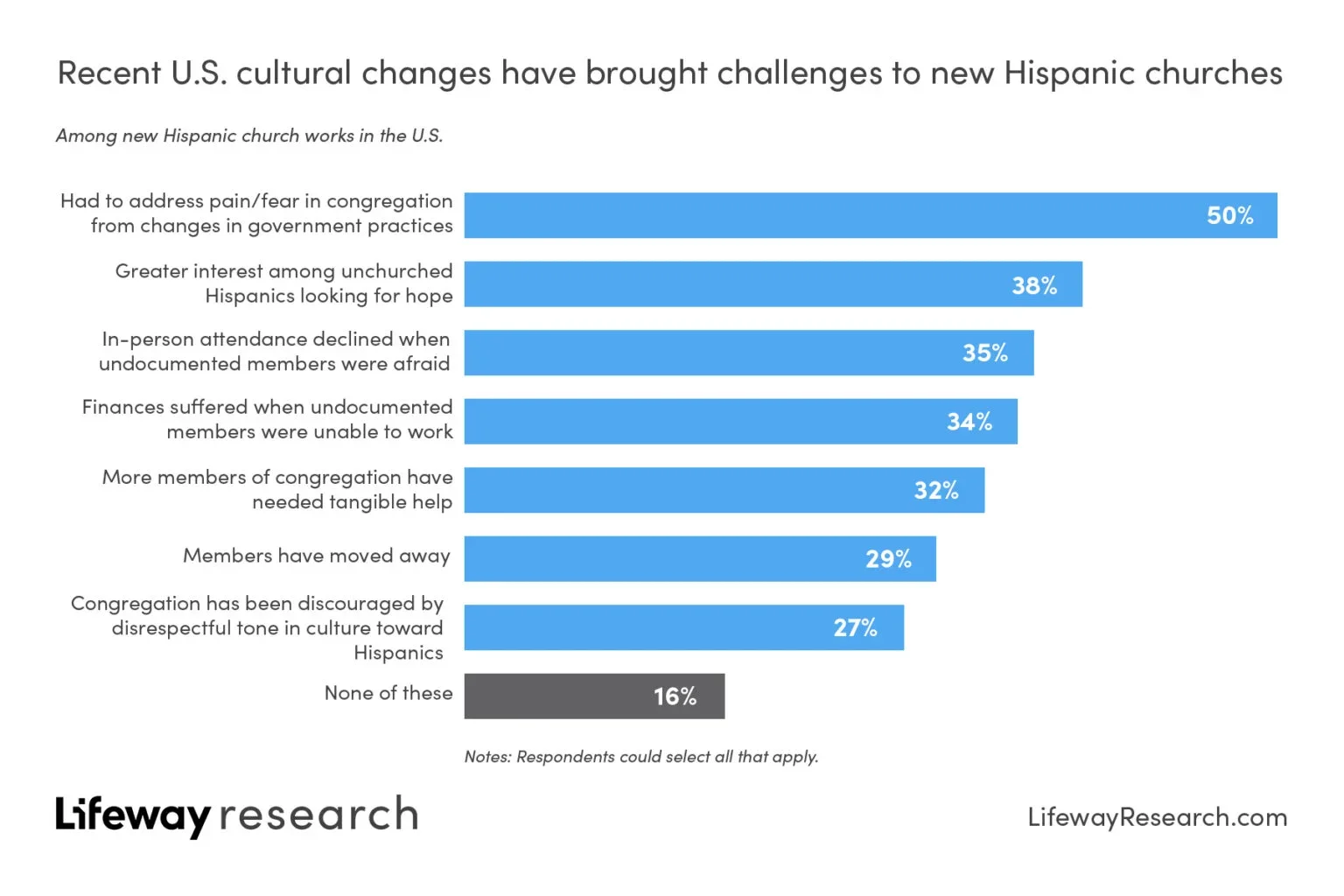
Increased deportations and other cultural changes in the past year have caused some issues for new Hispanic church works.
Half (50%) say they have had to address pain and fear in the congregation from changes in government practices. More than a third say in-person attendance declined when undocumented members were afraid to leave home (35%) and church finances have suffered when undocumented workers have been unable to work (34%).
A third of new Hispanic church works (32%) have seen more members of the congregation needing tangible help. More than a quarter say members have moved away (29%) and the congregation has been discouraged by the disrespectful tone of our culture toward Hispanics (27%).
Amid these issues, 38% say there has been greater interest among unchurched Hispanics looking for hope, while 16% say they haven’t seen any of these changes in their congregation.
“Rapid changes to government practices related to immigration have caused both challenges and opportunities for new Hispanic congregations. These churches continue to respond biblically with care, hospitality and practical help for these neighbors and members,” said McConnell.
Effective outreach
Despite potential complications, new Hispanic church works are reaching new people, averaging at least 12 new commitments to Jesus after their first year. These could be attributed to an evangelistic emphasis by the congregations.
When pastors at these congregations are asked what they want their church to emphasize the most, 68% say equipping the congregation to share the gospel with those they talk to. Fewer say inviting people to church to hear the gospel (13%), meeting practical needs in their community (7%), being a church for Christians in the community without a church home (6%), conducting evangelistic events (3%) or none of these (3%).
This evangelistic focus is common across all U.S. Protestant Hispanic churches. The 2022 Lifeway Research study found 47% saw 10 or more new commitments to Christ in the past year, while fewer than one in 10 (9%) reported no new commitments.
“It is common for church plants to be highly motivated to reach new people, but new Hispanic congregations are particularly evangelistic in their approach, and they continue this as the congregation matures,” said McConnell.
As part of their outreach, new Hispanic church works turn to a variety of activities. Most say they have continued to use outreach Bible studies (69%), fun social events (56%), ministry evangelism (54%), children’s special events (52%) and service projects (51%) after the launch of their churches.
Many have also continued to use door-to-door evangelism (41%), prayer walking (33%), social or affinity group meetings (33%), block parties (30%), mail invitations (29%) and revival meetings (29%).
Worship services
Most (61%) new Hispanic church works hold their primary worship service on Sunday mornings, but many offer services on other days and times.
Around 41% meet on weeknights, and 28% meet on Sunday afternoons. Fewer say they hold primary worship services on weekdays (6%), Sunday evenings (5%), Saturday evenings (4%) or Saturday mornings or afternoons (2%). Just 1% say their primary worship service time varies week to week.
When these congregations gather, two in three conduct their services entirely in Spanish (65%), and 4% are all in English. One in 5 (20%) are bilingual, while 12% have separate services for Spanish, English and/or bilingual.
Most new Hispanic church works (72%) plan to keep the language used the same for at least the next year. Almost 18% plan to move from all Spanish to bilingual or add English translation. Fewer say they are adding other languages (4%), moving from bilingual to mostly English (4%), moving from bilingual to mostly Spanish (2%) or moving from all in English to bilingual or adding Spanish translation (1%).
Among those that are not currently bilingual, 72% do not offer translation to Spanish or English. Almost a quarter (23%) provide translation into English via a headset or in part of the room, while 4% offer similar translation into Spanish.
“As they seek to reach people in their community, each new Hispanic congregation determines what languages are needed. This flexibility is also exercised as they find locations to meet that may require them to gather for worship services at times other than preferred times,” said McConnell.
Sources of support
When the new church work first began, 79% were receiving funding from church attendees, 63% from an affiliated denomination, 43% from the church’s lead pastor or staff, 41% from a sponsoring or mother church and 25% from a group of individual financial supporters recruited by the staff.
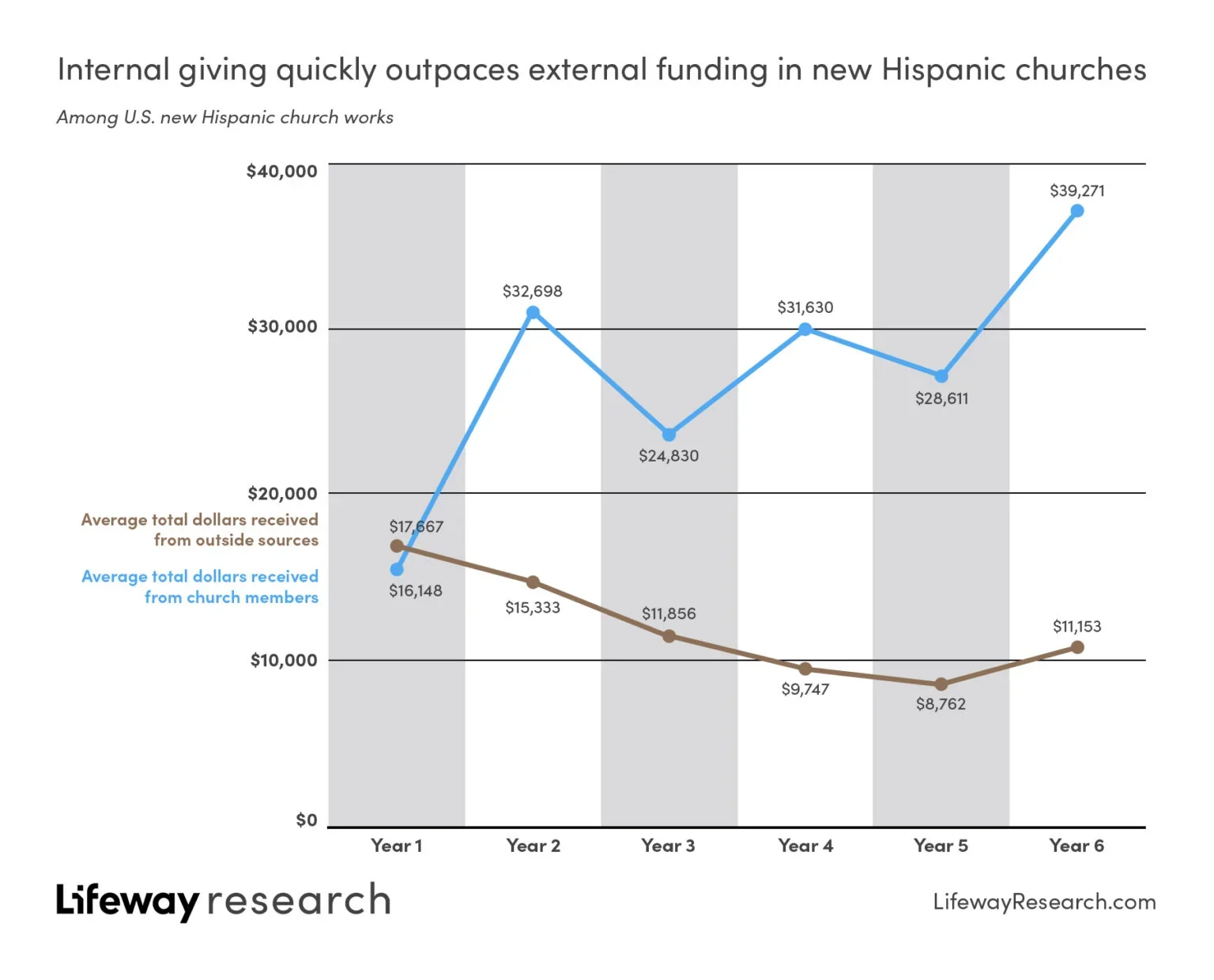
On average, the total dollars received from outside sources generally decrease over the first six years of the church’s existence, while contributions from the congregation generally increase. By the second year, the average church is receiving more from congregants than from those outside the church ($32,698 internal vs. $15,333 external).
Currently, almost half of new Hispanic church works (47%) are financially self-sufficient, including 24% that either started that way or became so during their first year. Slightly fewer (45%) are not self-sufficient, and 8% aren’t sure.
“Average outside financial support totals are relatively small for new Hispanic congregations, making the early work hard and often forcing leaders to have jobs outside the church as well,” said McConnell. “While the typical new Hispanic congregation sees steady growth in attendance, it can be a slower journey to financial self-sufficiency.”
More than a quarter of pastors (29%) did not receive financial compensation for their work with the church in the first five years, while 65% did receive it. Even among those who received pay, 62% say it was not adequate to meet all their and their families’ basic needs.
Four in 5 (79%) have worked an outside job at some point since the church started, including 59% who have done so the entire time. Most of those (54%) say they worked 40 hours or more at their job away from the church.
More than four in five pastors at new Hispanic church works with an outside job (84%) say it is a financial necessity for their family.
For more information, view the primary report in English or Spanish, the significant factors report, the 2019 v. 2025 comparison report and visit LifewayResearch.com.
Aaron Earls is the senior writer at Lifeway Research.