
Baroque Master Zurbarán’s Masterpieces Illuminate Both Faith And Flesh
(REVIEW) The Bible recounts that Jesus was crucified at Golgotha, a hill outside the walls of ancient Jerusalem.
But in the stunning “Crucifixion” of 1627 that introduces this retrospective of Spanish painter Francisco de Zurbarán at London’s National Gallery, the Lord’s pallid flesh and crumpled loincloth are set against viscous darkness.
On loan from the Art Institute of Chicago, the painting originally hung in the dimly-lit sacristy of the Dominican friary of San Pablo in Seville. So heightened is its illusionism that Zurbarán’s countrymen reportedly mistook it for a sculpture.
READ: Inside Carol Bove’s Mystical World
A mysterious, undefined space similarly provides the setting for the nearby “Apparition of Saint Peter to Saint Peter Nolasco” (1629), which depicts an intense moment of spiritual encounter. The 13th-century saint was unable to make the pilgrimage to Saint Peter’s tomb in Rome, and so, it is said, the apostle mystically appeared to him in Spain, on an inverted cross, as tradition records he was crucified. Regardless of the story’s veracity, Zurbarán’s genius lies in his ability to make mystical experiences feel utterly concrete.
These intensely spiritual paintings helped cement Zurbarán’s reputation in Seville, the wealthy port city where he lived for much of his career. This was the age of Catholic revival, when the church was affirming the importance of art as a means of stirring religious devotion. As one of the foremost painters serving that demand, Zurbarán produced altarpieces and devotional works for numerous religious institutions and individual patrons.
In London, The National Gallery — in collaboration with the Louvre in Paris and the Art Institute of Chicago — has gathered together more than 40 of Zurburán’s works for this exhibition, displaying them spotlit across seven darkened rooms to leave you in no doubt that he (alongside Diego Velázquez and Bartolomé Esteban Murillo) was one of 17th-century Spain’s greatest painters.
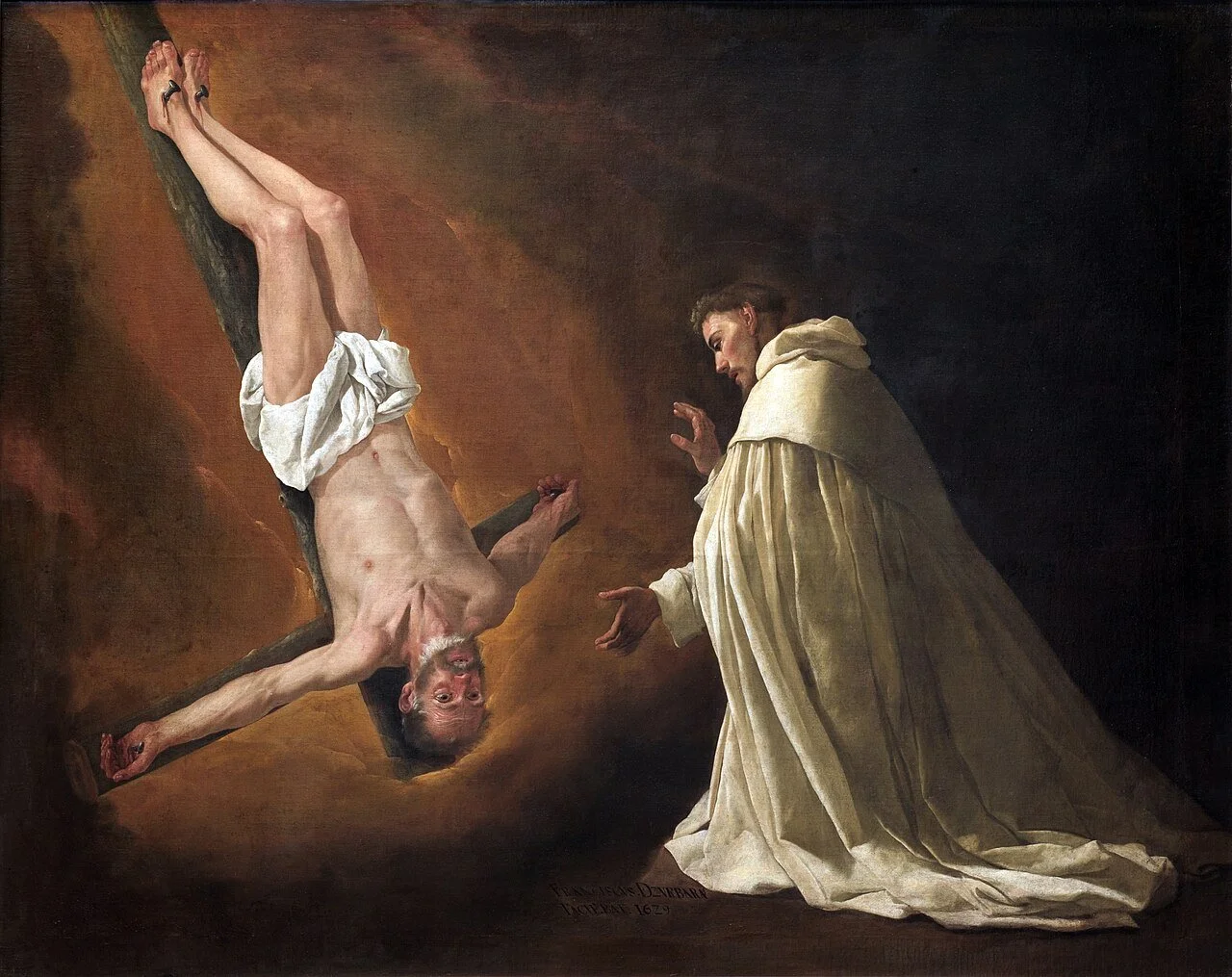
“Apparition of Saint Peter to Saint Peter Nolasco” (1629) Source: Wiki Commons
Three paintings from the astonishing 49-foot-tall (15 meters) altarpiece commissioned for the Carthusian monastery of Nuestra Señora de la Defensión (circa 1638-39) are reunited for the first time in almost 175 years. Here, a scene depicting the Virgin prayed to by adoring monks is flanked by two episodes from Christ’s infancy – the Visitation and the Circumcision. In the first, an emotional magi gazes in wonder at the Christ child, while in the second, the priests’ rich costumes show Zurbarán’s extraordinary attention to detail and interest in the sensuality of surface.
Painted lifesize and with great theatricality, these scenes draw you into their respective dramas, reflecting the church’s belief that art could serve as a bridge between heaven and earth, bringing the faithful closer to God.
Another room brings together a selection of single-figure saints, each one posed in quiet contemplation and dramatically illuminated against dark backgrounds.
The iconic 1636 canvas “Saint Francis of Assisi” depicts Francis in a dark and shallow niche. His partially illuminated brown habit covers his entire body except for his face, which gazes heavenwards in devotion. Nearby is “Saint Francis in Meditation” (1635-39), another deeply atmospheric image in which the kneeling saint prays alone in a dimly lit cell while cradling a human skull.
Also on display are several female saints, including Saint Casilda (1635), a 10th-century Muslim princess who is believed to have smuggled bread to incarcerated Christians. Zurbarán clothes her in magnificent court attire, her jewel-encrusted dress showcasing his exceptional skill as a painter of fabrics.
Zurbarán’s evident interest in pattern and texture perhaps stems from his early years — his father was a merchant who dealt in cloth and the artist later dabbled in the trade himself. From the heavy brocades of saints’ robes to the sumptuous silks of elegant, flowing gowns, each painting in this room suggests an intimate familiarity with textiles.
While Zurbarán is best remembered for his paintings of individual saints, this exhibition presents the full breadth of his production, including his exquisite still lifes. Several of these are shown alongside fruit and flower paintings by his son, Juan.
The standout is Zurbarán’s “Still Life with Lemons, Oranges and a Rose” (1633), a sensitive arrangement of objects across a polished wooden surface. This masterful study of the material world is an undeniable celebration of painting, but it is also a Catholic image: the cup of water and thornless rose being symbols of the Virgin Mary’s purity.
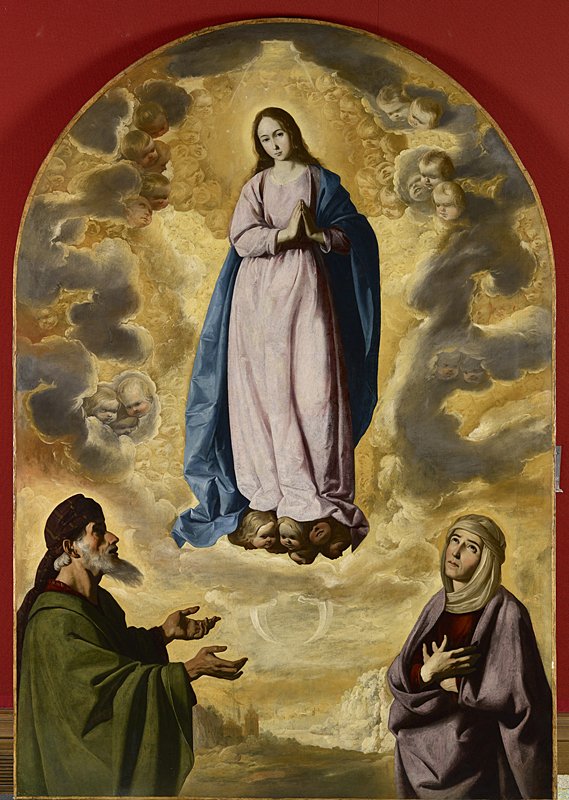
Francisco de Zurbarán’s “The Immaculate Conception with Saint Joachim and Saint Anne” (1638–39). (Image courtesy of National Galleries of Scotland)
Elsewhere, Mary is the subject of Zurbarán’s Immaculate Conception paintings. Of the 15 works on this theme that he completed during his career, two are displayed here. Both present the Virgin Mary as a vision of purity, floating on a cloud of cherubic heads, her hands clasped in prayer. One from 1632 features two boys praying beneath her, while in the other from 1638, her radiant youth is set against the aging features of her parents, Saints Joachim and Anne.
Christ’s crucifixion is another recurring subject for Zurbarán, which he painted at least a dozen times. Whether showing Christ alone or accompanied by onlookers, each one offers a different perspective on the Savior’s sacrifice.
A 1635 version painted for Seville’s Capuchin convent depicts a solitary Christ, focusing on the intensity of his mental torment. Nearby, the artist’s last known depiction of the theme from 1655 juxtaposes Christ’s physical agony with the emotional distress of the three mourning disciples at his feet.
The most unusual crucifixion is found at the end of the exhibition, where a painter, clutching his palette and brushes, stands by the cross. The figure has traditionally been identified as Saint Luke, the patron saint of artists, although this is more likely a self-portrait of Zurbarán himself, or at least his proxy.
By the time this painting was completed in 1650, Zurbarán’s fortunes were fading. Seville had been devastated by plague and economic turmoil, and changing tastes in art saw the younger Murillo overtake him as the go-to painter of religious scenes. His style softened and became increasingly sentimental as in works such as “The Holy Family” (1659), a tranquil and intimate scene possessing none of the drama of earlier works.
In the exhibition’s final room, Zurbarán’s late paintings are contrasted by the striking “Agnus Dei” (1635-40), which depicts an innocent lamb lying on a stone ledge, its legs bound in preparation for sacrifice.
The animal is, of course, symbolic of Christ, whom John the Baptist described as “the Lamb of God, who takes away the sin of the world” (John 1:29). But it is also a real creature whose physical presence is heightened by Zurbarán’s naturalistic rendering of its thick, matted wool, which is brightly lit against another dark background.
An undeniable masterpiece, the painting carries a profound spiritual power. As with the best works in this exhibition, it brilliantly accomplishes Zurbarán’s goal of inspiring emotion and devotion through the medium of paint.
“Zurbarán” is at The National Gallery, London through Aug. 23, 2006, after which it will travel to Musée du Louvre, Paris (Oct. 7–Jan. 25, 2027) and the Art Institute of Chicago (Feb. 28–Jun. 20, 2027).
David Trigg is a writer and art historian based in the U.K. He is the host of the “Exhibiting Faith” podcast. You can find him on Instagram @davidtriggwriter.