
Some Renaissance Paintings Of The Virgin Mary Have A Secret: Islamic Calligraphy
(REVIEW) In 1492, Italian artist Carlo Crivelli painted an idealized portrait of the Immaculate Conception for the church of San Francis in Pergola, a small town in central Italy. Observed every Dec. 8, the feast day commemorates the conception of the Virgin Mary, born free from original sin.
Like most religious paintings of the era, Crivelli’s portrait of Mary is rife with symbolism. Her loose, flowing hair indicates her maidenly virginity, while ripe pears and apples dangling at her side suggest her ultimate fruitfulness as the mother of Jesus.
Floating above her head, a pair of angels unfurl a banner bearing a Latin inscription, drawn from Biblical sources, which translates, “As from the beginning I was conceived in the mind of God, so have I in like manner been conceived in the flesh.”
READ: Faith Deserves Better News Coverage — And Here’s How You Can Help
At her slippered feet, more writing appears along the hem of her luxurious garment. Composed of highly stylized, vaguely Arabic, rune-like squiggles, the jumbled lettering, known to art historians as pseudoscript, is technically indecipherable. However, scholars have more recently been able to decipher key Arabic words, borrowed from the Muslim world.
“It runs so counter to our clash-of-civilizations mindset about Christianity and Islam now that it really short-circuits people’s idea about how medieval Christians viewed the Islamic world,” said Benjamin Tilghman, Nancy L. Underwood Associate Professor of Art History at Washington College in Maryland.
Even for those who can’t read Arabic, the portrait and the bizarre inscription still communicated a message that Crivelli’s audience would have understood.
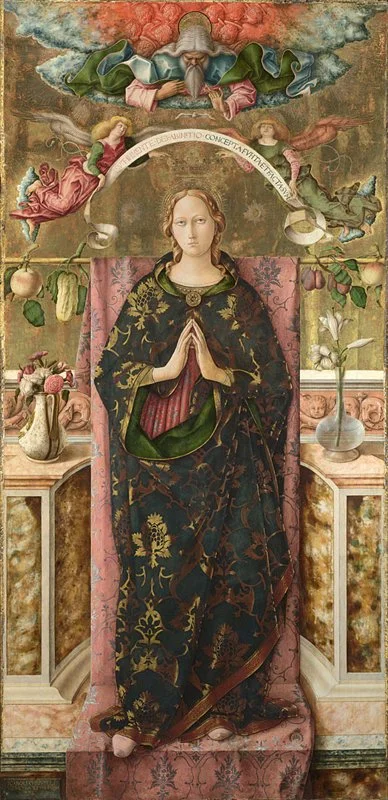
Carlo Crivelli’s “The Immaculate Conception.” Image courtesy of The National Gallery, London
“Robes and hems were associated with the Arabic-speaking world and the eastern Mediterranean where silks and beautiful rugs and textiles came from,” Tilghman said.
Because Mary herself was from the eastern Mediterranean, the subtle incorporation by Renaissance painters of abstractly rendered Arabic or Hebrew in religious art linguistically linked their sacred subjects to the region’s Biblical past as well as its bounteous wealth.
“Because of her status, painters dressed Mary in beautiful clothing made from the finest material, and one of the markers of the finest material is if it had Arabic inscriptions on it,” said Tilghman.
Such was the intention of England’s King Offa, eighth-century ruler of Mercia. His so-called “Offa dinar” — a gold coin stamped with the Muslim profession of faith (“There is no God but God”) in bungled Arabic — emulated contemporary Abbasid empire currency. The extremely rare coin is considered by art historians to be the earliest example of pseudoscript in Europe.
Commerce continued to be the mechanism by which European artists, especially Italian painters, were exposed to the calligraphy of the Muslim world. Busy trading ports such as Genoa and Venice (Crivelli’s hometown) were conduits for all manner of luxury goods from the Middle East and North Africa: Glassware, textiles, metalwork, and more. Beginning around 1300, many of the Italian peninsula’s most celebrated painters such as Giotto, Bellini, and Filippo Lippi began to subtly incorporate variations of the exotic calligraphy decorating these imported treasures into their paintings.
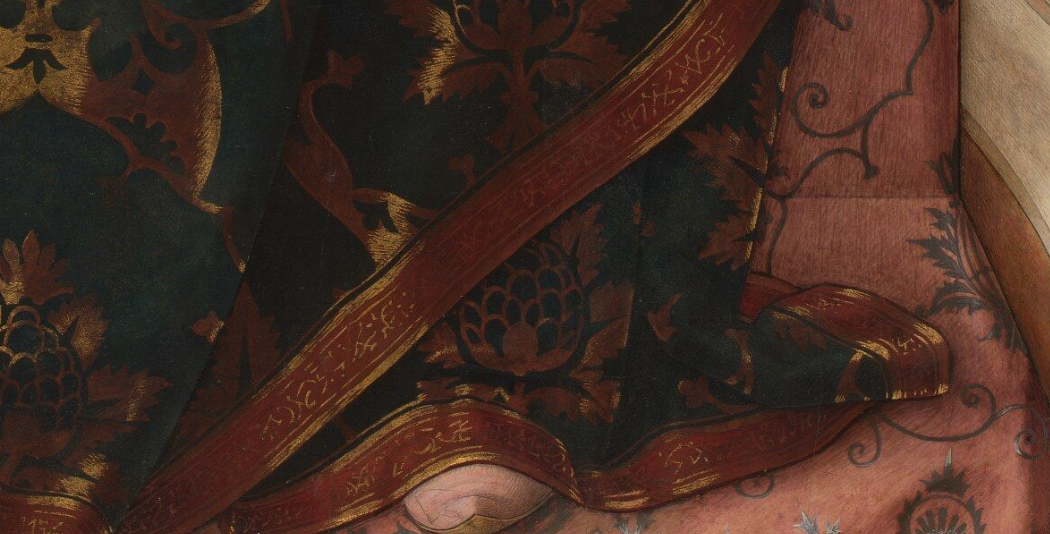
Image courtesy of The National Gallery, London
One popular inspiration was Mamluk metalwork, such as brass dishes and gilded basins inlaid with ornamental script. Even though artists may not have entirely understood the language adorning them, these richly engraved round vessels may well have served as models for the halos of Mary, angels and the infant Jesus.
“Perhaps they thought that the Arabic related to one of the languages at the time of Christ, like Chaldean or Aramaic. Some might have recognized that it was Arabic, but it is so stylized and abstracted, I would say the vast majority would not have recognized it as Arabic script,” said Stephen J. Campbell, professor of art history at Johns Hopkins.
Equally if not more prominent in Renaissance religious paintings is the appearance of pseudoscript in the hems of clothing, especially Mary’s. These flourishes were inspired by elegant Islamic robes of office, reserved for high-ranking officials and royalty, which featured luxuriously embroidered bands of writing known as tiraz.
“It makes her look royal,” said Tilghman, who further speculates that the mysterious, garbled lettering of pseudoscript symbolized the “unknowable, unspeakable, ineffable truth” of Mary’s transcendence.
Yet other scholars maintain that not all pseudoscript is quite so inscrutable. In 2007, Rome-based researcher Vincenza Grassi, an expert in Arabic epigraphy, took a close look at the Arabic lettering on the hem of the baby Jesus’ blanket in Gentile da Fabriano’s early 15th-century Madonna of Humility.
What she discovered was an Arabic royal title, reserved for sultans, which reads, in part: “Glory to … al-Malik [the King], the Lord, the Just, the Sublime, our Lord.” Specialists have also detected Islamic expressions such as baraka (God’s blessings), al-mulk (the title of a chapter in the Qur’an meaning “Sovereignty”), and al-yumn (prosperity) in a variety of Renaissance religious paintings.
On the one hand, the wholesale use of these Arabic invocations by Renaissance artists was purely imitative. Because the phrases routinely appeared on luxury items imported to Europe from Egypt and Syria during the late Middle Ages/early Renaissance, they frequently showed up in religious art of the time.
“These inscriptions were commonly available to artists, who chose to replicate them as symbols of opulence and luxury to honor the sacred figures they depicted,” according to Ennio Napolitano, a fellow at the Orient Institute Beirut whose research focuses on the interpretation of Arabic inscriptions in European art.
Their use, however, in Christian paintings should not be interpreted as an endorsement of Islamic concepts, which would have been “a religious breach,” Napolitano emphasized.
Still, they also serve as a reminder of the cosmopolitan nature of the era.
“The transfer of Islamic decorative epigraphical patterns in the Western world was made possible by the circulation of knowledge among three neighboring cultures, namely the Islamic world, the Byzantine East and the Latin West,” Grassi observed in her 2016 study, “Rethinking Arabic Pseudo-Inscriptions in Context.”
This makes sense to Campbell, who pointed out that even if the artists themselves did not have a grasp of Arabic, some of their well-educated, well-traveled patrons, such as the Dominicans or Franciscans, did. And if European Christians were comfortable enough with purchasing luxury items inscribed with Middle Eastern languages “it’s a short leap to including them in a picture,” Tilghman said.
Crivelli’s portrait of the Virgin was among the last religious paintings of the day to include pseudoscript, a trend that soon fell out of favor after 1500. Politics may have had something to do with the decline. European attitudes towards the Muslim world began to sour after the fall of Constantinople (modern-day Istanbul) to the Ottomans in 1453. The Sultan’s armies subsequently threatened to overthrow Europe itself, marching as far as the gates of Vienna before finally being repulsed.
Technology, too, played a role. The invention of the printing press in the mid-fifteenth century standardized the written word, including Middle Eastern languages, which began to appear in Western printed texts, a medium with which Renaissance artists couldn’t compete
“When European intellectuals began actually knowing how to read Arabic, Persian, Hebrew or Aramaic script, painters couldn’t just fudge it anymore,” Campbell said.
Admittedly, pseudoscript remains the purview of specialists. But once its presence and cross-cultural objectives are revealed to the casual observer, it not only becomes hard to unsee, it compels a reassessment of our own times as well as those of the great Renaissance painters.
Tom Verde is a freelance journalist, specializing in religion, culture and history.