
A Fiercely Independent Artist Found Catholicism — And Her Art Is ‘Quietly Intense’
(REVIEW) Celebrated for her quietly intense paintings of domestic interiors and solitary female figures, Gwen John is recognized as one of the finest Welsh artists of the early 20th century.
From the moment she left her home in Tenby, South Wales, John pursued a fiercely independent course — first in London and then Paris — where she lived until the end of her life.
Although she was acquainted with leading European modernists, she never aligned herself with any group or movement. Instead, John nurtured a personal visual language rooted in subtle symbolism and a poetic vision of the world.
READ: Why This Is England’s Best Stained Glass Window
Marking the 150th anniversary of John’s birth, the ambitious international touring exhibition “Gwen John: Strange Beauties” at the National Museum Cardiff foregrounds the religious dimension of her work. Indeed, her conversion to Catholicism in 1913 had a profound effect on her art, evident both in her choice of subjects and the evolution of her style. Bringing together well-known paintings with rarely seen works on paper from the museum’s extensive holdings, the exhibition demonstrates how the artist’s faith became deeply entwined with her practice.
After studying at the Slade School of Art in London and later under James McNeill Whistler in Paris, John moved permanently to the French capital in 1904. Intent on living independently, she rented a succession of modest lodgings in Montparnasse that doubled as studios.
Her paintings of this period see the domestic interior become a central subject, alongside intimate self-portraits and pictures of lone women. Notably, she painted several pairs of visually similar pictures with small compositional changes between them, some of which are reunited in the exhibition.
The closely related works “A Lady Reading” (1910) and “Girl Reading at a Window” (1911) not only demonstrate John’s growing interest in repetition and subtle variation but also how carefully she observed her subjects. These pieces, made before John’s conversion, show her interest in religious art, recalling Renaissance annunciation scenes depicting the Virgin Mary reading, although there are no angels to be seen.
Her multiple “Convalescent” paintings of an anonymous woman dressed in blue and sitting in a wicker chair reading a book or a letter, similarly evoke traditional images of Mary. Five have been brought together for the Cardiff exhibition, and in each one the figure is lit by a radiant light. Painted in the aftermath of World War I, they are poignant images of recovery which have also come to represent the new forms of independence that women were achieving during this period.
To support herself in Paris, John took work as a life model, posing for artists such as the sculptor Auguste Rodin, with whom she had a long and tempestuous affair. In 1911, she moved to Meudon, a suburb southwest of the city, where she became involved with the Catholic community there. She attended Mass at the small and intimate Church of Saint Martin and began sketching congregants, a practice she continued for the next two decades.
While John’s family had been Anglicans and she had occasionally visited nonconformist chapels as a child, her conversion to Catholicism was part of a larger trend among French artists and intellectuals during the late 19th and early 20th centuries. Her immersion in the faith also coincided with the conclusion of her decade-long relationship with Rodin, which was another likely factor in her desire for spiritual fulfilment.
For John, art making became a spiritual practice, and by the early 1920s, she referred to herself as “God’s little artist.” In her private writings, she claimed divine inspiration for her work. As she wrote in the late 1920s: “Je suis l’enfant de l’Enfant Jesus” [“I am the child of the Child Jesus”). He has told me to do my drawings.”

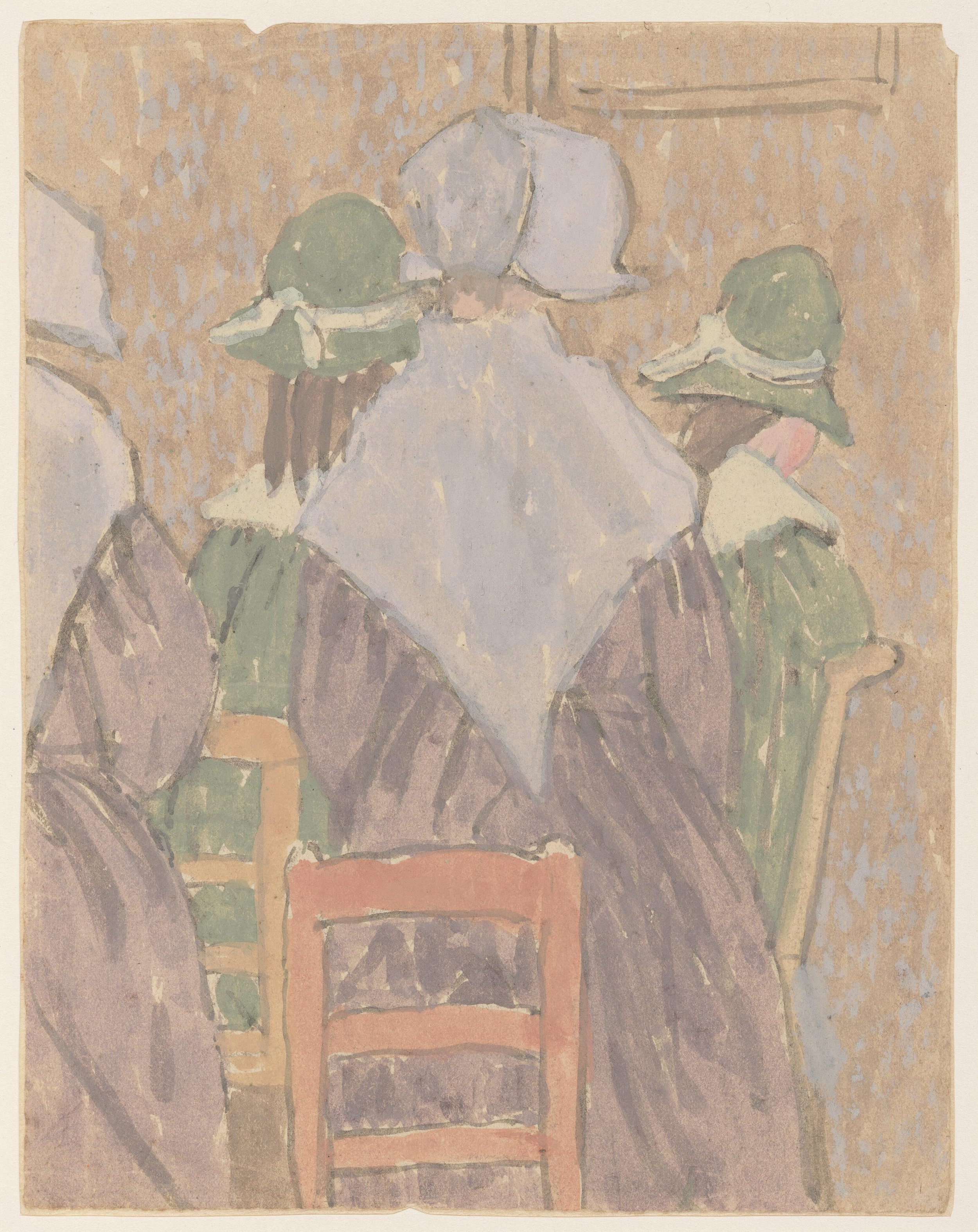
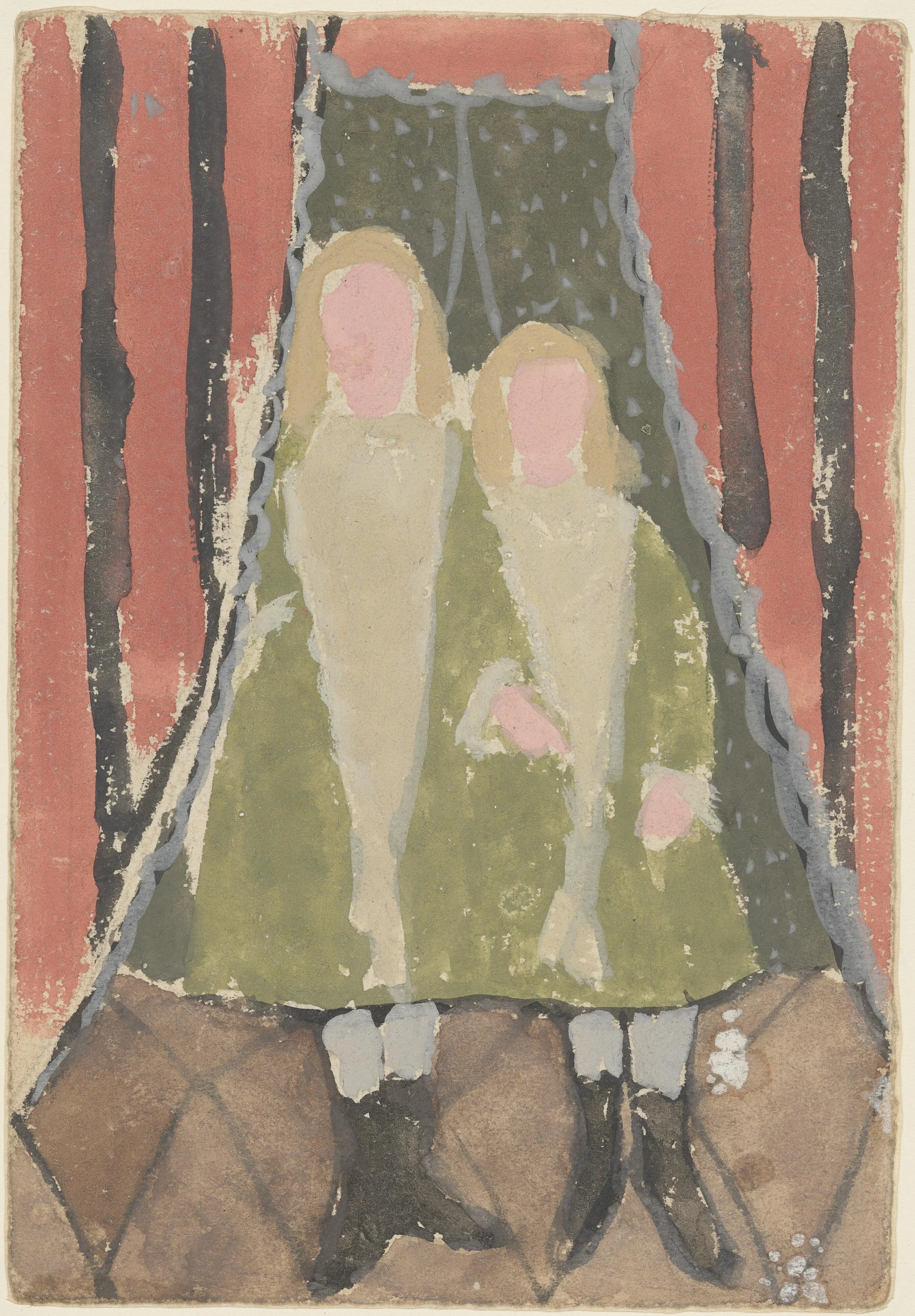

Images courtesy of National Museum Cardiff
After her conversion, she was commissioned by the Dominican Sisters of Charity at Meudon to paint a portrait of Mère Marie Poussepin, the founder of their order. At least six versions were completed, though only one was ever displayed at the convent.
From this time onwards, John rarely produced a painting or drawing without making multiple versions of it. She also moved away from the academic methods of painting she had learned as a student to work in a looser style informed by French modernism. She took particular inspiration from the painter Maurice Denis, who advocated for a modern approach to religious art.
But unlike her more radical contemporaries, her still and dignified portraits eschewed bold, bright palettes in favour of a restrained aesthetic with chalky, muted colours.
John’s paintings of Poussepin, which were based on an old portrait printed on a prayer card, were at once devotional images designed to encourage contemplation and works of modern art.
One version was exhibited at the prestigious Salon d’Automne exhibition in Paris, while two further versions were shown in John’s 1926 solo exhibition at London’s New Chenil Gallery. This exhibition also featured characterful portraits of the Dominican nuns that she had painted from life, several of which are on display in Cardiff. Some of the sisters are seated at a table while others are depicted against a plain background. Each one wears the traditional Dominican habit and possesses a quiet, almost mystical presence.
John even made deathbed drawings of nuns on several occasions. In one from 1918, the deceased figure holds a rosary in her hands, her serene expression giving the appearance of being asleep.
Between the 1910s and 1930s, John made hundreds of drawings and watercolors of congregants at the Church of Saint Martin. Typically depicting her subjects from behind, she filled sketchbooks with studies of women, nuns and children from the local orphanage.
Executing her sketches quickly and discreetly during services, she later reworked them in her studio, experimenting with colour and pattern. The exhibition’s co-curator, Lucy Wood, has suggested that John’s sustained practice of drawing in church can be understood as a form of worship, a process echoing the rhythms of prayer.
John was devoted to Saint Thérèse of Lisieux, a cult figure in early 20th-century French Catholicism. Thérèse taught the doctrine of the “Little Way,” which involved surrendering every part of one’s life to Christ and, specifically, embracing his cross in the ordinary, little things of daily life.
John made hundreds of drawings and watercolors of the saint and her sister Céline based on a prayer card. Sequentially copying and abstracting the source image, she changed colors, added details and sometimes even removed the figures’ faces. The exhibition closes with a selection of these small works, which range from quickly executed pieces in pen and ink to precisely painted watercolors. Whether intended acts of devotion or just stylistic experiments, they appear as enigmatic as the artist herself.
Although John was an artist rooted in tradition, she was attentive to developments in modern art. Her work was underpinned by her intellectual and religious interests alongside preoccupations with beauty, Renaissance art and modernism — all of which she sought to combine in her art. For her, Catholicism and modernism were two sides of the same coin — equal forces in her life and work that encouraged creative exploration while prompting her to look beyond the material world to discover the inherent wonder and beauty in all things.
“Gwen John: Strange Beauties” is at National Museum Cardiff through June 28 after which it will travel to the National Galleries Scotland: Modern Two, Edinburgh (Aug. 1–Jan. 4, 2027); Yale Center for British Art, Connecticut (Feb. 18-June 20, 2027); and National Museum of Women in the Arts, Washington D.C. (July 30–Nov. 28, 2027).
David Trigg is a writer and art historian based in the U.K. He is the host of the “Exhibiting Faith” podcast. You can find him on Instagram @davidtriggwriter.