
‘Inconsistency Of Attendance’: Men’s Ministry Vital to Churches’ Health
Although men may be attending church more, congregations with organized men’s ministries appear better equipped to fully disciple them.
A Lifeway Research study of 1,000 evangelical and Black Protestant male churchgoers and 473 men’s ministry leaders highlighted the importance of dedicated men’s ministries.
Currently, 58% of male churchgoers say their congregation has an organized men’s ministry, 23% say there is nothing formal but there are activities specifically for men, 14% say their church has no activities for men and 5% aren’t sure.
READ: Baptist Colleges Find Growth Despite ‘Challenging Times’ For Higher Ed
“As a whole, the findings from the research paint an encouraging picture of men’s ministry in churches across America,” said John Paul Basham, director of Lifeway Adults. “There is agreement in several key areas including what most defines a man and what moves the needle most in a man’s spiritual life.”
Numerous research organizations have noted a shrinking church attendance gender gap. Lifeway Research’s State of Discipleship found male and female churchgoers currently attend worship services at the same rate.
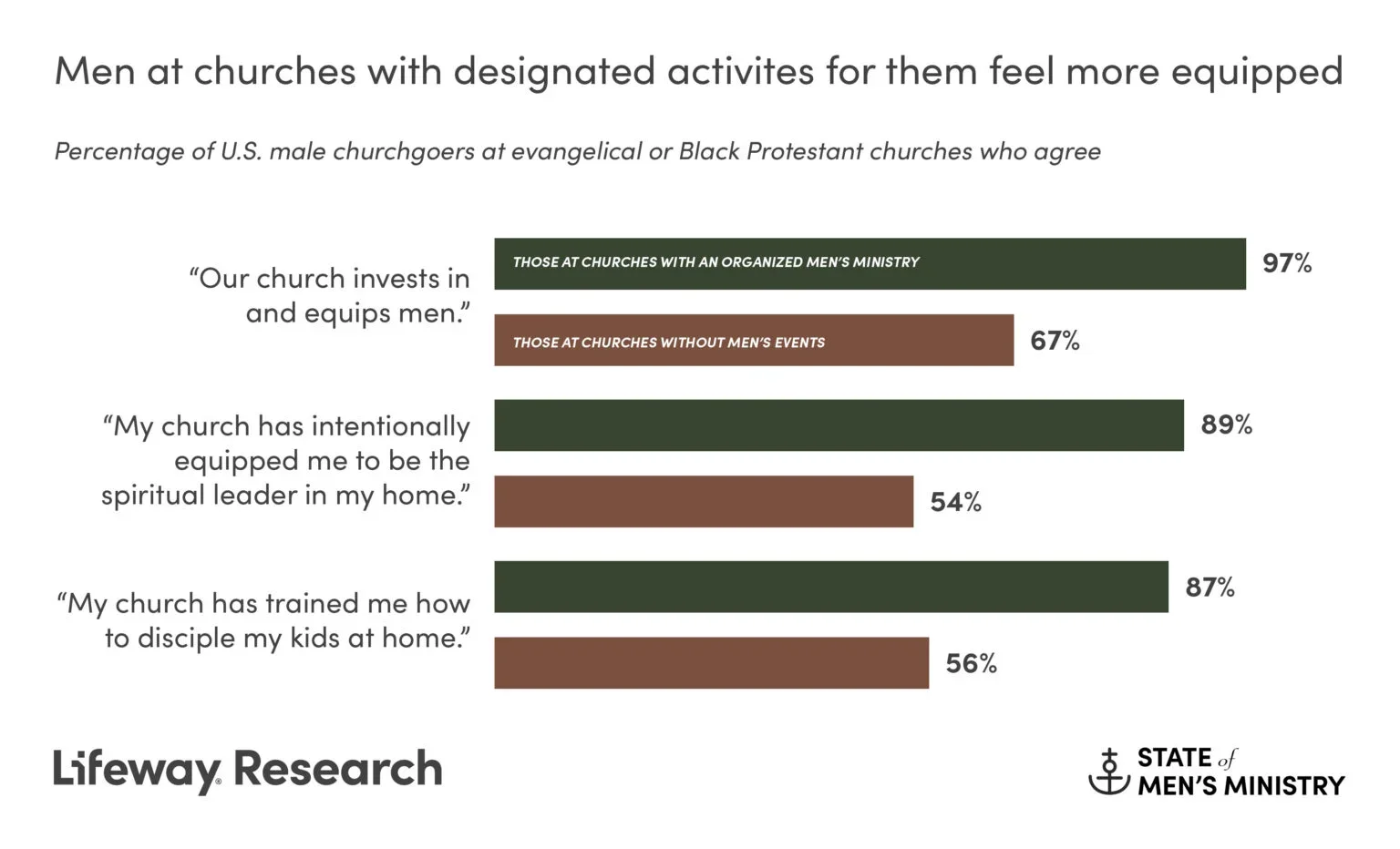
Overall, 97% of male churchgoers believe their church values men, according to this latest Lifeway Research study on men’s ministry. Attending churches with activities for men, however, significantly increases the likelihood a man feels ready for his spiritual calling.
Compared to men at churches with organized men’s ministries, those at churches without the intentionality of activities specifically for men are less likely to say their church invests in and equips men (67% vs. 97%), trains them to disciple their children (56% vs. 87%) and equips them as the spiritual leader in their home (54% vs. 89%).
“A little bit of intentionality has a big impact on men in church,” said Scott McConnell, executive director of Lifeway Research. “Men in churches that have an organized men’s ministry are noticeably more likely to report they have relationships at church and are personally invested in the spiritual growth of others than those in churches without activities specifically for men. Men flourish in key relational discipleship elements when there is an organized men’s ministry.”
Organization also makes a difference from the leader’s perspective. Around 3 in 4 men’s ministry leaders (74%) say their church has an organized ministry to men. Those leaders are more likely than leaders in churches without an organized men’s ministry to say they have a spiritual development pathway or plan to guide and encourage men to take the next step in their walk with Christ (46% vs. 27%).
Leaders within organized ministries rate themselves and their ministries higher on nearly every impact measure than those who lead informal ministries with men’s activities. In particular, 77% of organized ministry leaders say they hear men give God glory each month for what they are experiencing in their men’s ministry, compared to 46% of those heading an informal ministry.
“Upgrading a few men’s activities to an organized men’s ministry noticeably improves a church’s readiness to meet the needs of different types of men,” said McConnell. “Many men’s ministries have room to improve their plans and their approaches, but an intentional ministry is noticeably better than a church with simply something for men on the calendar.”
As churches evaluate their men’s ministry, there are several issues where leaders and churchgoers feel aligned, but other areas highlight disconnects between the two groups that could hinder ministry.
Aligned areas
Both ministry leaders and male churchgoers recognize the importance of a shared meal for men. Four in 5 (79%) ministry leaders say they held some type of food event last year to develop community and fellowship among new and existing men in their church, which makes it among the most common men’s events. Additionally, 2 in 3 leaders (65%) say those events were the most effective at developing community.
When asked about men’s activities their church offered last year, 60% of male churchgoers point to gatherings with food. They are more likely to mention their church offering those events than men’s small group Bible studies (54%), prayer gatherings (48%), guided discussions (40%), large group Bible study gatherings (39%), community service opportunities (39%), recreational activities (37%), retreats (28%) or gatherings with an outside speaker (26%).
“Whether food is the reason they are coming, the thing that makes inviting easier or simply means they feel less pressure to talk, men notice that food fits with a large portion of their men’s ministry gatherings,” said McConnell.
While eating together might be the most common event, both men and leaders say Bible study is the most important.
Seven in 10 leaders (70%) say they offered Bible studies for men in the past year to disciple them and encourage their walk with Christ. Almost half (48%) say that has been the most effective discipleship activity.
Among male churchgoers, not only do most (54%) recall their church providing small group Bible studies last year, but they also see that as a priority. When asked the three most important things their church needs to do to minister to men, 40% say teaching the Bible.
That’s a more common answer than providing encouragement and support for men (34%), creating a safe place for men to share struggles (30%), praying together as men (29%), listening and understanding men’s needs (28%), inviting and encouraging men to participate (27%), teaching men how to be a spiritual leader (27%), teaching men how to pray and study the Bible (25%), fostering relationships among men (18%) or defining biblical manhood (18%).
The desire to study the Bible together leads both men’s leaders and churchgoers to recognize discipleship as the purpose for their ministry.
Leaders are most likely to say discipling men is the top priority for their ministry (38%), ahead of reaching men who are not yet followers of Christ (24%), developing community and fellowship among men (17%), mobilizing men to serve and minister to others outside the church (13%) and mobilizing men to serve and minister to others within the church (7%).
They are also most likely to say they measure the effectiveness of their ministry based on men experiencing spiritual growth and more biblical thinking (25%), ranking that higher than changed lives (21%), positive feedback or excitement (17%), attendance and participation (16%), men reaching out and bringing others (11%) and friendships and community among the men (10%).
More than 1 in 5 churchgoing men (22%) say activities with only a social and no spiritual emphasis would discourage them from participating in their church’s men’s ministry.
Among those male churchgoers with designated activities for men, 55% say they have experienced spiritual growth they would not have experienced had it not been for their church’s men’s ministry.
Additionally, both see an importance in mentorship. Almost half of leaders (45%) say they offer mentoring to disciple men. One in 5 leaders (21%) say it has been one of the most effective discipleship activities. Churchgoing men see young men being mentored (59%) as one of the top values their church’s men’s ministries brings that wouldn’t exist otherwise.
“The majority of men in churches with men’s ministry activities report spiritual growth as a result. Many also benefit from gaining wisdom from other men and stronger individual and collective relationships,” said McConnell.
Ministry disconnects
In some areas, men’s ministry leaders and churchgoing men seem to have different perspectives on what’s happening and what they want out of activities. The most significant divergence may be on actually attending events.
While larger churches tend to have extensive men’s ministries, leaders at most congregations regularly draw only a few men. The median leader reports 20 men who are a regular part of their church participate in the men’s ministry, and almost half (47%) say they have 15 or fewer participants. Around 3 in 4 (72%) say the largest attendance at a men’s event last year was 50 or fewer.
Three in 5 men’s ministry leaders (61%) say their biggest challenge is men not attending or participating, by far the highest percentage of other potential challenges. Additionally, around half (48%) say more men participating in general is one of the two changes that would have the greatest impact on their ministry next year.
Three in 5 churchgoing men (60%) say they attend worship services at their church four times or more each month. They are less likely to be active in small group classes like Sunday School, however. Around a quarter (26%) say they attend small groups four or more times a month. Lifeway Research’s State of Discipleship finds female churchgoers attend small groups 3.2 times in a typical month compared to 2.8 times for churchgoing men.
Still, men say they participate in their church’s men’s ministry. More than 4 in 5 male churchgoers (83%) attended at least one men’s ministry activity last year. Around half (52%) say they participated in at least three, including 28% who say they attended five or more events.
“The consternation among men’s ministry leaders around men attending is likely driven by the inconsistency of attendance. Activities like Bible studies and mentoring don’t work well if men attend half the time. And it is hard to develop relationships with a new set of men each event,” said McConnell.
Additionally, leaders don’t see their men’s ministries as geared toward reaching those outside of the church, but the men involved seem to have a different perspective.
A quarter of men’s ministry leaders (24%) say reaching men who are not yet followers of Christ is the highest priority for their ministry, behind only discipleship (38%). Around 3 in 10 (29%) say their men’s ministry has primary responsibility in their congregation for outreach to men. But leaders don’t believe they’re effective at it.
Almost 2 in 5 (37%) say they don’t draw men from outside their church into Christian community well at all. Just 1 in 5 (21%) say they do that at least well, including only 2% who say they do it very well. Three in 10 (31%) believe their men’s ministry is well designed to meet the needs of men who are not yet followers of Christ.
“Inside of the church, we are reaching only a certain segment of our men, and outside of the church we are far less effective than we could be,” said Basham. “The encouragement to men’s ministry leaders is that men typically respond well to a challenge and just want a plan to follow. These statistics present an opportunity to identify the categories of men inside and outside of the church that are not being reached well and create a plan to reach them.”
Meanwhile, churchgoing men are using the ministry for outreach and would like help to do it more. Around 3 in 4 (73%) in churches with men’s activities say they invited at least one man from outside their church to a men’s ministry activity last year, and more than a third (37%) extended three or more invitations.
“Not only did most men attend at least one men’s event at their church last year, but even more importantly, among those who attended, 73% reported inviting someone to come to a men’s ministry event,” said Basham. “This shows there is willingness from men to attend these events and encourage others to do so.”
Three in 10 male churchgoers (30%) say they wish their church had more ministry to help men who struggle with sharing about Jesus with non-Christians they know. Around a third of leaders (36%) say their ministry currently mobilizes men to share the gospel personally at least well.
Other areas expose gaps between what a church provides and what men are looking for.
When asked in what areas they wish their church had more ministry to help men, nearly 2 in 5 male churchgoers say mental health (39%). Just 2% of leaders say that as a top-of-mind response to an open-ended question asking the most common spiritual need they see. Fewer than 2 in 5 leaders (38%) feel their ministry helps men find healing from trauma, hurts and grief at least well.
Around a quarter of men say they’d like more help from their church on sexual temptation and pornography (27%) and alcoholism or drug addiction (25%). Among leaders, 15% say they offered addiction recovery groups in the last year. In an open-end question, 2% say they believe addiction or immorality is the most common spiritual need in their ministry.
“Some of the needs mentioned by large minorities of men such as addictions require additional intentionality from men’s ministry leaders,” said McConnell. “While there is always room for caring and praying for the needs of individuals, greater intentionality is needed to provide specific, practical help for things that are side-tracking men.”
Missing young men
Men’s ministry leaders say few young men are involved in their events, and those young men often say they are getting their spiritual development from outside of the church.
Leaders estimate around a third (31%) of their participants are age 40 or less, including just 9% who are 18 to 25. Most (57%) are between 41 and 70, with 30% between 56 and 70. Another 12% are 71 and older.
Men’s leaders feel their ministry is far better designed to meet the needs of working men (82%), dads (77%) and retired men (72%) than single men (45%), men with no kids (39%) and men in college (28%).
Older men, however, are the least likely to take part. Churchgoing men 65 and older are the most likely to say last year they didn’t attend any activities for men in their church (27%) and didn’t invite any men outside the church to a men’s ministry activity (35%). They are also the least likely to intentionally spend time with other believers to help them grow in their faith (61% vs. 81% of those 18-49 and 74% of those 50-64).
“Churches need to involve older men into men’s ministry. Churches need their wisdom and need to help them connect with others relationally and show them how to invest in younger generations,” said McConnell.
Young men appear to feel the lack of design. Those 18 to 34 are among the least likely to recognize a variety of values in their church’s men’s ministry, including the least likely to say a safe space is provided for men to discuss their problems and struggles (40%), the relationships among men in the church are stronger (39%), men learn about and discuss biblical manhood (38%), opportunities are provided for men to grow as leaders (38%), relationships across age groups are stronger (28%) and a forum is provided for accountability among men (23%).
That age group is also among the least likely to say they have experienced spiritual growth they otherwise wouldn’t have because of their church’s men’s ministry (44% vs. 56% of those 50 to 64 and 62% of those 65 and older).
Male churchgoers 18 to 34 are among the most likely to use sources of spiritual development outside of their church, like social media (34%), group Bible studies in their community (29%) or a Christian mentor (26%).
Young men are also among those less likely to point to their own study of the Bible (38%) or serving alongside other Christians (24%) as a means of spiritual development.
“Jesus told His disciples not to discourage other ministries as long as they were focused on Jesus Christ. Similarly, churches should not discourage people connecting with good biblical content outside of church,” said McConnell. “But serious conversations about what young men are facing should be happening within the church as well, and close friendships should be fostered that can encourage development of helpful spiritual disciplines.”
For more information, view the complete men’s ministry leaders frequencies and differences reports, the complete male churchgoers frequencies and differences report and visit LifewayResearch.com/MensMinistry.
Aaron Earls is the senior writer at Lifeway Research.