
Even At The World Cup, England’s Flag Carries Meanings Beyond Soccer
(ANALYSIS) When England walk onto the field to face Norway in the World Cup quarterfinals, thousands of St. George’s flags will wave inside Hard Rock Stadium in Miami. Millions more will adorn pubs and homes across England.
The white background and bold red cross serve as a rallying point for fans dreaming of another step toward soccer immortality.
For many fans, the flag — which from the Late Middle Ages has been associated with Saint George, a military saint often depicted as a crusader, since the year 1290 — remains inseparable from soccer itself. It is a symbol of hope, community and national pride, unfurled every four years as England's supporters dare to believe that “football’s coming home.”

Real People. Real Reporting. Donate to Religion Unplugged now through August 17, and your gift will be doubled.
Outside stadiums, St. George’s Cross (which also appears on England jerseys) has come to represent something far more complicated. In recent years, England’s flag has become an increasingly common sight at violent marches and riots that have grown in both frequency and scale. That tension forms an unusual backdrop to England’s biggest match of the tournament.
Unlike the Union Jack, which represents the entire U.K., St. George’s Cross belongs exclusively to England. For decades, it occupied an uneasy place in public life. Outside major soccer tournaments, many English people were reluctant to display it because of concerns that it had become associated with far-right groups during the latter half of the 20th century.
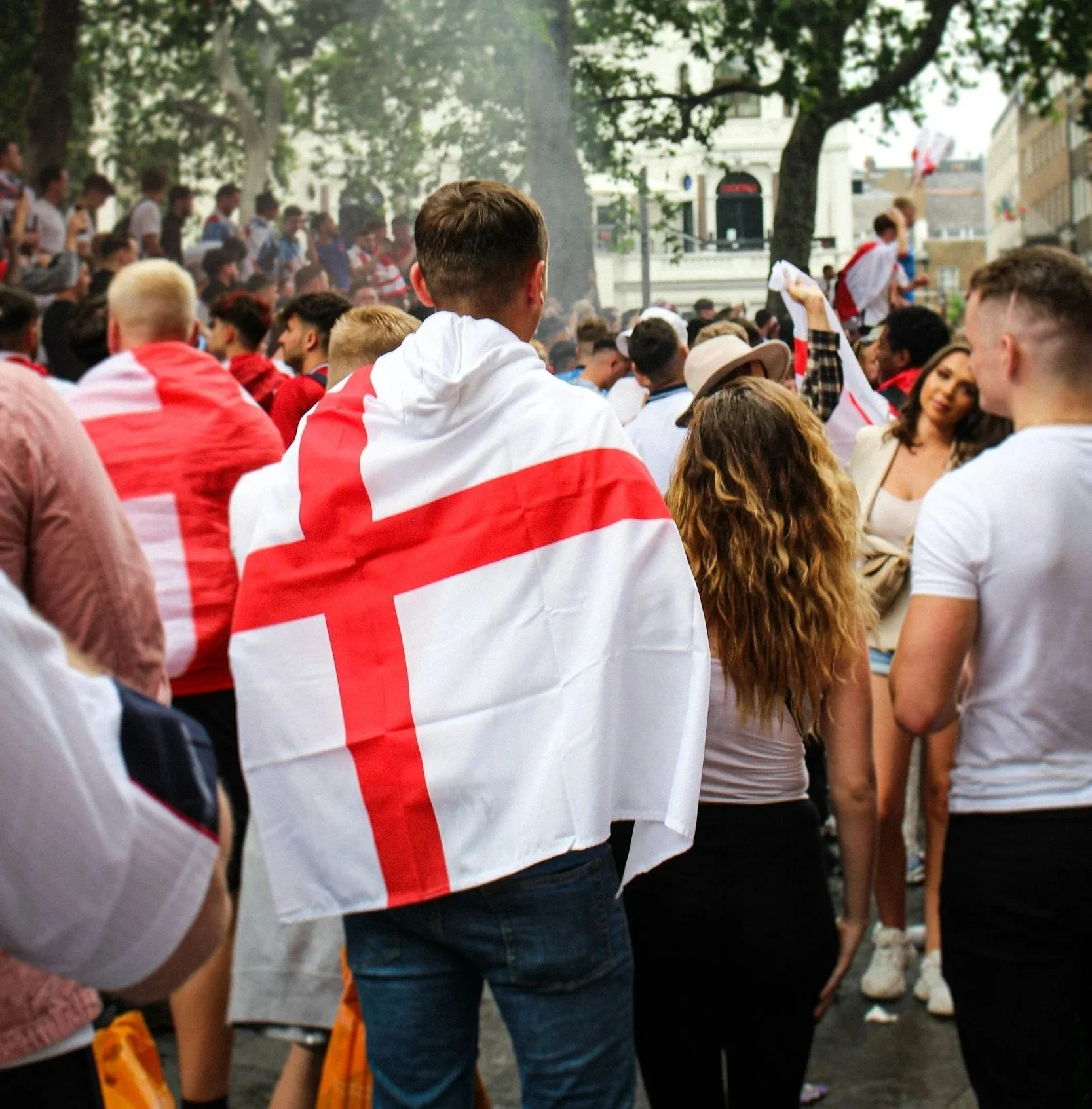
England fans gather to watch a soccer match. (Unsplash photo)
Evolving symbol since the 1990s
Soccer helped change that perception. Starting in the early ‘90s and accelerating through tournaments such as the 1996 European Championship and the 1998 World Cup, the flag became a mainstream symbol again.
Families decorated their homes, and cars flew miniature versions from their windows as a celebration of English identity rather than a political statement. The national team's multicultural makeup also broadened its meaning, with players from diverse ethnic and cultural backgrounds representing a modern England that challenged narrow definitions of nationhood.
For a time, soccer appeared to have reclaimed the flag. Yet, symbols are rarely fixed. Their meaning evolves according to the contexts in which they appear. Over the past several years, the St. George’s Cross has once again become highly visible beyond soccer, this time at demonstrations marked by confrontation, unrest and, in some cases, violence.
For many participants in those protests, displaying England’s flag is intended to reinforce arguments about patriotism, sovereignty or national identity. Critics argue that such groups deliberately wrap themselves in national symbols to present their causes as representing the country itself.
Supporters have countered that they are simply expressing legitimate national pride. Whatever the motivation, the repeated appearance of the flag during episodes of unrest has inevitably influenced how it is perceived by the wider public.

A pub in England prepares to welcome World Cup fans. (Unsplash photo)
Culture beyond soccer
Soccer — and the World Cup in particular — therefore occupies a unique position in this debate. The flag appears in cities and villages, outside homes of every political persuasion and among supporters of every ethnic background. The same emblem that may provoke unease in one context becomes an expression of shared celebration in another.
England’s national team has played an important role in preserving that broader meaning. The squad reflects the diversity of modern England, with players whose family histories span multiple continents. Their success has repeatedly offered an alternative vision of English identity — one rooted not in exclusion, but in collective achievement.
That is one reason why major tournaments often feel culturally significant beyond soccer. Victories temporarily create a shared national experience that transcends many of the divisions dominating political debate. During successful tournaments, the flag often returns to being simply what most supporters want it to be: the banner under which England competes.
Saturday’s quarterfinal against Norway arrives at precisely that intersection between sport and society. England enters the game carrying expectations that extend well beyond soccer itself. Progress to another semifinal would reinforce the remarkable consistency the team has enjoyed in recent years, although it should be noted that England has only won the World Cup once (and that was back in 1966).
It would also produce another weekend in which the St. George’s Cross fills streets, pubs and stadiums for reasons that have nothing to do with political confrontation. That should not erase the genuine debates surrounding the flag’s changing symbolism. National symbols inevitably become arenas in which competing ideas about identity are expressed.
Soccer continues to demonstrate that no single movement or ideology owns St. George’s Cross. Millions of fans display it not as a statement about politics but as a declaration of belonging to a team, a shared experience and enduring hope of millions that this could be the year England wins the World Cup again.
Clemente Lisi serves as executive editor at Religion Unplugged.