
Canadians See Split Between Religious Beliefs and Truth
Canadians don’t think religious belief is about objective truth, and their religious beliefs demonstrate that reality.
The new State of Theology in Canada Study surveyed more than 3,000 Canadians on 35 questions. Conducted by Lifeway Research and sponsored by Ligonier Ministries, the study sought to gauge the theological and cultural beliefs prominent in Canada.
“With the State of Theology survey, we want to reveal what people really believe about God and His Word — both outside the church and inside the church,” said Chris Larson, chairman of the board for Ligonier Ministries Canada.
“We hope these survey results can highlight key areas where people more broadly, and churches specifically, may be influenced by cultural ideas that contradict the truth of Scripture. And the aim in all this is to equip Christians for intentional discipleship, to bring a biblical corrective to widespread, false and destructive ideas.”
Scott McConnell, executive director of Lifeway Research, agreed and noted that “most Canadians may not relish their views being compared to the Bible, as fewer than 2 in 5 say it has authority or is completely accurate.”
Canadians aren’t looking to religion or the Bible for conviction and expertise. Half (51%) agree religious belief is not about objective truth, 23% disagree and 25% aren’t sure. Additionally, only a third (34%) believe the Bible has the authority to tell us what we must do. Most (56%) disagree, with 38% strongly disagreeing, and 10% aren’t sure.
“Across theological questions, Canadians have diverse views, and the places where the most Canadians share the same theological views reflect pluralistic thinking,” said McConnell. “Yet, it is interesting to see some beliefs where a majority agrees with the Bible and others where a clear majority has other views.”
Lifeway Research and Ligonier Ministries have also regularly conducted the State of Theology Study in the United States.
Theological thoughts
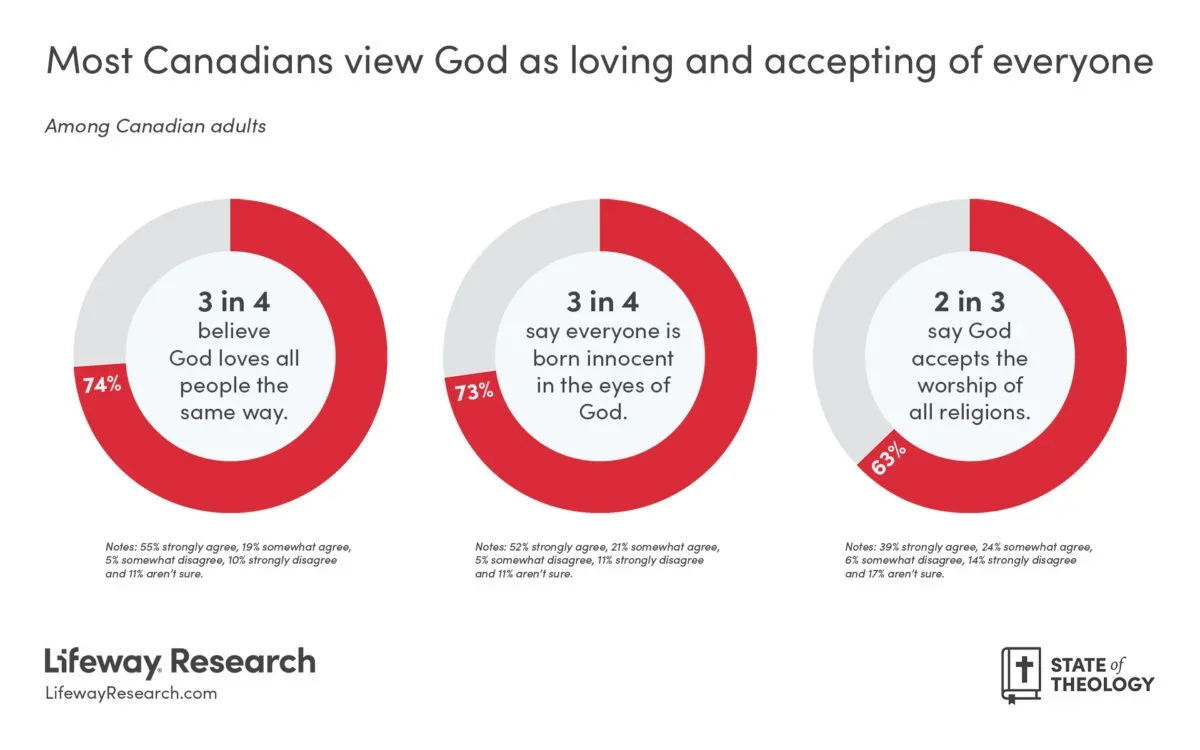
Canadians are more sure about God’s love and acceptance of everyone than other issues in the State of Theology. Three in 4 (74%) say God loves all people the same way, and 73% believe everyone is born innocent in the eyes of God. Almost 2 in 3 Canadians (63%) believe God accepts the worship of all religions. One in 5 (20%) disagrees.
Close to 3 in 5 (59%) believe God is unchanging, while 20% disagree. Most (52%) say God is a perfect being and can’t make a mistake. A third (33%) disagree.
Canadians are split over God’s concern about their daily lives. Two in 5 (41%) believe God is unconcerned with their day-to-day decisions, while 42% disagree.
Most Canadians (56%) believe there is one true God in three persons: God the Father, God the Son and God the Holy Spirit, but they aren’t clear about the specifics. The same percentage (56%) say Jesus was a great teacher, but He was not God. Similarly, 58% agree the Holy Spirit is a force and not a personal being.
Half of Canadians (48%) agree the biblical accounts of Jesus’ physical resurrection are completely accurate. The rest are split between those who disbelieve that the resurrection actually occurred (28%) and those who aren’t sure (24%).
“About half of Canadians are Catholic or Protestant Christians, and there are few biblical beliefs that more than half of Canadians embrace,” said McConnell. “There isn’t any social desirability drawing Canadians to agree with biblical beliefs. Either they believe the Bible and the God of the Bible or they don’t.”
Eternity and salvation
Canadians aren’t sure about eternal destinations or how to secure salvation.
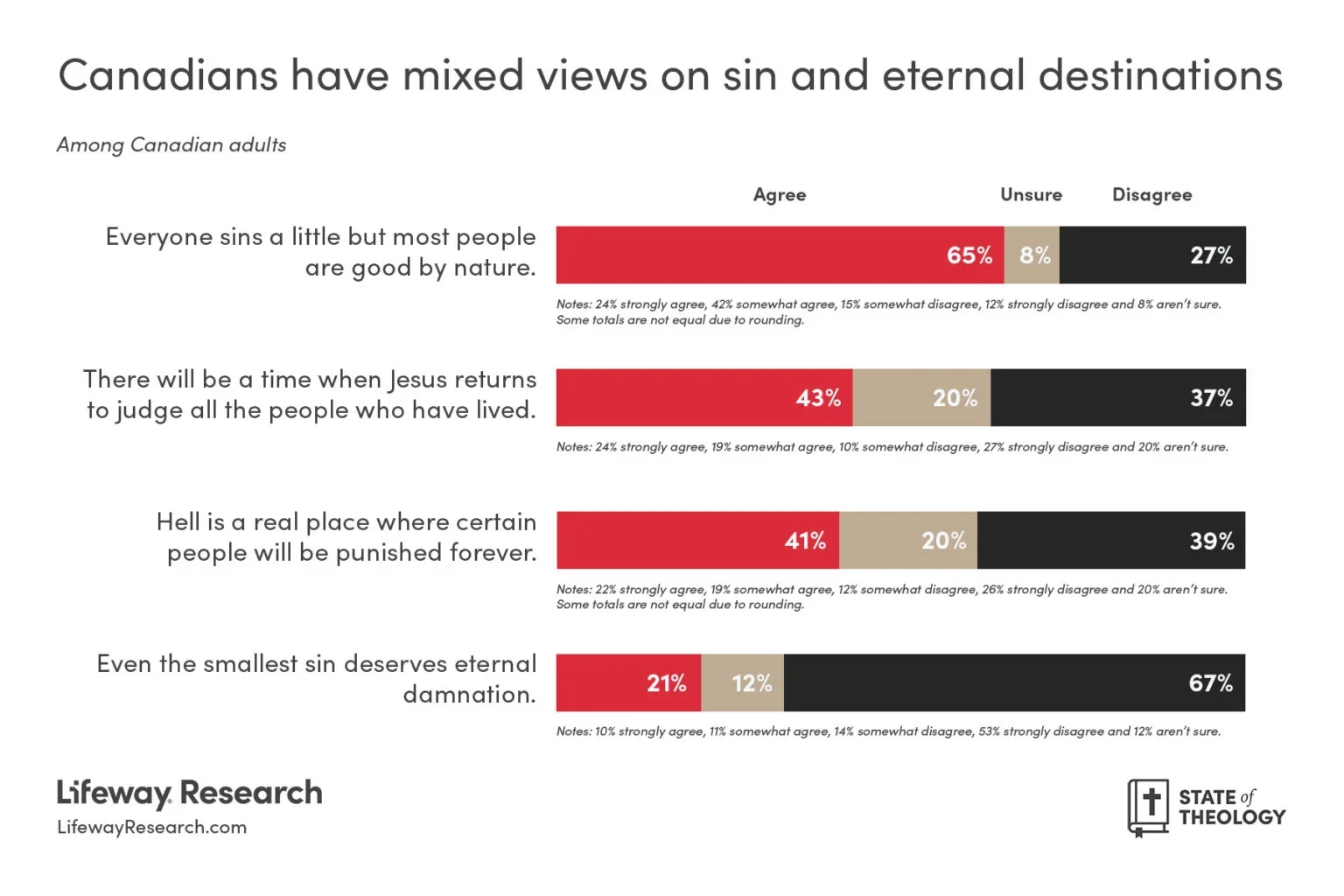
They are split over the existence of hell. Two in 5 (41%) believe hell is a real place where certain people will be punished forever. Slightly fewer (39%) disagree, and 20% aren’t sure.
Most Canadians believe eternal punishment would require major sins. Around 1 in 5 (21%) believe that even the smallest sin deserves eternal damnation. Two in 3 (67%) disagree, with 53% strongly disagreeing.
More than 2 in 5 Canadians (43%) say there will be a time when Jesus returns to judge all the people who have lived, while 37% disagree and 20% aren’t sure.
Canadians aren’t sure there’ll be a lot of people to judge harshly. Two in 3 (65%) say everyone sins a little but most people are good by nature.
As far as how to avoid hell and judgment, 40% believe only those who trust in Jesus alone as their Savior receive God’s gift of eternal salvation. Three in 5 (60%) disagree.
Similarly, 43% agree God counts a person as righteous not because of their works but only because of their faith in Jesus. More than 1 in 3 (36%) disagree.
“With only a small majority believing in a perfect or unchanging God, it is noteworthy that even fewer Canadians agree with the Bible’s teaching on how to become right with God and avert eternal punishment,” said McConnell.
The Bible and church
Canadians are unsure of the Bible’s truthfulness and the value of church attendance and membership, even for Christians.
Most (54%) believe the Bible, like all sacred writings, contains helpful accounts of ancient myths but is not literally true, while 30% disagree. Two in 5 (42%) think modern science disproves the Bible. A third (35%) disagree.
On the other side, a third of Canadians (36%) say that the Bible is 100% accurate in all it teaches, while half (50%) disagree.
Most Canadians are fine with going alone in their worship practices. Three in 5 (61%) believe worshiping alone or with one’s family is a valid replacement for regularly attending church. Just 1 in 5 (21%) disagree.
Additionally, only 28% agree every Christian has an obligation to join a local church. Almost 3 in 5 (59%) disagree, with 37% strongly disagreeing.
“While more may be positive toward the Bible, around a third of Canadians defend the Bible by disagreeing with common criticisms of it. Even fewer stand up for the necessity of worshiping and finding community in a local Christian church,” said McConnell. “The general adult population in Canada has not heard a convincing explanation for why the Bible and the church are worth being devoted to.”
Cultural convictions
Canadians are split across varied cultural issues, including marriage, sex and gender.
Most (55%) believe God created marriage to be between one man and one woman, including 37% who strongly agree. Almost a third (32%) disagree, with 23% strongly disagreeing.
A third of Canadians (34%) agree that sex outside of traditional marriage is a sin. Most (57%) disagree, including 40% who strongly disagree. Similarly, 34% say abortion is a sin, while 55% disagree, with 39% who do so strongly.
Half (50%) believe the Bible’s condemnation of homosexual behavior doesn’t apply today, and 30% disagree. Also, 46% say people should be able to choose their gender regardless of their biological sex, while 42% disagree, including 29% who strongly disagree.
Compared to these cultural issues, Canadians are more united that Christians should leave their faith behind when they enter the political realm. Two in 3 (64%) believe Christians should not allow their religious beliefs to influence their political decisions.
“For most Canadians, the Bible’s teaching on how to live is only as convincing as the Bible itself. When half openly doubt the Bible, it is not surprising that the majority disagree with the Bible on how it says to live,” said McConnell.
For more information, view the complete report and white paper.
Aaron Earls is the senior writer at Lifeway Research.