
Churchgoers Look To Join Others In Their Discipleship Walk
Churchgoers are getting better at developing and deepening relationships within their congregations, but it’s still not a strength.
U.S. Protestant churchgoers say they’ve established several friendships with others in their church and are trying to use those relationships to grow their faith, according to Lifeway Research’s State of Discipleship.
Building relationships is one of eight signposts that measure characteristics evident in believers who are progressing in spiritual maturity. It ranks sixth among the other signposts, with the average churchgoer scoring 64.0 in the attribute.
READ: Relic Theft Shocks Paris Church Amid A Rise In Religious Art Crimes
“When you think of a local church, you think of people coming together. We could assume those relationships formed naturally, but that is rarely the case. In an individualistic culture, immersing yourself in the lives of other people who are not your family is unnatural,” said Scott McConnell, executive director of Lifeway Research.
“It is counter-cultural for people in local churches to continue to make the effort to foster trusting and caring relationships that are focused on following Christ together.”
Forming friendships
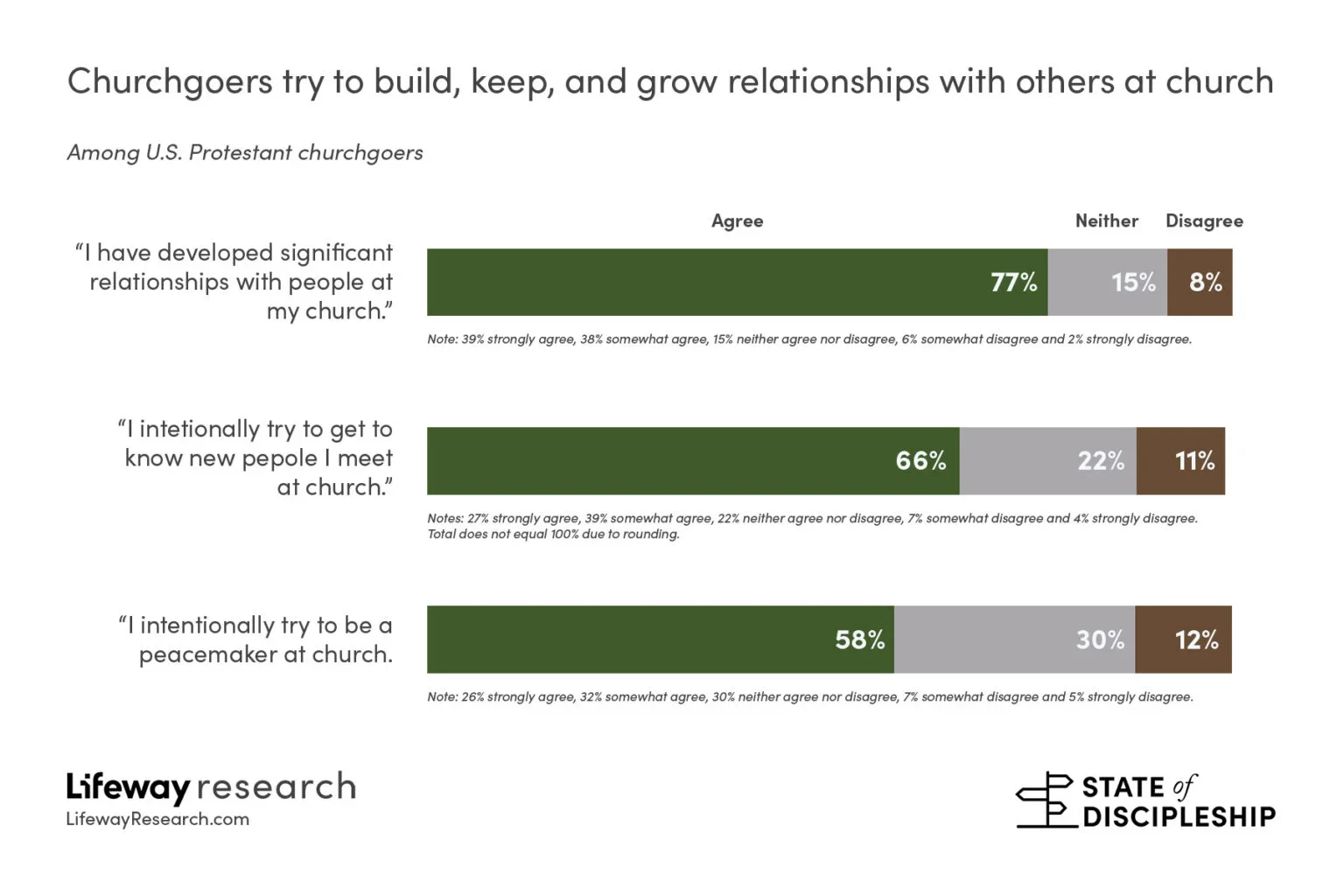
Most churchgoers make an effort to connect with those they don’t know. Two in 3 (66%) say they intentionally try to get to know new people they meet at church. One in 10 (11%) disagree, and 22% neither agree nor disagree.
U.S. Protestant churchgoers have improved since a 2013 Lifeway Research study, when 53% sought to get to know new people, 22% disagreed and 25% weren’t sure.
Seemingly, those efforts often blossomed into deeper friendships. More than 3 in 4 churchgoers (77%) say they have developed significant relationships with people at their church, while 8% disagree and 15% neither agree nor disagree.
Those numbers are similar to a 2019 Lifeway Research study, when 78% said they had developed such relationships. In 2013, 74% agreed.
“These two efforts may not naturally exist together—working to meet new people and investing in being a good friend to those you know—but they reflect biblical attitudes toward relationships. It is not an either/or. We can strive for depth of friendships and be eager to meet new people at church,” said McConnell.
Churchgoers today are more likely than those several years ago to focus on establishing peace within their congregations. Now, almost 3 in 5 (58%) say they intentionally try to be a peacemaker at church. Few (12%) disagree, and 30% aren’t sure.
In 2019, Lifeway Research found 49% said they tried to be a congregational peacemaker, 13% disagreed and 38% said neither.
Discipleship and relationships
Often, those attempts to get to know new people and form friendships have become part of U.S. Protestant churchgoers’ discipleship.
More than 2 in 3 (68%) say they have several Christian friends who keep them accountable, while 13% disagree and 19% aren’t sure.
Additionally, most (58%) say they intentionally spend time with other believers to help them grow in their faith. Around a quarter (27%) aren’t sure, and 15% disagree.
Those numbers mark improvement over previous years. In 2013, 42% said this was the case, while 48% agreed in 2019 that they were intentional about spending time to help others grow in their faith.
One way many churchgoers help others grow is through an adult small group or class, like Sunday School, Bible studies or other similar group gatherings. A 2024 Lifeway Research study found the average U.S. Protestant church had seven groups with 69 adults participating across all groups.
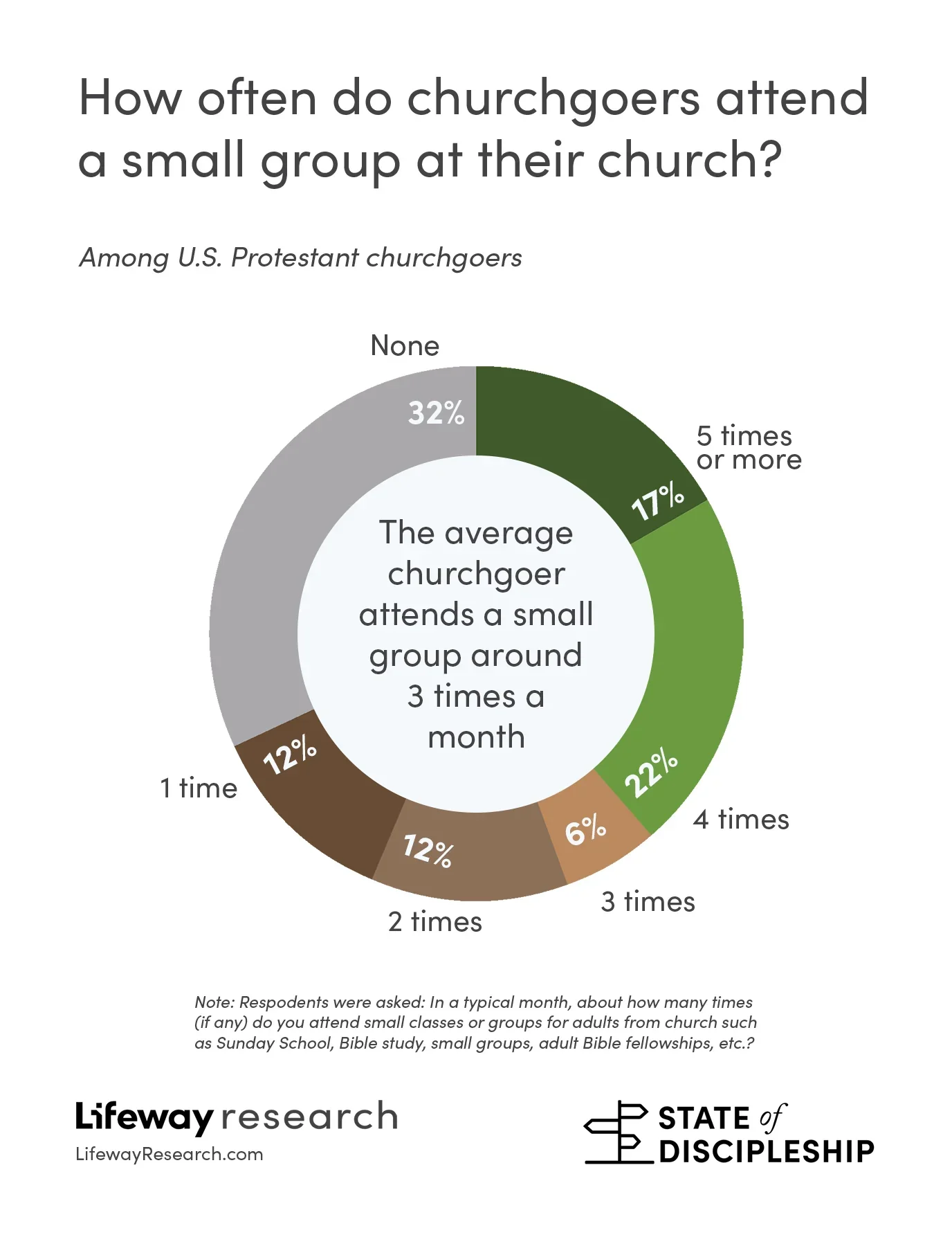
The average churchgoer attends a small group around three times a month. Almost half (45%) attend at least three times a month, with 22% attending four times and 17% five or more. Fewer say they attend once (12%) or twice (12%) a month.
Those who aren’t attending a type of small group offered by their churches have been steadily decreasing over the past decade. In 2013, 41% said they did not attend at all in a given month. By 2019, 38% were not involved in a small group. Now, around a third (32%) say they don’t regularly participate in a typical month.
“While higher numbers of churchgoers have been claiming to be involved in a small group Bible study, pastors are not so sure. Since 2008, pastors say they have seen a growing gap between worship attendees and small group or Sunday School participation,” said McConnell.
“Technically both cannot be true. Churchgoers who have heard the importance of groups state their participation in the best possible light, while pastors, who feel responsibility for all their members likely can’t exclude those who attend worship less than once a month from their estimates.”
In an additional Lifeway Research study of U.S. Protestant churchgoers, 74% believe it is important for every adult to be involved in a Bible study group or Sunday School class at church, including 35% who strongly agree. One in 5 (21%) disagree, and 5% aren’t sure. Those numbers are similar to a 2019 study.
That same study found most churchgoers (55%) have been asked by someone at church about their relationship with God within the past month, including 28% who say it has happened in the last week and 27% in the last month.
Fewer say it has been within the last six months (13%), the last year (5%) or more than a year ago (6%). Some (14%) say they don’t recall that ever happening to them. Another 8% aren’t sure.
Bowing heads together
As churchgoers form relationships with other believers, they aren’t just talking to each other. Most are also talking with God together, and those prayers often include non-Christians.
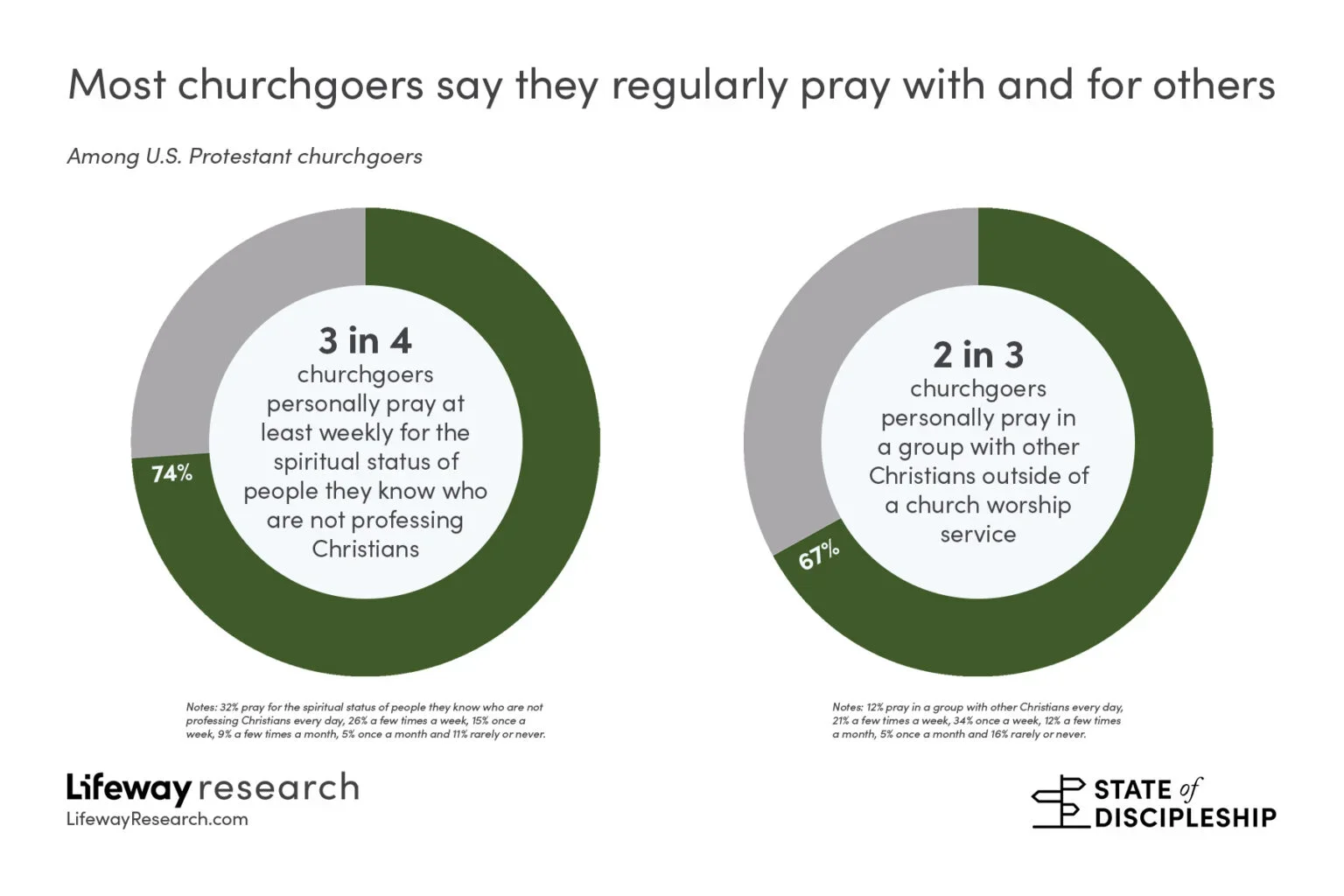
According to the State of Discipleship study, 2 in 3 U.S. Protestant churchgoers (67%) say they pray in a group with other Christians apart from a church worship service at least once a week, including 12% who pray every day, 21% who do so a few times a week and 34% who pray once a week.
Around 1 in 8 (12%) pray in a group a few times a month. One in 20 (5%) pray with other Christians once a month. Another 16% say they rarely or never do so.
Additionally, 74% of churchgoers pray for the spiritual status of people they know who are not professing Christians at least once a week, including 32% who do so every day, 26% who say they pray a few times a week and 15% who do so once a week.
Few pray for the spiritual status of those they know a few times a month (9%) or once a month (5%). Around 1 in 10 (11%) say they rarely or never pray for non-Christians in that way.
“Building biblical relationships is not just about forming friendships that benefit oneself. It is an others focus that desires for more people to experience the life in Jesus Christ that unites us,” said McConnell.
For more information, view the complete State of Discipleship report, the other churchgoer report and visit LifewayResearch.com/Discipleship.
Aaron Earls is the senior writer at Lifeway Research.