
Global Study Finds Catholicism Facing Big Losses From ‘Religious Switching’
ATLANTA — A new report highlights a major shift in global religious identity, with Catholicism experiencing some of the largest losses due to people changing their faith once they reach adulthood.
The Pew Research Center analysis, released on Thursday, was based on surveys conducted in 24 countries and examined “religious switching” — when people adopt a different religion than the one in which they were raised. The findings reveal a complex picture within Christianity, particularly between its two largest branches: Catholicism and Protestantism.
“We’re measuring [conversions] over the lifetime of a respondent … not the last year or the last five years,” said Alan Cooperman, director of Pew Research Center.
READ: Nigeria Convicts Nearly 400 Terrorists As Christian persecution continues
The analysis underscored a broader global trend of religious change, driven not just by population growth or decline, but by individuals actively rethinking and reshaping their religious identities over time.
“Religious switching refers to when people identify with a different religion in adulthood than they were raised in as a child,” the report said. “Within Christianity, however, religious switching has affected the two largest subgroups – Catholicism and Protestantism – differently.”
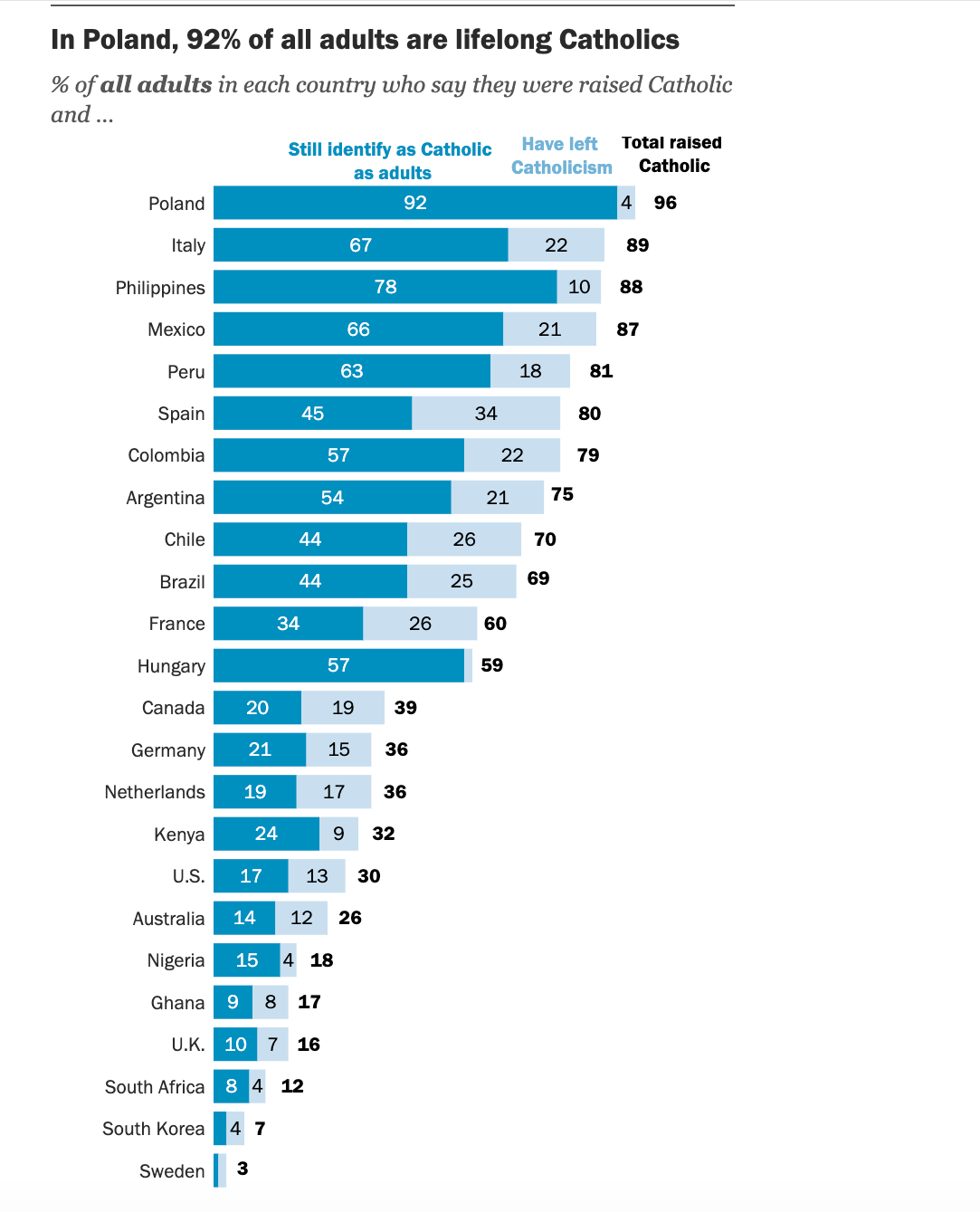
Pew found that Catholicism has lost more adherents than it has gained in nearly every country surveyed. In many nations with historically strong Catholic roots, large portions of the population have moved away from the faith.
“Disaffiliation is especially common in parts of Europe and Latin America,” the analysis said. “That includes Chile, where 19% of all adults are former Catholics who now identify as atheist, agnostic or ‘nothing in particular.’”
Although a significant majority of adults in countries like Poland remain lifelong Catholics, other nations show substantial departures. In Italy, 22% of adults report leaving Catholicism, while only 1% say they joined it after being raised in another tradition — resulting in a net loss of 21 percentage points.
Across the 24 nations studied, Catholicism experienced net losses in 21. Hungary was the only country where more people joined the faith than had left it, while Kenya and South Korea saw roughly equal movement in and out.
Former Catholics often either convert to Protestantism or leave religion altogether. Religious disaffiliation — identifying as atheist, agnostic, or “nothing in particular” — is especially common in parts of Europe and Latin America. In Chile, for example, nearly one in five adults are former Catholics who no longer identify with any religion.
Despite these losses, Catholicism remains the majority religion in several countries, including Poland, the Philippines and Italy.
Overall, Hungary and Poland had the highest retention rates of people raised Catholics who remained so, at 97% and 96%, respectively. The United States rate was 57%, while Canada was at the bottom at 51%.
Protestantism shows mixed trends
Protestantism, meanwhile, presents a more balanced picture. While it has lost followers in some regions, it has gained in others — resulting in a near-even split between countries with net gains and net losses, the report found.
“But unlike with Catholicism, there are several countries where more people have joined Protestantism than have left it,” the analysis said. “In fact, Protestantism has seen a net gain from switching in nearly as many places as it has seen a net loss.”
This growth is particularly notable in Latin America. In Brazil, for example, 15% of adults have joined Protestantism after being raised in another faith, compared with just 6% who have left it — a net gain of 9 percentage points. Many of Brazil’s new Protestants — most of them evangelicals — are former Catholics.
However, declines are evident in parts of Europe, including Sweden, the United Kingdom, and Germany, where more people are leaving Protestantism than joining.
Those who leave Protestantism are most likely to become religiously unaffiliated. In Australia, 15% of adults are former Protestants who no longer identify with any religion, while only small shares convert to Catholicism or other faiths.
Overall, Protestant populations remain relatively small in most of the countries studied, Pew said, typically accounting for no more than a quarter of the population. However, there are exceptions: Ghana and Kenya stand out as majority-Protestant nations.
Regarding a Christian revival in various parts of the world, Cooperman said there is “a difference between national figures and local ones.”
“I wouldn’t say nothing is happening,” he added, “but we are looking at a small amount of data.”
Clemente Lisi serves as executive editor at Religion Unplugged.