
📖 Most Churchgoers Failed A Bible Literacy Quiz: Can You Pass It? 🔌

Weekend Plug-in 🔌
Editor’s note: Every Friday, “Weekend Plug-in” meets readers at the intersection of faith and news. Click to join nearly 10,000 subscribers who get this column delivered straight to their inbox. Got feedback or ideas? Email Bobby Ross Jr.
OKLAHOMA CITY — I’m no Bible scholar, but I enjoy studying the Scriptures.
I’ve attended church all my life. I’ve reported full time on religion for over a quarter-century. I’ve helped teach kindergartners at my home congregation — where 5-year-olds learn to recite all 66 books of the Old and New Testaments — for over a decade.
On top of all that, I’m a whiz on the Bible questions on “Jeopardy!”
So when I saw a recent Lifeway Research headline indicating that 2 in 3 churchgoers flunked a biblical literacy test, I wondered how I’d do.
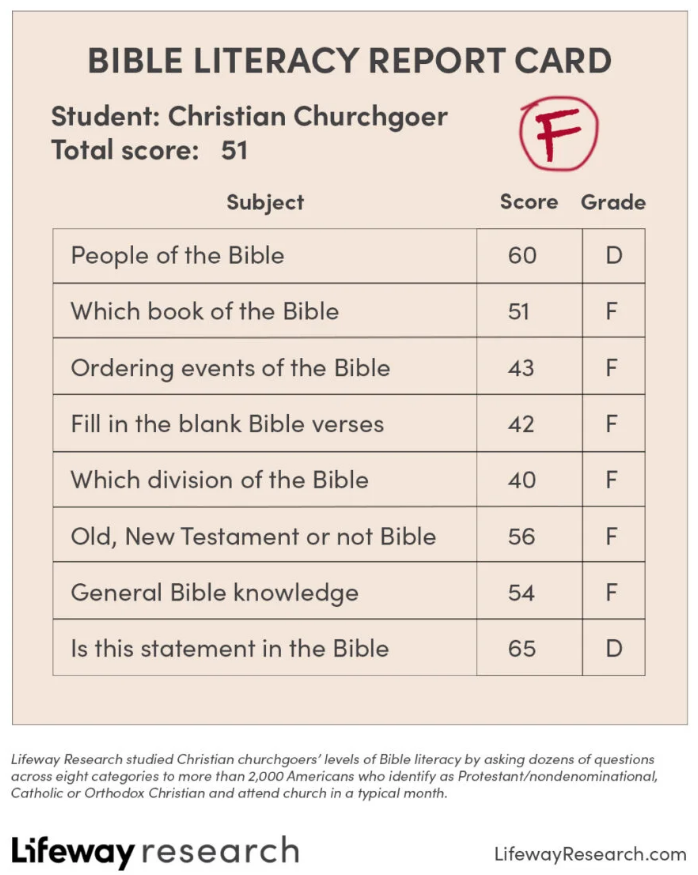
The survey report by Lifeway’s Aaron Earls noted:
If churches gave pop quizzes on the Bible this Sunday, most people in the pews would fail.
Lifeway Research asked more than 2,000 American Christian churchgoers dozens of questions about general Bible knowledge. The average respondent scored 51. Around 2 in 3 (65%) earn an F, below 60. Almost 1 in 10 (9%) receive a D, between 60 and 69. Another 9% receive a C, between 70 and 79. Just 8% score a B, 80 to 89, and 9% reach A status, 90 and higher.
“Church leaders often theorize that churchgoers don’t know their Bibles but have typically lacked objective proof,” said Scott McConnell, executive director of Lifeway Research. “This study confirms most Christian churchgoers haven’t learned or don’t remember many things in the Bible and how it is organized.”
To satisfy my curiosity, I took the 25-question quiz that Lifeway posted online (featuring half of the original 50 questions). Feel free to test yourself before I offer a few spoilers below.
I got 21 answers right. That’s a score of 84, a grade of B.
I had no trouble on some questions, including where in the Bible you find the Sermon on the Mount (Matthew), the story of the Good Samaritan (Luke) and Paul’s missionary travels (Acts).
But on others, I made educated guesses, such as placing Ecclesiastes in the Bible’s poetry/wisdom literature division and picking “John has a vision on the island of Patmos” as occurring last in a series of five biblical events. That latter one just screamed Revelation, the final book of the New Testament.
Of the four I missed, I simply didn’t know this one: When asked which of five biblical events occurred first, I picked “Samuel hears God call his name.” The correct answer was “Deborah judges Israel.”
In the other three cases, I didn’t think hard enough. Otherwise, I would have picked Sarah (the correct answer) as the mother of Isaac instead of Rebekah (my wrong answer). Duh!
I would have known that God’s covenant through Noah (the correct answer) occurred before his covenant with Abraham (my wrong answer). Duh!
I would have recalled that the Bible says “Listen, Israel: The LORD our God, the LORD is one” (the correct answer and what my gut was telling me) instead of “Listen, Israel: The LORD our God, the LORD is holy” (the wrong answer that I picked against my better judgment). Duh!
I had so much fun that I urged my wife, Tamie, to take a crack at the quiz. I was not surprised at all when she only missed one. I married an intelligent woman.
Her miss: She placed 1 Chronicles in the New Testament instead of the Old. No doubt, her eyes played tricks on her and flashed 1 Corinthians, which is indeed in the New Testament, in her brain.
Like me, my friend Cheryl Mann Bacon, retired journalism chair at Abilene Christian University in Texas, missed four.
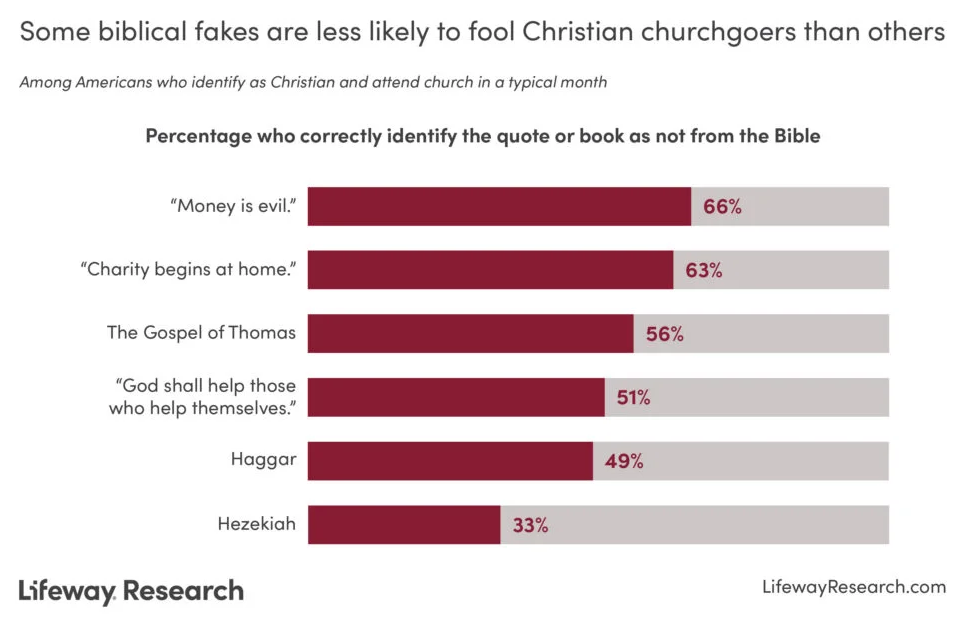
My favorite miss of hers: She placed the Book of Haggar in the Old Testament. It’s actually not in the Bible at all. For what it’s worth, Haggai is a book in the Old Testament. As for Hägar, he’s a Viking in the funny pages.
My oldest child, Brady, founder of Oklahoma-based Clear Path Leadership, got a perfect score: 25 out of 25. An undergraduate Bible degree and two graduate Bible degrees apparently came in handy for him.
My colleague Erik Tryggestad, president and CEO of The Christian Chronicle, and my friend David Duncan, a Texas preacher who earned a Doctor of Ministry degree from the Houston Graduate School of Theology, also got all the questions right.
But my friend Jeremie Beller, dean of the Bible college at my alma mater, Oklahoma Christian University, missed one question: “Who was the person whom Pontius Pilate released during Jesus’s trial?”
Beller chose Barnabas, the Son of Encouragement, instead of Barabbas, the murderer.
Even though I’m certain my friend with the Ph.D. in communication and social influence actually knew the right answer, I intend to keep razzing him about checking the wrong one.
“I am ashamed of myself,” he joked in a text message.
On the serious side, Lifeway — an entity of the Southern Baptist Convention — reported:
Several factors influence how much higher or lower a Christian churchgoer will score on the Bible quiz. Those likely to increase a score the most are reading the Bible every day (+13.8 points) and having a graduate degree (+10.7). Other positive factors include reading the Bible a few times a week (+7.7), saying they engage with the Bible to help them know and relate to God (+5.4) and reading devotional material (+4.8).
Other factors are likely to lead to a decreased score, including rarely or never reading the Bible (-6.2 points) and having a high school diploma or less formal education (-4.5).
“Bible literacy comes with both reading and studying the Bible — digging to understand each passage but also moving throughout the Bible regularly to aid in remembering it,” said McConnell. “Knowing the Bible involves the heart, mind and emotions. Bible literacy is impacted by a motivation to be in relationship with God, a desire to be encouraged by the Word and thoughtful exploration of its meaning.”
Lifeway’s findings inspired my friend Trey Morgan, lead minister for the Sunset Church of Christ in Lubbock, Texas, to develop a Bible literacy survey for his congregation.
“We’re in the process of seeing how we stack up as a church,” Morgan told me. “Are we overestimating their biblical knowledge or underestimating it?”
The goal, he explained, is to see “what we need to teach and preach better so people can learn.”
Inside The Godbeat
At Charlie Kirk’s funeral last year, President Donald Trump said the slain conservative political activist “did not hate his opponents” and “wanted the best for them.” On the other hand, Trump said, “I hate my opponent, and I don’t want the best for them. I’m sorry.”
Once again this week, the president declined an opportunity to embrace the countercultural theology of Jesus, telling CBS’ “60 Minutes,” “I do hate some of my enemies, and I always will.”
In an analysis piece here at Religion Unplugged, executive editor Clemente Lisi delves into “Trump, Forgiveness And Christianity’s Road To Heaven.”
The Final Plug
“Will there be hound dogs in heaven?”
I asked that question in a 2024 Plug-in column after adopting a basset hound named Frannie.
Two years later, Frannie remains the canine queen of our household. Which is probably why I enjoyed Netflix’s new movie “A Dog’s Perfect Christmas,” featuring a talking basset hound, so much.
Happy Friday, everyone! Enjoy the weekend.
Bobby Ross Jr. writes the Weekend Plug-in column for Religion Unplugged and serves as editor-in-chief of The Christian Chronicle. A former religion writer for The Associated Press and The Oklahoman, Ross has reported from all 50 states and 20 nations. He has covered religion since 1999.