
More Protestant Churches Feeling Economic Squeeze
As the economy strains the U.S. public, pastors report increasing pressures and giving lagging behind inflation.
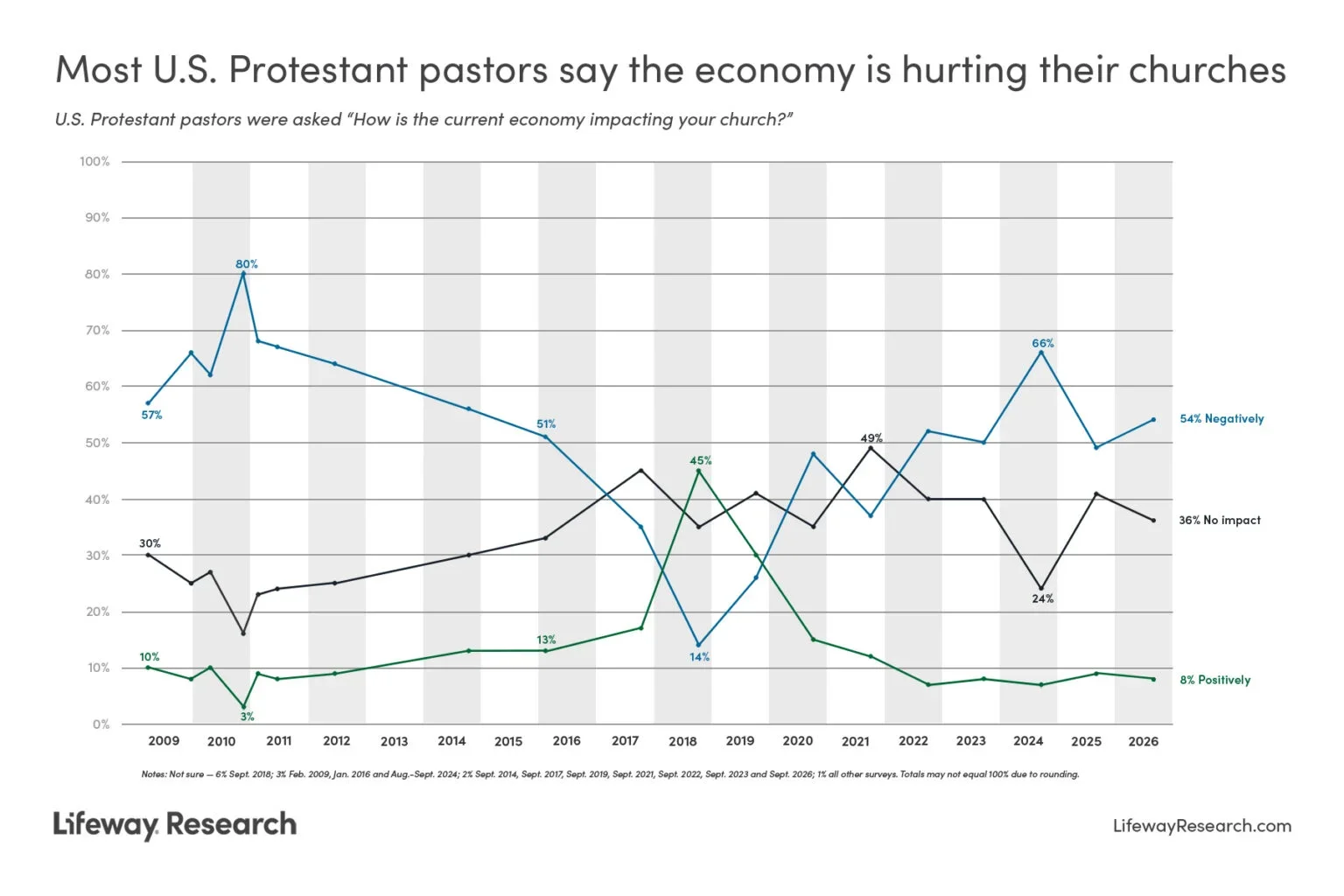
Lifeway Research’s annual tracking survey reveals most U.S. Protestant pastors (54%) report the economy is negatively impacting their congregation. Slightly more than a third (36%) say it’s having no impact, while 8% see a positive economic effect.
“Pastors hear the needs and problems of people in their congregations every week, so it is not surprising that they feel their pain from economic factors,” said Scott McConnell, executive director of Lifeway Research. “Even seemingly positive financial changes such as a member getting a promotion or more overtime could negatively impact a church if those people attend less.”
Economic impact
In 2024, two-thirds of pastors (66%) said the economy was hurting their church. Last year, that fell to 49%, but the negative impact has climbed back up to 54% in 2026, including 7% who say the economy is impacting their congregation very negatively.
Generally, pastors feel pessimistic about the economy and their congregations. Since 2009, only four times has a plurality of pastors felt the economy was not negatively affecting their congregations, including just once, in 2018, when a plurality said it was having a positive impact.
Some pastors are more likely to say the economy is hurting their congregations this year. African American pastors are the most likely to say the economy is having a negative impact on their church (82%). Mainline Protestant pastors are more likely than their evangelical counterparts to be experiencing negative effects (66% v. 47%).
Denominationally, Methodist (68%) and Presbyterian/Reformed pastors (66%) are more likely than Pentecostal (51%), Baptist (46%) and nondenominational pastors (38%) to report a negative impact.
Pastors at congregations with 250 or more in attendance are the most likely to say the economy isn’t having any impact on their church (46%).
“In the same economy, different churches will be affected differently. High gas prices will have no impact on an urban pastor who uses public transportation to visit his congregation, whereas a rural pastor driving two hours each way to visit someone in the hospital will feel significant pain,” said McConnell. “Similarly, rising heating and cooling costs could impact expenses differently based on the size, age and location of the church’s building or the type of fuel their HVAC unit uses.”
Flat giving versus rising inflation
Relatively few churches saw giving increase at all, despite rising inflation. The average church reports a modest 1.24% rise in giving over 2025, while the median change was 0%. Meanwhile, the Consumer Price Index, the most widely used measure of inflation, was up 3.7% as of September 2026.
Around a third of U.S. Protestant pastors (36%) say giving at their church is higher than in 2025. A similar percentage (37%) report offerings at the same level as last year, while 22% say it is below 2025 and 4% aren’t sure.
Specifically among those who reported a numeric change in giving, 1 in 5 pastors (20%) report a giving decrease in 2026, including 6% who say it fell 1-9%, 11% who report a 10-24% decrease and 3% with a 25% or more drop.
More than 2 in 5 (42%) say giving is the same as in 2025. Around 1 in 6 (16%) saw giving increase by less than 10%, 13% say it climbed 10-24% and 4% experienced giving jumping by 25% or more. One in 20 (5%) aren’t sure how giving this year compared to last.
Many of the same pastors who reported a negative economic impact are facing decreased giving. African American pastors are the most likely to say their giving has dropped compared to last year (47%). They are also one of the most likely to say giving fell by 25% or more (17%).
Smaller-church pastors, those at congregations of fewer than 50, are also among the most likely to report a decline in giving (31%).
Evangelical pastors are more likely than mainline to say giving is up compared to 2025 (40% v. 33%). Nondenominational pastors are the most likely to say offerings have increased in 2026 (52%).
Pastors at larger churches are more likely to have seen increased giving, including those at congregations of 100 to 249 (42%) and 250 or more (51%).
“Other studies have shown larger churches and non-denominational churches are among the most likely to be growing, so it is not surprising that they are also in a better place financially. Such growing churches may also be in communities that are growing,” said McConnell.
Budget balance
Despite flat giving overall, half of U.S. Protestant pastors (50%) say offering levels are about what was budgeted. Around a quarter (25%) report giving below budget numbers, 23% saw giving higher than budgeted and 3% aren’t sure.
“It is still possible that some churches where giving is down compared to last year could end the year with enough giving to close that gap. Churchgoers often give an extra gift at Christmastime,” said McConnell.
Again, African American pastors are the most likely to say their offerings have been lower than budgeted (55%). Methodists (33%) and pastors in the South (30%) are also among the most likely to report giving trailing their budget.
Meanwhile, evangelical pastors are more likely than those at mainline congregations to say giving is above budget (26% v. 18%). Nondenominational (35%) and Baptist pastors (29%) are among the most likely to report higher-than-budgeted giving. Those at churches in the West are among the most likely to say giving is higher than budgeted (27%).
Pastors of the largest congregations, those with attendance of 250 or more, are the most likely to say their 2026 giving has been higher than budgeted (38%).
For more information, view the complete report.
Aaron Earls is the senior writer at Lifeway Research.