
When Faith Took The Field: Christianity And The Popularity Of College Football
(REVIEW) When Indiana and Miami take the field on Jan. 19 at Hard Rock Stadium near Miami, it will be the culmination of a college football season that started back in late August. Aside from crowning a national champion, the CFP National Championship game also marks the latest chapter in a sport that dates back to the late 1800s.
By the early part of the 20th century, football’s popularity on college campuses was on the rise. Knute Rockne rose to prominence in 1913 at the University of Notre Dame, then a largely unknown Midwestern Catholic school. When Army scheduled Notre Dame as a warm-up game, they thought little of the school.
Rockne and quarterback Gus Dorais made innovative use of the forward pass — at the time a relatively unused weapon — to defeat Army 35-13. The victory helped establish Notre Dame as a national power.
READ: The Viral Holy Water Moment Behind The Pittsburgh Steelers’ Big Win
Not far from Indiana, in neighboring Illinois, Wheaton College used football to advance evangelism and help define Christian manhood to its male students. The game, however, wasn’t limited to the Midwest.
Across the South and in the West, football also became a big deal. For example, Texas Christian University and Baylor University, both Baptist schools, showcased football’s role in developing Christian university identity and preeminence.
Such stories, and others, are part of a new book, “The Gridiron Gospel: Faith and College Football in Twentieth-Century America” by historian Hunter M. Hampton. Rather than treating religion as a side note to athletic success like is so often done, Hampton places faith at the center of the story. In doing so, he reveals how the sport became a powerful vehicle for moral formation of young men, community identity and religious expression on college campuses.
From the onset, the book argues that college football was never just a game. From the early embrace of muscular Christianity stretching to the present, Hampton recounts how Christian leaders, institutions and athletes used football to promote ideals of discipline and sacrifice – all with a spiritual purpose. Football, in this telling, functioned as both a proving ground for faith and a public stage on which religious values could be displayed.
But Hampton, an assistant professor of history of Stephen F. Austin State University in Texas, argues that not everyone accepted football’s “brute, warlike nature.” Instead, he added, schools like Notre Dame doubled-down on football. In the end, it was students, Hampton added, who thought “the violent game furthered the school’s mission.”
Notre Dame may have been one of the first schools to encourage football among its male students, but certainly not the last. Hampton’s analysis is particularly strong in its attention to the diversity of the various schools profiled.
By examining Protestant, Catholic and Latter-day Saint contexts, the book avoids a one-size-fits-all narrative. Instead, it shows how different Christian traditions adapted the game to their own theological and cultural needs. Hampton digs into all this with the curiosity of a scholar and the enthusiasm of a pigskin fan.
“The Gridiron Gospel” is told in just six chapters across 205 pages. Each focuses on a school — like Notre Dame, BYU and Liberty University — and an era of the 20th century. In the book’s introduction, Hampton notes his tome is “about the convergence of two distinctly American passions: Football and religion. It explores how each influenced the other. Both contain lessons in sacrifice, community and morality.”
The book is scholarly, but accessible to most readers. Hampton makes his arguments with the backing of archival materials and research, but keeps the prose readable for the general sports fan.
Highlighting the link between college sports and faith isn’t new. Last month, America, the Jesuit magazine, published a piece about Rockne and his legacy at Notre Dame. It was a fitting tribute even though the Fighting Irish went 10-2 this season and just missed out on the 12-team College Football Playoff bracket.
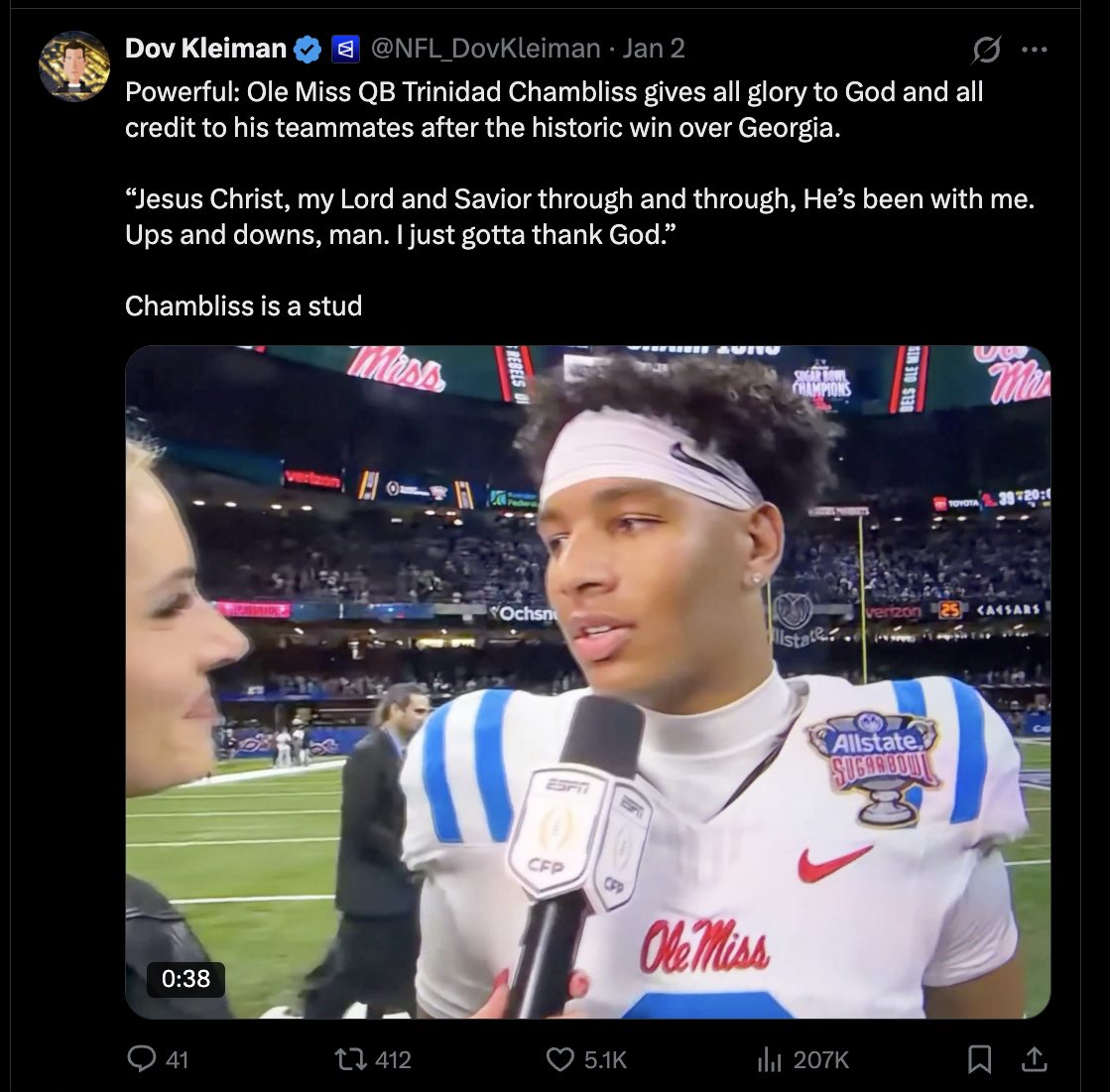
Overall, “The Gridiron Gospel” is a wonderful addition to the study of religion and sport. “The Gridiron Gospel” convincingly shows that college football was not just shaped by faith, but actively helped form how millions of Americans understood Christianity throughout the twentieth century — beliefs that persist on many football fields across U.S. colleges and universities to this day.
Clemente Lisi serves as executive editor at Religion Unplugged.