
Pastors And Churchgoers Say Their Congregation Is Multigenerational
When pastors look out from the pulpit and congregants glance around the pews, most say they see a church with people from across the generations.
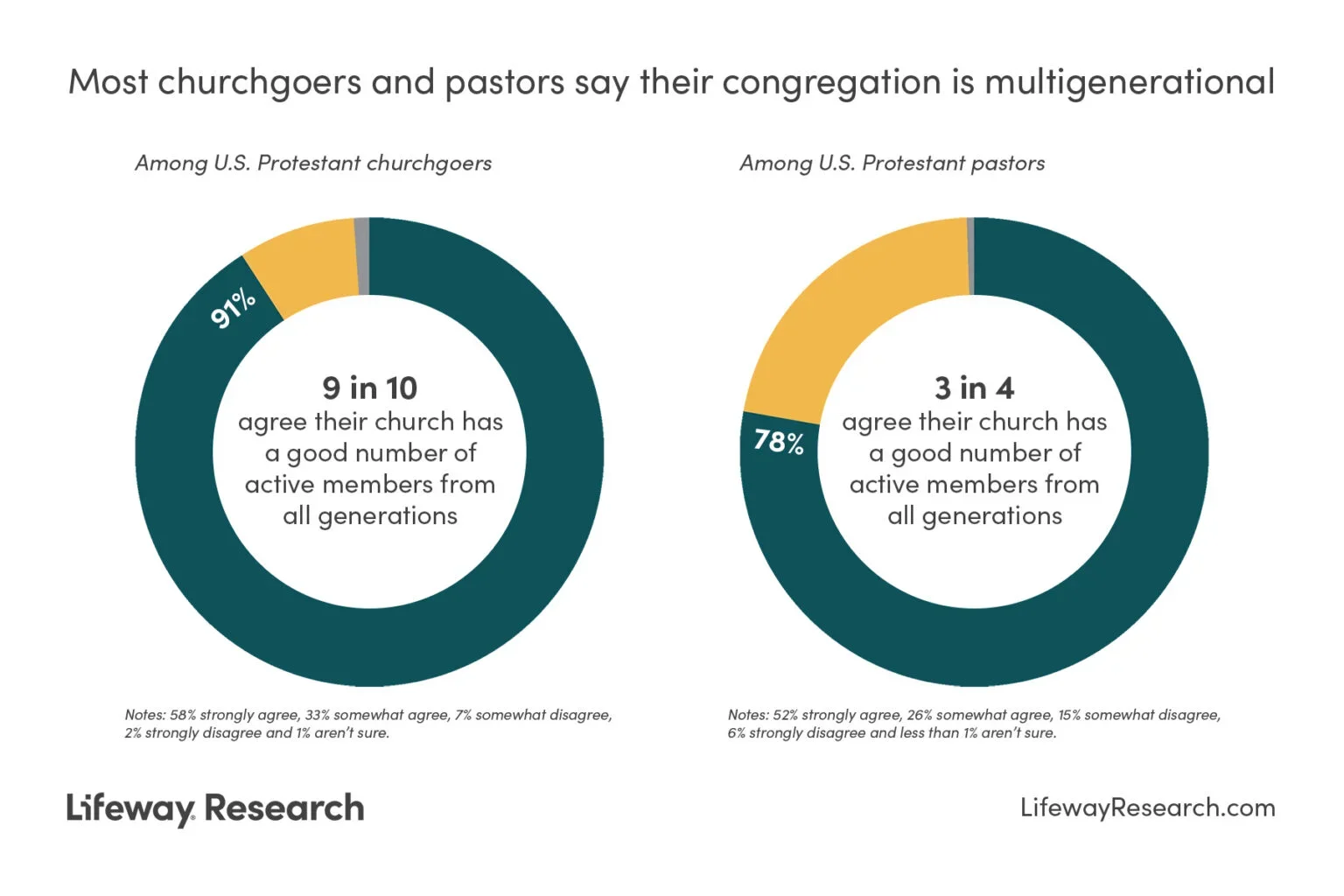
Almost 4 in 5 pastors (78%) and 9 in 10 churchgoers (91%) believe their church is multigenerational, with a good number of active members from all generations, according to Lifeway Research.
Despite their perceptions, the statistical reality paints a picture of a congregation that skews older. According to Pew Research, the median age of a Christian in the United States rose from 46 in 2007 to 54 in 2024. Most Protestant Christians (57%) are 50 or older, including evangelicals (55%). Pew Research also found 43% of U.S. adults 71 and older attend religious services at least monthly, compared to 31% of 18-30-year-olds.
“Whether you are a pastor or lay person, your views of the health of your church include your perception of whether your church can reach all generations. This question is about the viability of ministry across age groups, not whether they are proportional in size,” said Scott McConnell, executive director of Lifeway Research. “A visitor’s reaction would likely be similar based on whether they see a good number of people their age, signaling opportunities for connection.”
McConnell said a lack of generational diversity can stem from several reasons. “How can a church find itself without a mix of generations? Sometimes it is an intentional strategy to reach one population on a college campus or a senior adult community,” he said. “But much more often, it is a lack of intentionality in reaching the next generation and a refusal to set aside preferences that put off younger people.”
Pastors’ perceptions
When pastors are asked about the age demographics of their church, 78% believe they lead a multigenerational church, including 52% who strongly agree. Around 1 in 5 (21%) disagree, and less than 1% aren’t sure.
“A healthy church is reaching new people with the gospel,” said McConnell. “The Holy Spirit is not just working in one demographic group, but sometimes a congregation’s sphere of influence where they share the gospel is limited.”
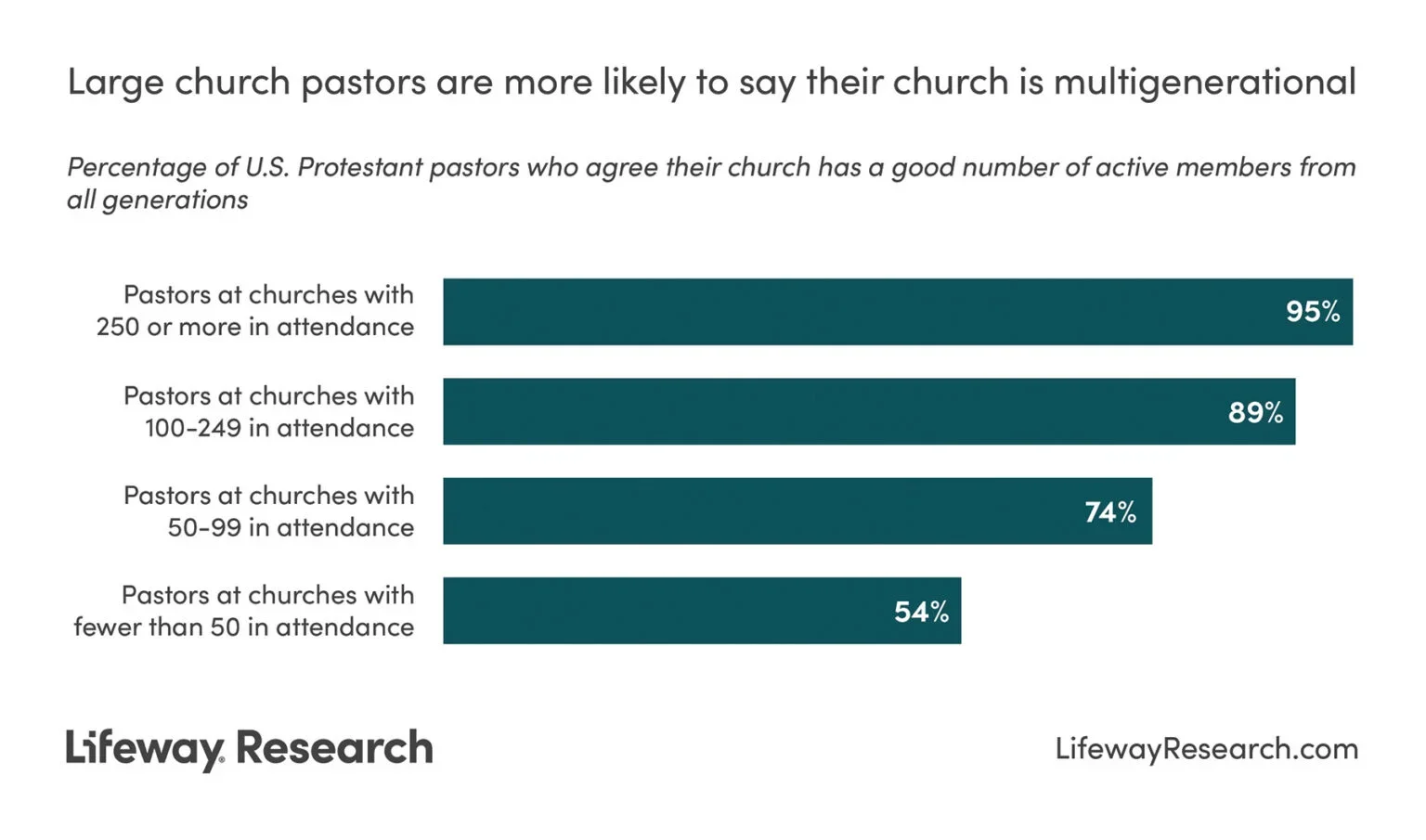
In many cases, the larger the church, the more generationally diverse the congregation is. Pastors at churches with attendance of 250 or more (95%) are the most likely to agree their church is multigenerational, followed by pastors of congregations with attendance of 100-249 (89%), 50-99 (74%) and less than 50 (54%). Pastors at the smallest congregations, fewer than 50 in attendance on a typical weekend, are more split over their multigenerational status. While 54% agree, 45% disagree.
Younger pastors are also more likely to lead multigenerational congregations. Pastors younger than 45 (82%) and those ages 45-54 (88%) are more likely than pastors who are 55-64 (75%) and 65 and older (72%) to say their church has a good number of active members from all generations.
Evangelical pastors are more likely than mainline clergy to see a multigenerational congregation (80% v. 74%). Denominationally, Holiness (90%), Pentecostal (88%) and nondenominational pastors (88%) are more likely to agree than Lutherans (76%). Methodist pastors are the most likely to disagree (39%) and say their church is not multigenerational.
Those in the Midwest are more likely to agree than those in the Northeast (80% v. 71%).
“While most churches believe they are welcoming to newcomers, people only feel welcome when the church has made room for them,” said McConnell. “Almost half of pastors say their church is challenged by people dynamics such as having strong opinions about non-essentials (48%) and resistance to change (46%).”
Perspective from the pews
Churchgoers are more likely than pastors to believe they are part of a multigenerational congregation. Around 9 in 10 (91%) say their church has a good number of active members from all generations, including 58% who strongly agree. Just 8% disagree, and 1% aren’t sure.
“More churchgoers say they are in a multigenerational church than pastors, because more people attend mid-size and larger churches that tend to have this mix,” said McConnell. “A larger number of small churches exist in the pastor numbers that are more likely to lack many people from all generations.”
Church size remains a contributing factor for the congregation’s perception. Those attending churches of 500 or more in attendance on a typical weekend (98%) and those with 100-249 in attendance (95%) are more likely than those at churches with 50-99 in attendance (89%) and those at churches with fewer than 50 (79%) to say their church is multigenerational. Churchgoers at congregations of fewer than 50 in attendance are the most likely to disagree (18%).
Churchgoers with evangelical beliefs are more likely than non-evangelical churchgoers to believe their church has a good number of active members from across the generations (94% v. 87%).
Denominationally, Baptists (94%) and those at nondenominational churches (92%) are more likely than Methodists (81%) and Lutherans (84%) to agree.
Churchgoers in the West are more likely than those in the Midwest to see their church as multigenerational (93% v. 87%). Those in the Midwest (12%) are most likely to disagree.
McConnell said a multigenerational congregation can have a compounding impact.
“Churches strive to be welcoming to Christians who move to their area and are looking for a new church home,” he said. “But it is difficult for a church to get new people to connect to their church if there is nobody like those people at that church.”
For more information, view the pastors report and the churchgoers report, and visit LifewayResearch.com.
Aaron Earls is the senior writer at Lifeway Research.