
Men And Women Offer Unique Discipleship Strengths
They may share a congregation, but men and women have different discipleship needs, according to new analysis from Lifeway Research.
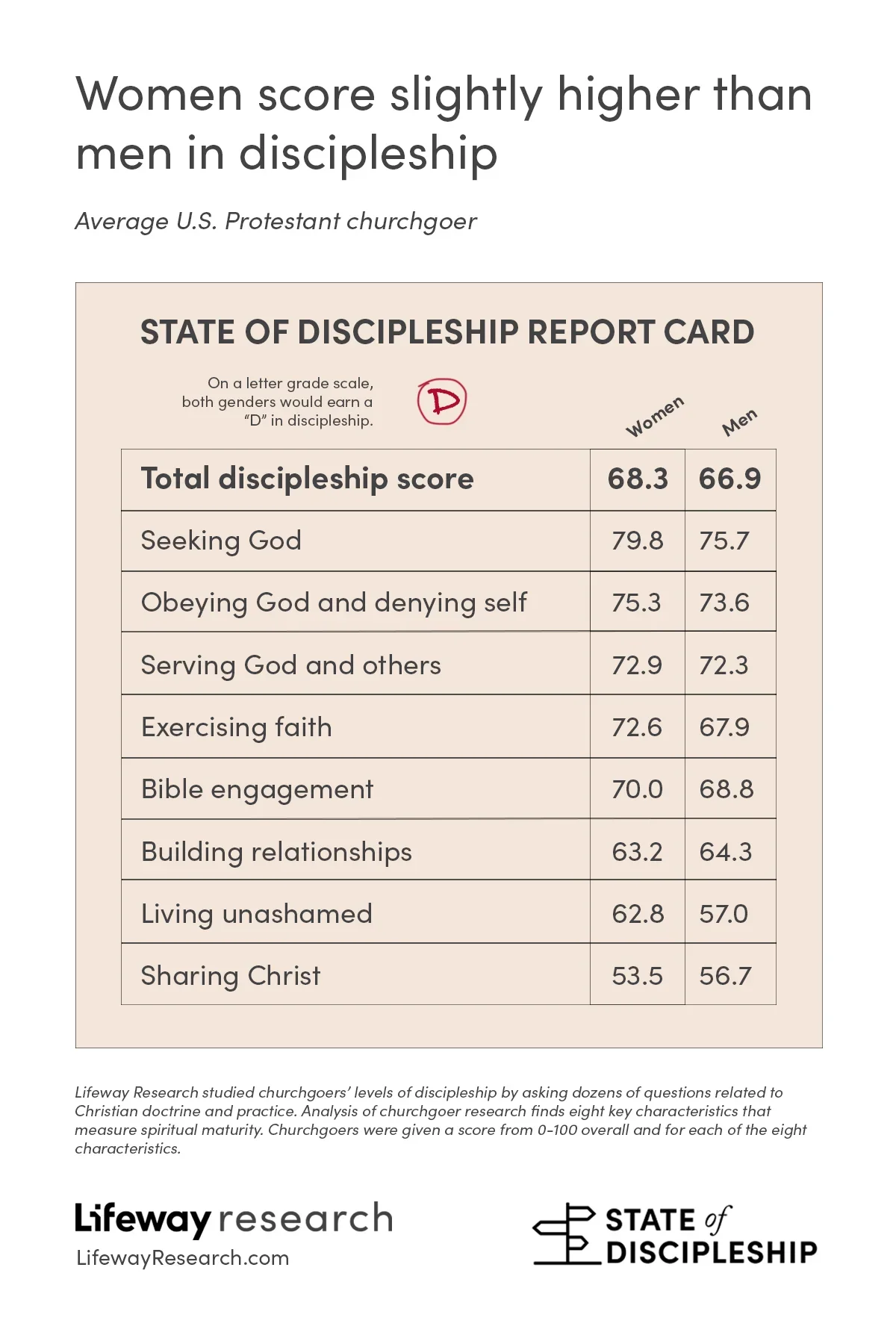
In general, women have higher discipleship scores than men in the State of Discipleship. Across the eight signposts that are characteristics consistently present in the lives of believers progressing in their spiritual maturity, the average score for women is 68.3 compared to 66.9 for men.
Specifically, women score higher in seeking God (79.8 v. 75.7), obeying God and denying self (75.3 v. 73.6), exercising faith (72.6 v. 67.9) and living unashamed (62.8 v. 57.0). Men score higher in sharing Christ (56.7 v. 53.5).
“Jesus’ call to follow Him in all the ways He commanded is for all women and men,” said Scott McConnell, executive director of Lifeway Research. “And while none of the differences among churchgoers is dramatic, there are more than a few ways women and men differ in how well they are currently following Christ. Most of those differences show women slightly more in step with biblical practices.”
Men and women attend worship services at similar rates, with both averaging near five times each month. Women, however, are more likely to attend small groups in their congregations. On average, they attend a group 3.2 times in a typical month, while men attend 2.8 times.
Among various discipleship attitudes and actions, the two genders tend to have strengths in different areas.
Areas where men lead
In general, men tend to be more likely to engage in actions directly related to helping others and themselves know Christ and grow in relationship with Him.
They are more likely to have committed Scripture to memory. In the past six months, the average male churchgoer has memorized a Bible verse 5.9 times compared to 4.7 times among women at church. Men are also more likely to have attended a conference or retreat to invest in their spiritual growth in the past year (38% v. 32%).
Male churchgoers are more likely than women to say they have been discipled or mentored by a more spiritually mature Christian, meeting at least once a month for several months to help their spiritual development (47% v. 39%). Additionally, they are more likely to have done the same for someone less spiritually mature (39% v. 31%).
Men are more likely to say they have several Christian friends who keep them accountable (71% v. 67%). They are also more likely to intentionally spend time with other believers to help them grow in their faith (62% v. 55%). Male churchgoers are more likely to intentionally try to get to know new people they meet at church (70% v. 64%).
“Much of the research points to men’s proclivity toward problem-solving,” said John Paul Basham, director of Lifeway Adults. “Many of the areas in which men score highest point to natural tendencies in the heart of a man and offer opportunities for connecting men in ministry.”
Male churchgoers are also confident in sharing their faith with others and are looking to be even more evangelistic.
Men are more likely to feel confident they can share their belief in Christ with someone else effectively (86% v. 82%). They’re also more likely to intentionally interact with people who do not profess Christian beliefs (55% v. 46%) and regularly pray for the courage to tell people they are a Christian (56% v. 47%).
As women often trail men in responses related to evangelism, Andrea Lennon, director of Lifeway Women, said this reveals an area where churches can help.
“The research underscores the need to equip women with practical tools to share their faith with confidence while continuing to grow in their love for God and His Word,” she said.
Male churchgoers are looking to live out their faith. They are more likely to say they have participated in a mission trip in the United States (31% v. 24%). Almost 3 in 4 (72%) say they seek justice for those who need it, compared to 67% of female churchgoers.
Men in the church recognize a need to make Jesus preeminent. They are more likely to agree a Christian must deny themselves to serve Christ (66% v. 60%).
However, Basham noted men’s comparatively lower scores in other areas could hinder their spiritual growth.
“Men score lower than women in their desire to attend small group Bible studies, and many agreed that reading and studying the Bible has not made significant changes in the way that they live,” he said. “This points to a weakness in Bible engagement that will undermine a man’s ability to engage in the ways that feel most natural to them.”
Areas where women outpace
Female churchgoers tend to easily weave prayer throughout their lives and trust God even in hard times. They are more likely to express praise and gratitude to God during difficult circumstances (88% v. 84%).
Every day, women are more likely to set aside time for prayer of any kind (61% v. 50%) and time for private worship, praise or thanksgiving to God (43% v. 35%). Again, each day, female churchgoers are more likely to express praise and thanksgiving to God for who He is (60% v. 51%), confess their sins and ask for forgiveness (47% v. 40%) and pray for the spiritual status of people they know who are not professing Christians (36% v. 28%).
They are more likely than men to have maintained a personal prayer list (64% v. 57%). Women are also more likely to say they pray for the same specific needs throughout the day, pleading for God to act (67% v. 62%).
Lennon said the research reveals the direct result of intentional women’s ministries in local churches. “Simply put, women value God’s Word and strive to follow it, resulting in lives marked by prayer and faith,” she said.
Women are often less hesitant to trust God and adapt their lives to fit His instructions.
Female churchgoers are more likely to say they listen to or read teaching about the Bible every day (27% v. 22%). As they read and study Scripture, they are more likely to trust God’s way is best when they don’t like something the Bible teaches (81% v. 76%).
“Women’s ministry was born out of a desire to connect deeply with God, His Word and one another,” Lennon said. “One thing we can learn from the State of Discipleship findings is that women are growing in their love and knowledge of God’s Word, which was a key factor in the inception of women’s ministry.”
Women are more likely to have served without the expectation of something in return. On average, in the past six months, they served someone they knew could not repay them 6.9 times, compared with 5.0 times among men.
Compared to men in the church, they are less likely to say they don’t think about God throughout many of their activities (21% v. 25%), reading and studying the Bible has not made significant changes in the way they live their lives (24% v. 29%) and that they usually choose their way when they realize they have a choice between their way and God’s way (25% v. 32%).
Even when they are struggling, women are more open about those areas. They are less likely than men to say they hesitate to share with Christian friends about their own doubts and spiritual struggles (26% v. 32%).
“Women tend to thrive in the context of meaningful relationships. This begins with a woman’s relationship with God, and it extends to her relationships with others. Sharing life and being present with one another brings a sense of belonging and purpose to a woman’s faith journey,” said Lennon.
“This truth inspires women to lean into the discipleship process with an open heart and mind. While women can always work on being more transparent and vulnerable, women are willing to share, learn and grow together.”
Basham said he’s not surprised the research revealed a general hesitation among men to share their doubts and struggles with other Christian friends.
“More concerning is the fact that men reported that when they realize they have a choice between their way and God’s way, they usually choose their way,” he said. “Both findings point to the need for men to be led into Christian community with other men who can model what obedience and transparency look like in the life of a believer.”
Aaron Earls is the senior writer at Lifeway Research.