
Spiritual Matters Missing From Many Churchgoers’ Conversations
While some Americans show up to church on Sunday morning, those in their lives Monday through Saturday may never hear about it.
Lifeway Research’s State of Discipleship revealed many U.S. Protestant churchgoers don’t see their faith as pervasive throughout their lives and aren’t concerned if others know about it.
Living unashamed is the last of eight signposts that measure characteristics evident in believers who are progressing in spiritual maturity. The average churchgoer scored one of the lowest scores in this category, 61.0, ranking it seventh.
“Ideally a Christian would be talking about their relationship with Jesus Christ, not as something they have to say, but as an overflow of their love for Him and His impact on their lives. The honesty of churchgoers about gaps in living unashamed reveals large numbers have room for growth in this important aspect of discipleship,” said Scott McConnell, executive director of Lifeway Research.
Letting others know
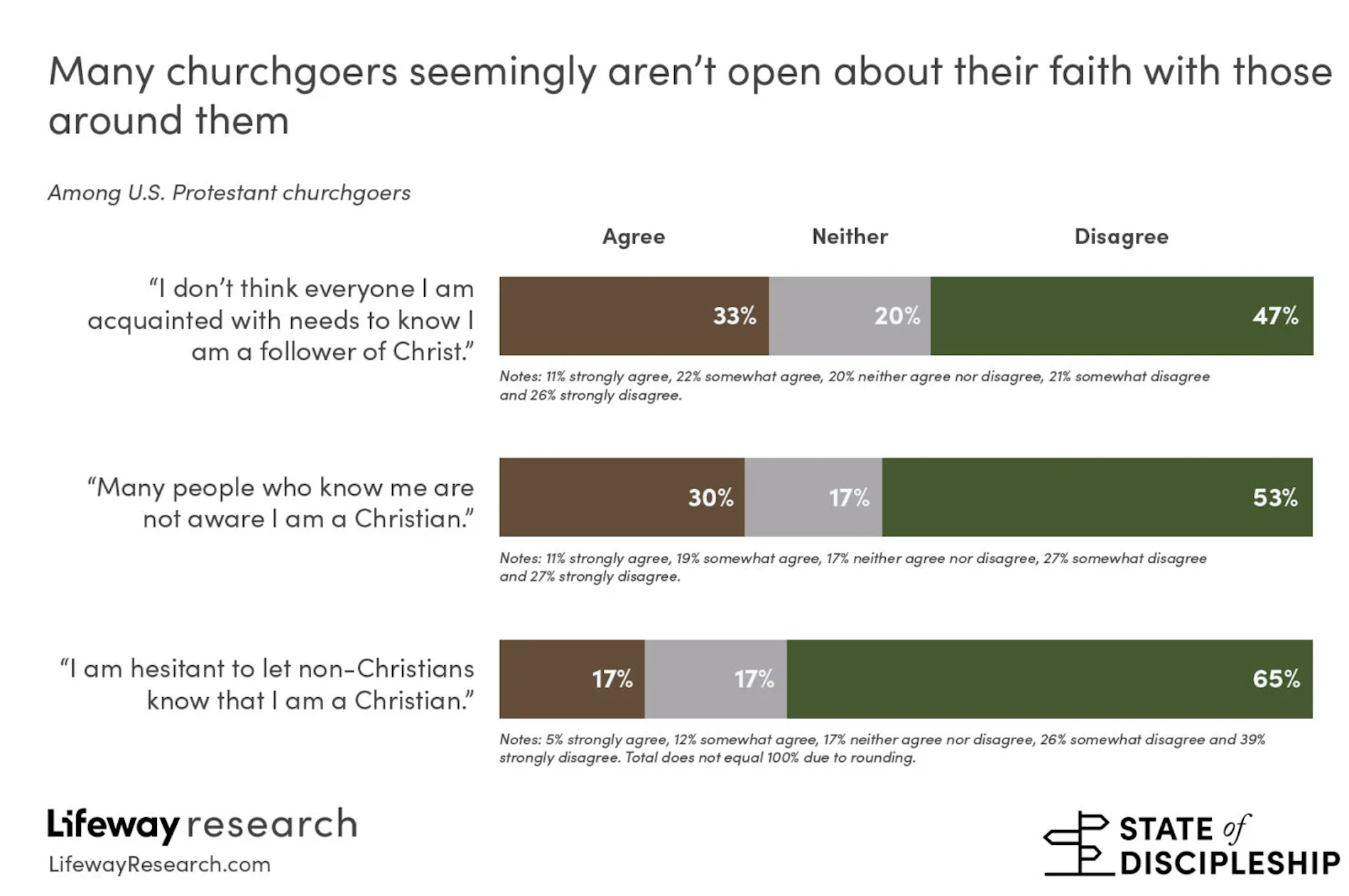
Around 1 in 6 U.S. Protestant churchgoers (17%) say they are hesitant to let non-Christians know they are a Christian, including 5% who strongly agree. Two in 3 (65%) disagree, including 39% who strongly disagree, while 17% neither agree nor disagree.
Even more say many people in their lives don’t know about their beliefs, and the number is growing. Today, 30% agree many people who know them are not aware they’re a Christian. Around half (53%) say that’s not the case, including 27% who strongly say so, and 17% aren’t sure.
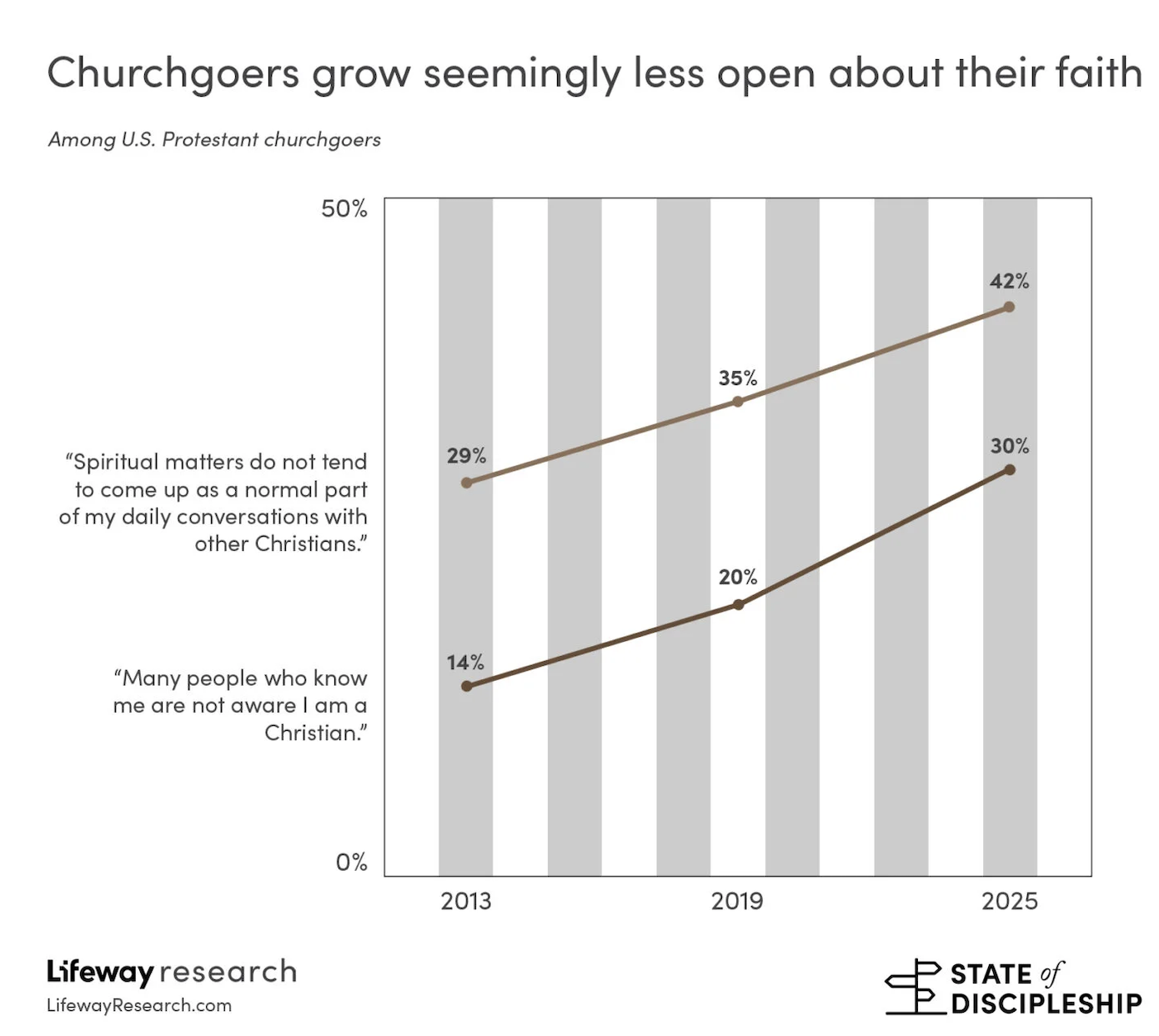
In a 2013 Lifeway Research study, 14% of churchgoers said many people who knew them weren’t aware they were a Christian. That climbed to 20% in a 2019 Lifeway Research study, before reaching 30% today.
People may not be aware of the churchgoers’ faith because many churchgoers don’t think it’s necessary for others to know. A third (33%) say they don’t think everyone they are acquainted with needs to know they are a follower of Jesus, including 11% who strongly agree. Less than half (47%) disagree, including 26% who do so strongly, and 20% aren’t sure.
“It can be very easy to compartmentalize our lives. We have work friends, neighborhood friends, church friends and friends we meet up with for fun who may not overlap,” said McConnell. “The discipleship question is whether Jesus Christ is in all of these parts of our lives as part of our core identity as a follower of Christ.”
Many churchgoers aren’t even regularly talking about their faith with fellow believers. More than 2 in 5 (42%) say spiritual matters don’t tend to come up as a normal part of their daily conversations with other Christians, including 1 in 7 (14%) who strongly agree. Around a third (35%) disagree, and almost a quarter (23%) aren’t sure.
Just as some churchgoers are becoming less open about their faith with non-Christians, some are also growing less likely to talk about their faith with other Christians. In 2013, 29% said spiritual matters don’t tend to come up as a normal part of their daily conversations with other Christians. By 2019, the percentage had increased to 35% and now 42% in the most recent study.
Impact of faith
While some churchgoers aren’t talking about their faith, they may also not be allowing their faith to shape them privately and publicly.
Almost a third of U.S. Protestant churchgoers say they are generally a different person in public than they are in private, including 1 in 10 (11%) who strongly agree. Half (51%) disagree, including 29% who strongly do so, and 17% neither agree nor disagree.
Additionally, 1 in 5 (21%) say many aspects of who they are have nothing to do with God, including 7% who strongly agree. Three in 5 (61%) disagree, including more than 1 in 3 (36%) who strongly disagree, while 18% aren’t sure.
Compared to a few years ago, churchgoers today are more likely to see some areas of their identity as divorced from their faith (21% vs. 16% in 2019).
“Living unashamed is an indication of spiritual integrity. What you think about your relationship with God should be evident in the substance of your relationships with other churchgoers and be present in your interactions with non-Christians,” said McConnell.
For more information, view the complete report and visit LifewayResearch.com/Discipleship.