
💉As In Christa Pike’s Case, Spiritual Advisers Often Play A Role At Executions 🔌

Weekend Plug-in 🔌
Editor’s note: Every Friday, “Weekend Plug-in” meets readers at the intersection of faith and news. Click to join nearly 10,000 subscribers who get this column delivered straight to their inbox. Got feedback or ideas? Email Bobby Ross Jr.
OKLAHOMA CITY — Four years before Oklahoma became the 46th state, a woman named Dora Wright was executed in frontier territory in 1903.
Wright paid the ultimate price for killing a young girl, as she and another convicted murderer, Charles Barrett, were hanged side by side.
In imposing the sentences in June 1903, U.S. District Judge William Henry Harrison Clayton urged both defendants to make themselves right with God and confer with a gospel preacher.
“I do not want to add anything to your present lamentable condition, but simply to say to you that if I were you I would make all preparation for the great change that will shortly come to you,” the judge told Barrett.
In similar remarks to Wright, Clayton informed her, “It will not be long until you will have to meet your God, to face your Maker. You have from now until the 17th day of July in which to prepare yourself.”
I researched the details of Wright’s death a quarter-century ago while covering state prisons for The Oklahoman, Oklahoma City’s daily newspaper.
At the time, I was preparing to serve as a media witness at the lethal injection of Wanda Jean Allen — a two-time killer who on Jan. 11, 2001, became the first woman executed in Oklahoma since statehood in 1907.
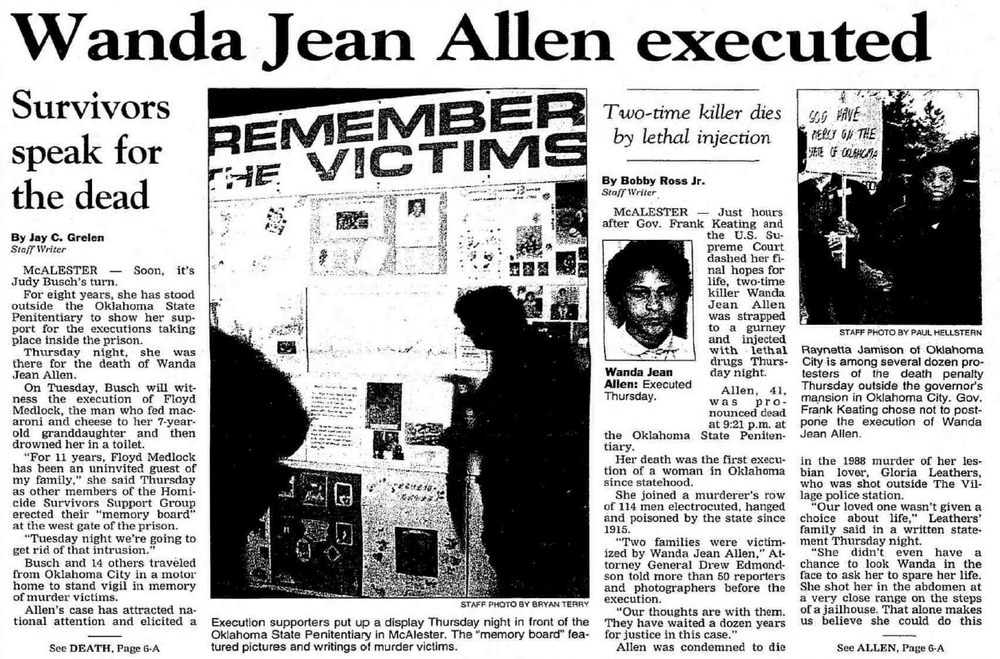
A screenshot of The Oklahoman’s front page after the Jan. 11, 2001, execution of Wanda Jean Allen.
In my coverage of Allen’s death, I wrote:
In the moments before the execution, a chaplain read aloud from the Bible. A playful Allen, wearing a gray inmate shirt with a white sheet covering most of her body, turned her head toward her attorneys and spiritual advisers.
She then smiled and stuck out her tongue.
David Presson, a member of Allen's legal team, flashed the "I Love You" sign at her.
She replied, "Bet that."
"It's wrong," the Rev. Robin Meyers, minister of the Mayflower Congregational Church, said after watching Allen's last breath.
"It's wrong," agreed the Rev. Walter Little, pastor of the Redeemer Lutheran Church in Oklahoma City. "Sitting there and reading the Scripture and committing murder."
• • •
LAST WEEK, Tennessee attempted to make Christa Pike — sentenced to death for a 1995 murder she committed at age 18 — the 19th woman executed nationally since the U.S. Supreme Court reinstated capital punishment in 1976.
That number compares with 1,666 executions of male inmates in the past 50 years, according to the Death Penalty Information Center. The latest inmate put to death: 46-year-old Jamaal Howard in Texas on Wednesday night.
Pike’s death would have marked Tennessee’s first execution of a woman in 200 years.
Instead, the state botched its lethal injection of the 50-year-old Pike, who regained consciousness Tuesday, six days after the failed attempt to kill her.
This shocking news caused me to reflect on the role of spiritual advisers at executions, including in Pike’s case.
In a minute-by-minute timeline of Pike’s experience, Associated Press media witness Kim Chandler noted:
Her spiritual adviser was standing beside the gurney near her head. He spoke to her. They sang a song. The lyrics were not audible, but included repeating the phrase — “I love you.” The spiritual adviser stroked her forehead.
Minutes ticked by. She raised her head and looked around; she smiled. Then she said her arm was hurting and asked a prison official in the room if it was supposed to feel that way.
Ten minutes in, at 7:37 p.m., she sighed, the IV in her arm fed from a control room adjacent to the death chamber, separated by a ledge. At 7:41 p.m., a rock or paper weight about the size of a golf ball was placed on the ledge. Prison officials have not confirmed what it means, but its placement appeared to coincide with a direction in the protocol that says after the drugs are administered, a five-minute countdown begins until the curtain is closed.
At 7:46 p.m., officials closed the curtain, blocking the witnesses’ view of the death chamber. Pike’s spiritual adviser left the chamber and sat briefly with her attorney in the media witness room.
WPLN, Nashville’s National Public Radio station, reported last month:
Pike’s spiritual advisor, Rev. Mikey Noechel, is a Buddhist teacher who will be with her as she’s executed for her part in the 1995 murder of Colleen Slemmer. She’s scheduled to be put to death on Sept. 30.
Rev. Noechel recently met with This is Nashville’s Tasha A.F. Lemley to explain how he pictures that day. He explained the Buddhist practice of Metta, or loving kindness meditation. He introduced that to Christa Pike early on in their relationship more than two years ago. It’s what he and Pike plan to be actively practicing on their way to her death and through the execution process.
The conversation between Rev. Noechel and Lemley took place at Wild Heart Meditation Center in East Nashville.
In Tennessee’s execution chamber, spiritual advisers often give last prayers.
In a story before Pike’s scheduled Sept. 30 execution, The Tennessean’s Molly Davis explained:
Each person condemned to die in Tennessee is allowed a spiritual adviser. They are one of the few allowed to visit the inmate in the 14-day period leading up to the execution, known as death watch. At times, these advisers are everyday people who began by volunteering with prison ministry groups. Their lives are changed by what they find.
Since executions in the state were restarted in 2025, advisers have been allowed in the death chamber throughout much of the process. Sometimes they are a member of the clergy. Often, they are grappling with the same faith-related questions as the person inside prison walls.
After death, spiritual advisers walk out of prison and into their everyday lives. Despite the emotional weight of being there for someone's final moments, they believe it's an important role.
• • •
IN A CASE decided by the U.S. Supreme Court, Texas inmate John Henry Ramirez fought to have Southern Baptist pastor Dana Moore pray and touch him at his 2022 execution — and won.
In 2021, attorney Daniel Chen with the Becket Fund for Religious Liberty spoke with Robert Dunham, the Death Penalty Information Center’s executive director, about that case.
The history of audible clergy prayer at executions goes back centuries, even before the founding of the United States, Chen told Dunham.
Physical touch is a little different, the attorney noted.
“For most of history, the methods of execution used by the government made it physically impossible for clergy members to touch a condemned person at the time of death,” Chen said. “So if you think hanging, firing squad, electrocution or the gas chamber, it’s really infeasible to have a clergy member or spiritual adviser by your side, holding your hand, touching your shoulder, offering you some solace.
“But I will say, even with these methods of execution, clergy typically engaged in physical touch up until the last possible moment,” he added.
Despite the legal precedents, practices involving inmates and spiritual advisers vary from state to state, according to The Marshall Project’s Katie Moore. The journalist delved into Missouri twice denying spiritual advisers to condemned inmates in their dying moments.
Moore reported earlier this year:
The presence of spiritual advisers at executions has been a question in several states. In recent years, the U.S. Supreme Court has favored religious freedoms inside and beyond prison walls. In its 2022 ruling in Ramirez v. Collier, the court said a condemned man in Texas could have a spiritual adviser who was allowed to lay hands on him and pray out loud while he was put to death.
The court’s 8-1 decision was rooted in the First Amendment and the Religious Land Use and Institutionalized Persons Act, which provides religious protections for incarcerated individuals. The justices urged states to adopt policies streamlining the process for allowing spiritual advisers into execution chambers.
The Missouri Department of Corrections ignored the court’s advice and has not updated its execution protocols, which were last adopted in 2013.
• • •
IN SOUTH CAROLINA, convicted murderer Brad Sigmon was executed by a firing squad last year after voicing concerns about the lethal injection process.
The Rev. Hillary Taylor, a United Methodist pastor and executive director of South Carolinians for Alternatives to the Death Penalty, served as Sigmon’s spiritual adviser.
Taylor spent two hours with Sigmon before the execution and witnessed his death from behind bullet-resistant glass.
In a 2023 story, the New York Times’ Emma Goldberg detailed how an atheist chaplain, Devin Moss, ministered to an Oklahoma death row inmate named Phillip Hancock, an atheist himself:
There is an adage that says there are no atheists in foxholes — even skeptics will pray when facing death. But Hancock, in the time leading up to his execution, only became more insistent about his nonbelief. He and his chaplain were both confident that there was no God who might grant last-minute salvation, if only they produced a desperate prayer. They had only one another.
An Arkansas preacher named Jeff Hood has witnessed more than a dozen executions in at least five states, including the Aug. 18 lethal injection of William Frances Silvia Jr. in Florida.
Hood’s death row ministry has drawn praise as well as criticism.
"What you're being called to do in that room is to stand there and comfort someone as they're murdered," he told the Miami Herald. "My job is to die with them. There is a piece of me left inside the chamber every time."
Inside The Godbeat
“Forecast: God reigns and the Son shines.”
“Honk if you love Jesus, text if you want to meet him.”
“Too hot to keep changing sign. Sin bad. Jesus good. Details inside.”
Aren’t church signs fun? Associated Press religion writer Giovanna Dell’Orto highlighted the ones above in a recent feature. Dell’Orto contributed to a creative AP series called “American Objects,” which celebrates the nation’s 250th birthday.
A few of the other objects featured so far: the remote control, the bobblehead and — via AP religion writer Luis Andres Henao — the Gideon Bible.
The Final Plug
Back in August, the Chicago White Sox gave away 40,000 miter-shaped hats in honor of the team’s most famous fan, Pope Leo XIV.
As Major League Baseball’s playoffs roll along, the surprising White Sox — who lost at least 100 games each of the previous three seasons — remain alive. Next up: a winner-take-all Game 5 of the American League Division Series vs. the Cleveland Guardians on Saturday night.
“We’ve got the high power of prayer,” Chicago fan Nick Schmit told USA Today this week.
Happy Friday, everyone! Enjoy the weekend.
Bobby Ross Jr. writes the Weekend Plug-in column for Religion Unplugged and serves as editor-in-chief of The Christian Chronicle. A former religion writer for The Associated Press and The Oklahoman, Ross has reported from all 50 states and 20 nations. He has covered religion since 1999.