
More Than Just A Game: Why Soccer Is Very Much Like A Global Religion
NEW YORK — Soccer’s global reach and emotional intensity have long invited comparisons to religion. Both scholars and fans testify that the analogy is more than just a metaphor.
From local club loyalties to the sweeping unity of the World Cup, the game functions in ways that closely resemble systems of shared belief, ritual and identity.
This will play out this summer at the FIFA World Cup, which starts on June 11 and will be jointly hosted by the United States, Canada and Mexico. It will be the first World Cup to feature an expanded format of 48 teams, significantly increasing the scale and diversity of the competition.
READ: Lamine Yamal, Islam And Spanish Soccer’s Growing Religious Fault Lines
Vicki Michaelis, director of the John Huland Carmical Sports Media Institute at the University of Georgia, described soccer fandom as “a religion without atheists,” arguing that allegiance to a team can unite people more powerfully than traditional faith.
“We could all be of five different religions up here,” she said, “but if we cheer for the same team … we are together. We are a community.”
This sense of belonging is amplified by soccer’s accessibility. Unlike many sports that require specialized equipment or facilities, soccer can be played almost anywhere.
“When something is that accessible, it becomes relatable,” Michaelis said. “And when it’s relatable, it becomes something people can believe in because if you can see it, you can be it.”
Dr. Kirk Bowman, a scholar who has studied soccer in more than 35 countries, emphasized the scale of that belief system. Soccer is the most popular sport in 154 countries, far outpacing competitors like cricket and rugby.
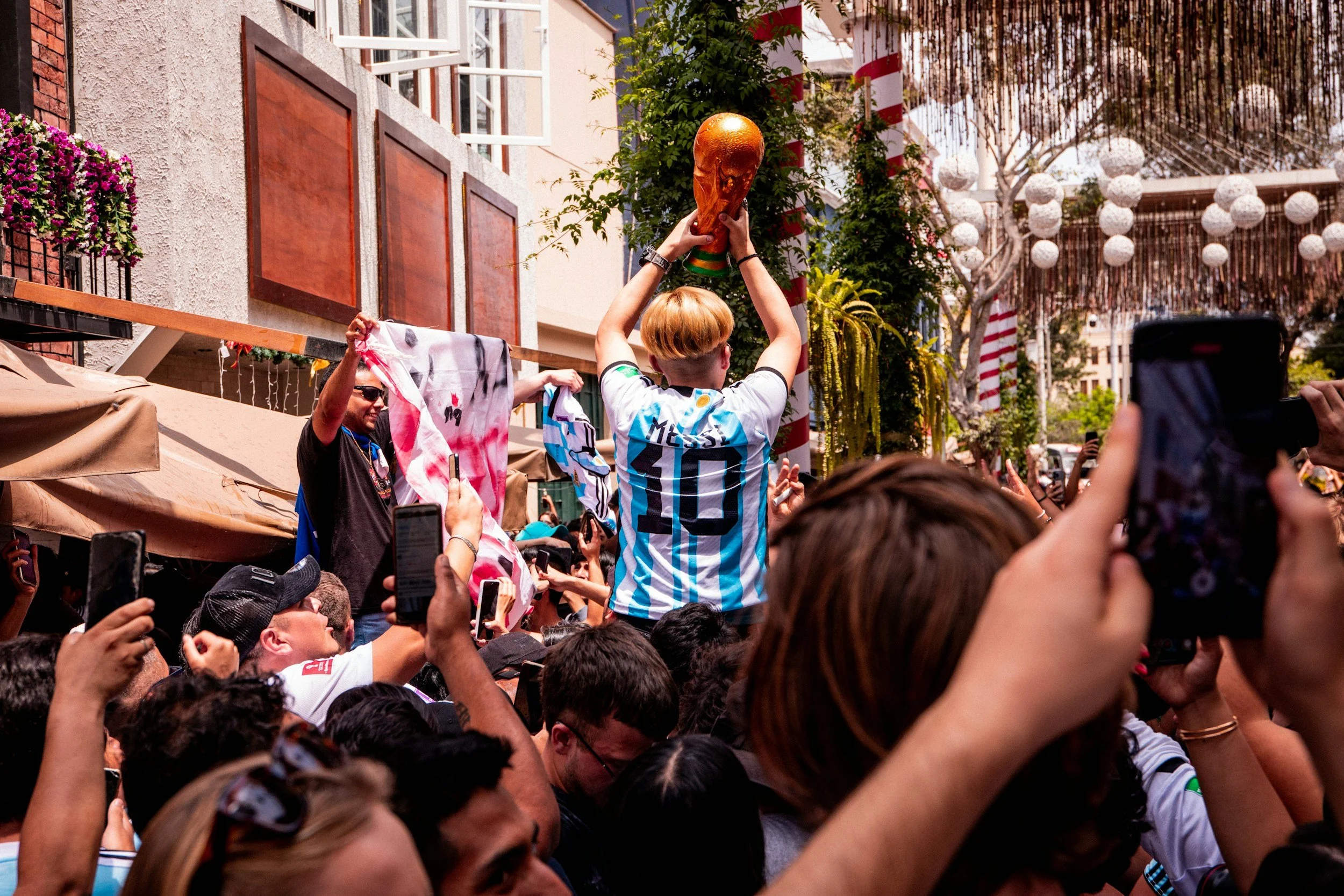
In places like Argentina, players like Lionel Messi are given god-like status. (Unsplash photo)
In many societies — particularly immigrant communities — Bowman said the sport becomes central to identity, functioning much like religion. In Uruguay, for example, national identity coalesced around football success in the early 20th century.
“Before the 1924 Olympics, they didn’t even have a strong national identity,” Bowman said. “But after their success in football, that identity formed and stayed with them.”
Despite a population of just 2.5 million, Uruguay went decades without losing major competitions, reinforcing a shared sense of pride and belonging.
The quasi-religious nature of this sport is perhaps most visible across the border in Argentina, where legendary players have taken on near-mythic status. Bowman pointed to figures like Diego Maradona and Lionel Messi as “almost divine,” noting reports of tens of thousands of fans participating in collective rituals and superstitions during World Cup runs.
“That kind of collective belief is extraordinary,” he said.
At the local level, soccer clubs serve as hubs of social life. In Buenos Aires alone, a city of roughly 12 million people, there are 69 stadiums, each tied to a neighborhood identity. Many clubs extend beyond sport, offering community services and fostering relationships that reinforce cultural or ethnic ties.
Bowman described this as “bonding capital,” which strengthens internal group cohesion.
Yet those divisions can dissolve on the international stage. When national teams compete, especially in events like the World Cup, rivalries often give way to unity.
“Rivals become allies,” Bowman said of the World Cup, describing a shift to “bridging capital” that connects otherwise divided groups.
The crowds inside stadiums, Michaelis said, are akin to religious gatherings, noting that stadiums can temporarily erase differences among attendees.
“People sitting together in the pews may have great differences,” she said. “But during that time, they are a community.”
However, she cautioned that such unity is often fleeting. “The minute you step outside, those differences return,” she said.
The World Cup itself occupies a unique place within this framework. While it fosters national unity, it can also heighten divisions between countries. Michaelis contrasted it with the Olympics, which she said creates a broader sense of shared identity.
“At the Olympics, everyone is there together, ‘worshipping’ at the event,” she said. “The World Cup is a little different because of strong national identities — it’s one team versus another.”
Such devotion can have a darker side. Michaelis and Bowman both pointed to corruption within soccer organizations, such as FIFA, as being a byproduct of intense loyalty.
“When you have believers,” Michaelis said, “you feel untouchable.”
Clemente Lisi serves as executive editor at Religion Unplugged.